
When the Mirror Does Not Reflect the Bias: How Sexism Blinds Users to Search Engine Stereotypes
Investigating user perception of gender bias in image search: the role of sexism
This study investigates how individual user traits, specifically sexism, influence the perception of gender bias in image search results. Researchers used the Ambivalent Sexism Inventory (ASI) and a "reverse image search" crowdsourcing experiment to demonstrate that sexist users are significantly less likely to detect social stereotypes and algorithmic bias in search engine outputs.
TL;DR
Search engines are not just tools; they are mirrors of societal stereotypes. A groundbreaking study from SIGIR '18 reveals that our ability to notice these biases depends heavily on our own internal prejudices. By testing users against the Ambivalent Sexism Inventory (ASI), researchers found that sexist individuals—particularly those with "benevolent" sexist views—are far less likely to recognize gender-biased search results, effectively seeing skewed data as "objective."
The Perception Gap: Why We Trust Biased Algorithms
Users generally trust search engines as objective arbiters of truth. However, when Google returns a sea of male faces for the query "CEO" or "Smart Person," it isn't just reflecting data—it's reinforcing a stereotype. The danger lies in the feedback loop: if users don't perceive the bias, they won't demand transparency, and the algorithm continues to "train" the public's perception.
The authors identified a critical gap: while we can mathematically prove an image set is biased, we didn't know who notices it. Their intuition was that people's social schemas (their mental shortcuts about gender) would act as a filter, making stereotype-congruent results seem "natural."
Methodology: The "Reverse Image Search" Experiment
To capture genuine perception without "priming" (influencing) the participants, the researchers used a clever four-part task on a crowdsourcing platform.
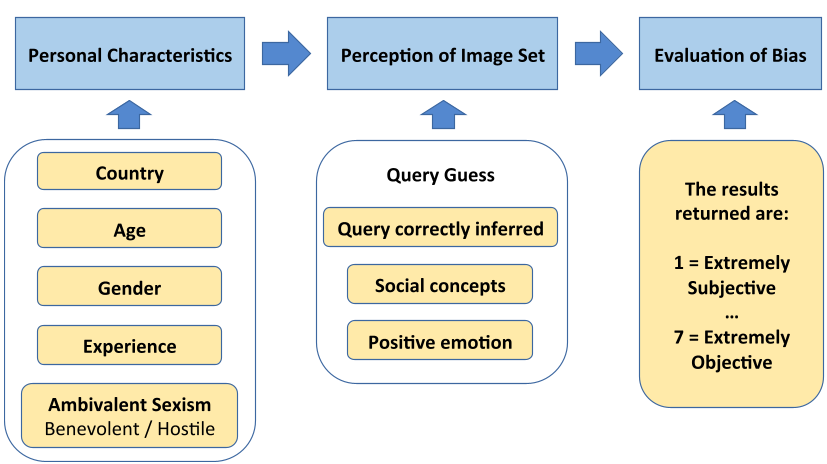 Figure 1: The conceptual model linking User Characteristics to Perception and Evaluation.
- Blind Description: Users saw 9-image grids and described them. They didn't know these were Google Search results for traits like "smart" or "aggressive."
- The Reveal: Only later was the query revealed. Users were then asked: "Is this result set objective?"
- Measuring Sexism: Finally, users took the ASI, which splits sexism into two flavors:
- Hostile Sexism (HS): Openly negative views toward women.
- Benevolent Sexism (BS): Seemingly "positive" but restrictive views (e.g., "women are naturally more nurturing").
Key Insights: Benevolent Sexism is the Silent Killer of Awareness
The data across the UK, USA, and India revealed a striking correlation.
1. The Normalization of Stereotypes
For "positive" trait queries like "Smart Person" (which returned mostly men) and "Warm Person" (mostly women), those with high Benevolent Sexism scores were significantly less likely to mark the results as subjective. To them, a world where only men are "smart" and only women are "warm" is not biased—it's correct.
2. Demographic and Regional Factors
The study confirmed that sexism levels vary by geography and gender. Men generally scored higher on both HS and BS scales. Interestingly, regional differences were stark:
- India: Highest scores in BS and HS.
- USA: Intermediate scores.
- UK: Lowest scores on these dimensions.
 Table 2: Logistic regression showing the negative correlation between Benevolent Sexism and the detection of non-objectivity.
Structural Analysis: The Path from Trait to Perception
Using Structural Equation Modeling (SEM), the researchers mapped out exactly how this happens. A user's internal sexism influences their initial perception (the "social words" they use to describe images), which then directly dictates whether they will label a search engine as biased.
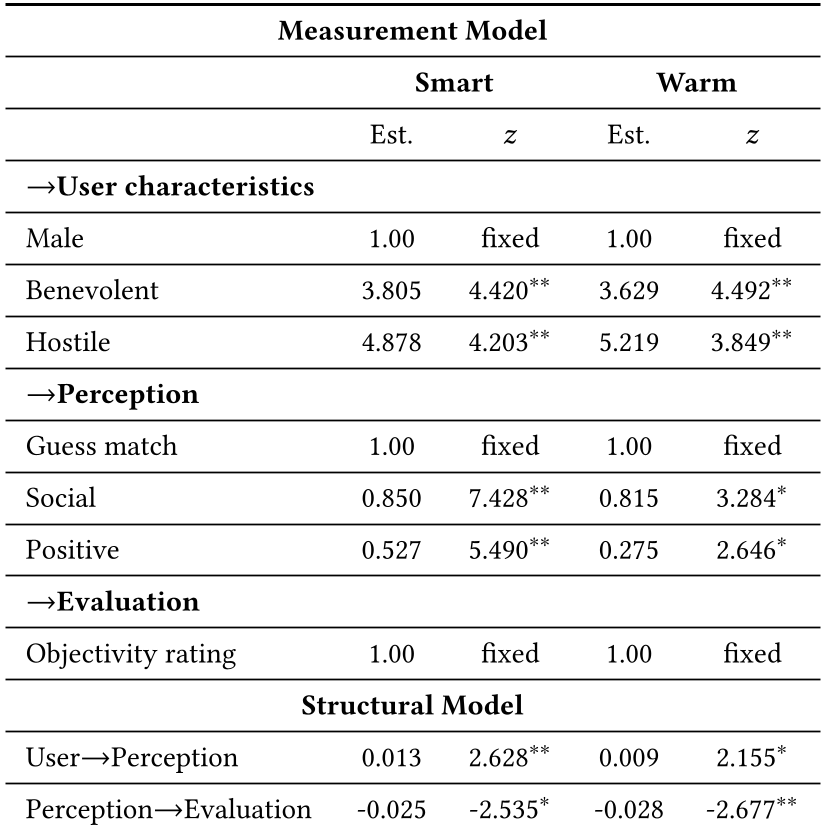 Table 3: The structural model confirming that user characteristics mediate how they perceive and evaluate images.
Conclusion: A Warning for AI Developers
This research provides a sobering takeaway for the AI community: Algorithmic transparency is not enough if the audience is biased.
If we simply "show" users that an algorithm is biased, those who already hold stereotypical views will simply have those views validated. This suggests that future Information Retrieval (IR) systems shouldn't just strive for technical neutrality; they must actively challenge the user's Inductive Bias to prevent the digital reinforcement of archaic social roles.
Limitations: The study focuses on binary gender and specific character traits. Future work needs to explore intersectional biases (race, age, class) and how these dynamics play out in real-time, high-pressure professional environments where image search is a daily tool.