
MAS-Fintech: Revolutionizing Investment Recommendations via Virtual Organizations and Hybrid AI
An Investment Recommender Multi-agent System in Financial Technology
This paper proposes a novel investment recommender system built on a Multi-Agent System (MAS) architecture using Virtual Organizations (VOs). The system integrates Case-Based Reasoning (CBR) with a hybrid HBP-PSO algorithm (Neural Networks combined with Particle Swarm Optimization) to provide personalized financial investment suggestions.
Executive Summary
TL;DR: This paper introduces a sophisticated multi-agent social computing platform designed to modernize investment advisory. By organizing autonomous agents into "Virtual Organizations" (VOs) and employing a hybrid HBP-PSO algorithm, the system transforms raw market data and financial news into personalized, high-accuracy investment recommendations tailored to a user's specific risk profile.
Positioning: This work represents a structural evolution in Fintech, moving from monolithic prediction models to a distributed, decentralized multi-agent architecture that emphasizes the "human-agent" collaboration in financial decision-making.
Problem & Motivation: The Fintech Disruption
Since the 2008 financial crisis, traditional banking has struggled with a reputation for opacity and rigidity. Fintech emerged as a response, yet many current digital advisors face a technical bottleneck: precision vs. scalability.
Prior works in stock prediction often used isolated Machine Learning models that struggled with:
- Data Silos: Difficulty in merging quantitative stock data with qualitative financial news.
- Optimization Traps: Standard Back-Propagation (BP) networks often fail because they converge on local optima rather than finding the best global investment strategy.
The authors' insight is that investment isn't just a math problem—it's a social computing problem that requires a structured organization of specialized entities.
Methodology: The Core Architecture
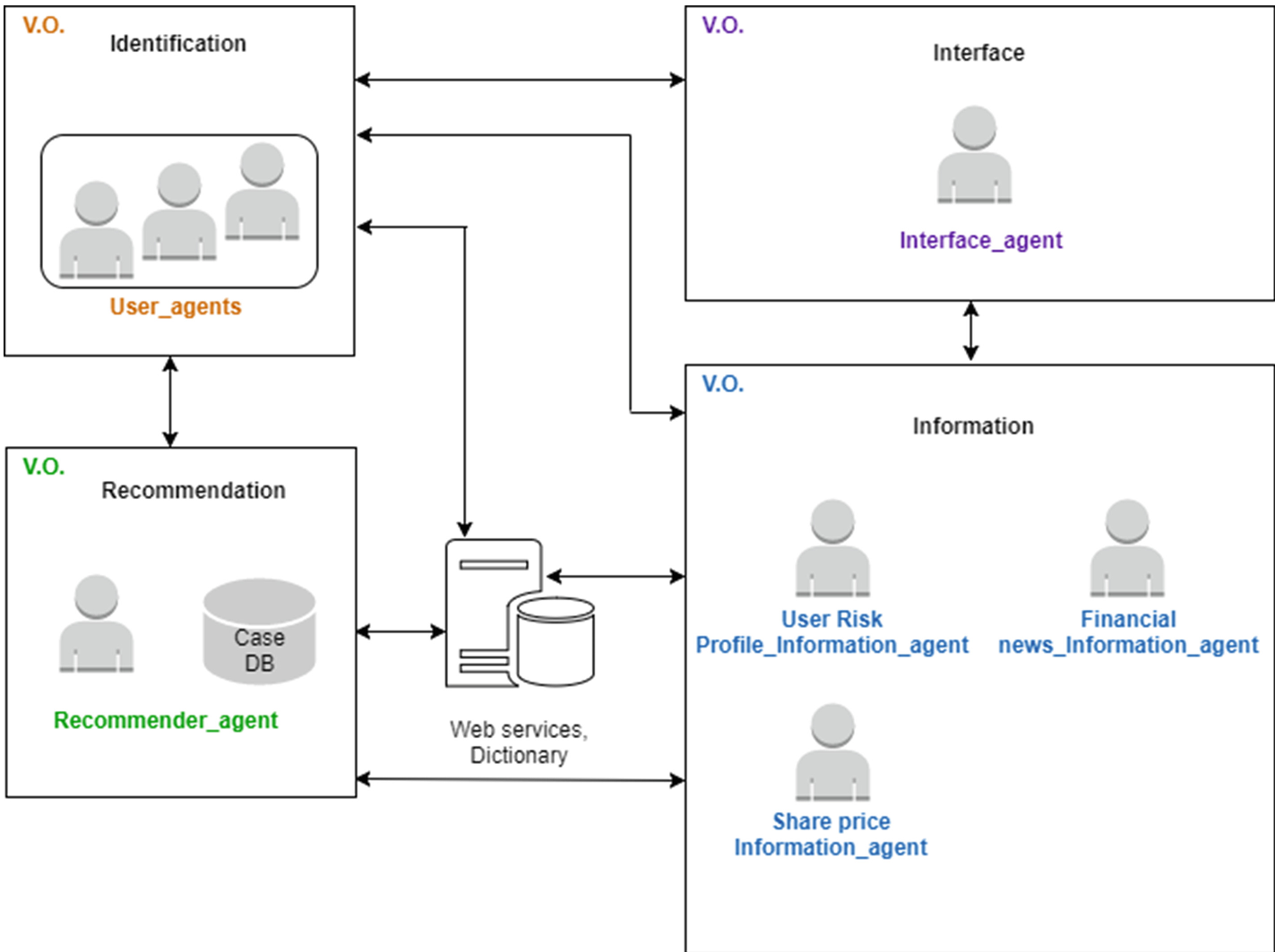
The proposed system is built on Virtual Organizations of Agents (VOs). Unlike traditional MAS, VOs allow for dynamic adaptation where agents can change roles and coordination rules based on the system's global objectives.
1. The Distributed Organization
The architecture is divided into specialized VOs:
- Identification VO: Manages user profiles and risk tolerance.
- Information VO: Contains sub-agents dedicated to "Share Price" tracking and "Financial News" scraping.
- Recommendation VO: The "brain" of the system, utilizing a Case-Based Reasoning (CBR) engine.
2. The Hybrid HBP-PSO Algorithm
To solve the precision problem, the authors introduce a Hybrid BP-PSO approach.
- BP (Back-Propagation): Excellent at approximating measurable functions (like price trends) but prone to getting "stuck."
- PSO (Particle Swarm Optimization): An evolutionary computation technique inspired by social behavior (like bird flocking) that excels at searching the entire solution space for the global optimum.
By using PSO to optimize the parameters of the BP network, the system achieves a higher accuracy in predicting asset performance than standard linear regressions or basic neural nets.

Experiments & Results
The system is designed to process a rich feature set:
- Asset classes & Profitability
- Interest rates & Public share processes
- Unstructured Financial News (extracted via the News_Information_agent)
The authors cite that integrating the Data Base Management System with this distributed agent logic can result in I/O operations being 27 times faster than traditional methods. While the detailed empirical results for the HBP-PSO on the IBEX35 market are slated for the next phase of the project, the structural design demonstrates a clear path toward overcoming the "precision gap" identified in earlier portfolio selection surveys.
Critical Analysis & Conclusion
Takeaway
The shift from "Algorithms" to "Organizations" is the paper's strongest contribution. By treating financial recommendation as a collaborative task between specialized agents, the system achieves a level of modularity and scalability that monolithic models lack.
Limitations
As an architectural proposal, the paper remains light on the specific "transfer rules" for how news sentiment (qualitative) is mathematically weighted against historical stock prices (quantitative) within the HBP-PSO framework.
Future Outlook
The next logical step, as the authors suggest, is the deployment of this VO onto global markets like the NASDAQ and Dow Jones. This will test the Inductive Bias of the HBP-PSO algorithm across different market volatilities, potentially setting a new standard for decentralized robo-advisors in the Fintech industry.