
The Invisible Power of Fairness: Mapping Algorithms to Democratic Ideals
The Invisible Power of Fairness. How Machine Learning Shapes Democracy
This paper explores the intersection of Fair Machine Learning and Political Philosophy, mapping various mathematical fairness definitions (e.g., Statistical Parity, Individual Fairness) to specific democratic models. It argues that the choice of a fairness metric is not a neutral technical decision but a reflection of deep-seated societal values and democratic interpretations.
TL;DR
Is fairness a math problem or a political one? This paper argues that every time we choose a mathematical definition of "fairness" for an algorithm—be it for credit scoring or criminal justice—we are essentially voting for a specific version of democracy. The authors map the landscape of Fair Machine Learning (ML) onto political philosophy, revealing that while our tools excel at "Competitive" fairness, they are largely failing to address "Egalitarian" needs.
Problem & Motivation: The Myth of the Neutral Metric
In the quest to fix biased AI, the ML community has birthed a "zoo" of definitions: Statistical Parity, Equal Opportunity, Calibration, etc. However, a mathematical proof (Kleinberg et al., 2017) famously showed that it is impossible to satisfy all these criteria simultaneously.
This puts the data scientist in a precarious position. By selecting one metric, they are not just optimizing code; they are acting as an "invisible power." For instance, if an algorithm prioritizes "False Positive Parity" in recidivism prediction, it might favor the defendant's right not to be wrongly accused, yet if it prioritizes "Predictive Value Parity," it favors the justice system's utility. The authors argue these aren't just technical trade-offs—they are echoes of centuries-old democratic debates.
Methodology: The Democratic Mapping
The authors categorize fairness definitions by identifying which "Ideal Type" of democracy they represent. They bridge the gap between AI's procedure/output and the political idea of justice.
The Taxonomy of Fair ML
As shown in the table below, the "Group Fairness" definitions dominate the current literature, but their political implications vary wildly.
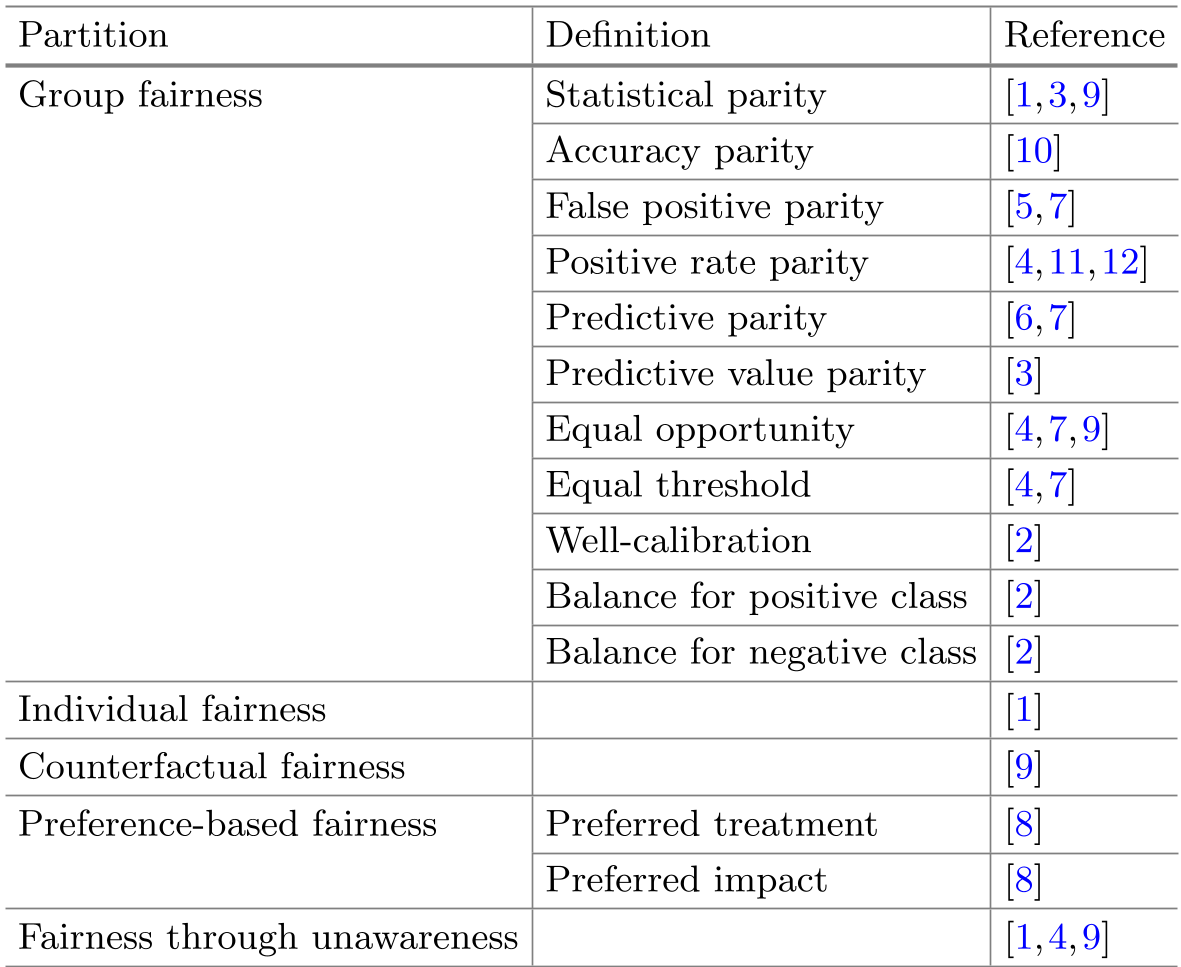
The core of the methodology lies in the alignment of these technical terms with five political models:
- Liberal Democracy: Focuses on the individual. Aligns with Individual Fairness where "similar people are treated similarly."
- Competitive Democracy: Focuses on the "fairness of the game." Aligns with Equal Opportunity (Standard ML metrics).
- Egalitarian Democracy: Focuses on redistribution. Aligns (partially) with Preference-based Fairness, though largely underserved by current ML tools.
- Republican & Deliberative Democracy: Focused on transparency and debate. These are often missing from the math entirely and reside in the realm of Explainable AI (XAI).
Key Insights: Why Your Model is "Competitive"
The research highlights that most current Fair ML is Competitive in nature.
- The Competitive Logic: In a competitive model, we assume everyone wants to win (e.g., get a loan). The math ensures that "the odds of winning" are balanced relative to merit or group membership.
- The Missing Egalitarianism: True egalitarianism doesn't just ask for equal odds in a flawed system; it asks to favor the disadvantaged to correct historical resource gaps. The authors note that preference-based models (Zafar et al., 2017) are a step in this direction, but we lack metrics that explicitly embody distributive justice.
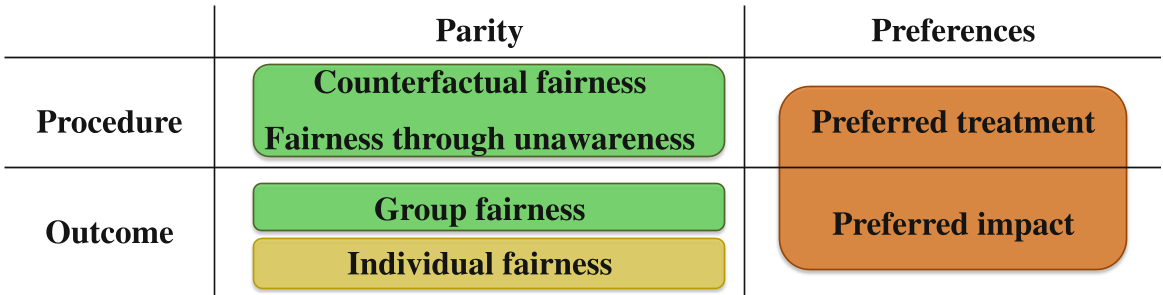 Figure: The decision-making process involving trade-offs between parity, preferences, and procedural constraints.
Experiments & Observations: COMPAS as a Case Study
The paper revisits the COMPAS recidivism tool controversy. ProPublica found the tool was more likely to falsely label black defendants as high-risk.
- The Conflict: The tool's creators argued it was "well-calibrated" (Statistical Parity), while critics argued it failed "False Positive Parity."
- The Cultural Insight: The paper argues this debate wasn't about bad math; it was a clash between a Procedural Justice view (if the score is accurate, it's fair) and a Substantive Equality view (if it harms one race more, it's unfair).
Critical Analysis & Conclusion
The authors conclude that "Data Scientists are the new judges." By burying political choices in code, we risk a technocracy where societal values are decided by those who understand Python but not Plato.
Takeaways for the Future:
- Beyond Parity: We need "Egalitarian" metrics that allow for affirmative action within the algorithmic structure.
- Agent-Based Modeling: The authors propose using simulations to see how different democratic "agents" would react to specific fairness constraints over time.
- Limitations: The paper is primarily a conceptual bridge. The next step is a quantitative framework where a user can input their "Democratic Value Profile" and receive a recommended set of mathematical constraints.
Ultimately, the power of fairness is invisible because it is hidden in the loss functions. Bringing it into the light of democratic debate is the only way to ensure that algorithms truly serve the people.