
Beyond Smart Connect: When ASI Meets the Social Internet of Things
IoT-Enabled Social Relationships Meet Artificial Social Intelligence
This paper introduces the paradigm of Artificial Social Intelligence (ASI) as a solution to the "social relationships explosion" in the Internet of Things (IoT). It proposes a framework to move beyond "smart objects" to "social objects" by integrating social context, trust management, and social-aware computing into the IoT ecosystem.
TL;DR
As we approach a world with over 40 billion connected devices, the bottleneck is no longer just bandwidth—it's social complexity. This paper argues that "Smart Objects" must become "Social Objects." By introducing Artificial Social Intelligence (ASI), the authors provide a roadmap for machines to understand human social context, manage trust autonomously, and solve the "Social Relationships Explosion" that threatens to overwhelm current IoT infrastructures.
The "Social Relationships Explosion"
In the early days of IoT, we worried about the Data Explosion (sensing layer) and the Connection Explosion (network layer). However, as devices become integrated into our daily lives, a third, more complex crisis has emerged: the Social Relationships Explosion.
Existing systems are "unsocial." They treat a request from a stranger the same as a request from a trusted friend's device. This lack of social hierarchy and context leads to:
- Management Bottlenecks: Inefficient routing and discovery in a sea of billions of heterogeneous entities.
- Semantic Blindness: Machines that can process "what" you said but not "why" or "in what social capacity" you said it.
Methodology: Mapping the Social Space
The core of this work lies in how it bridges the gap between the physical and social dimensions through Cyber-Physical-Social Systems (CPSS).
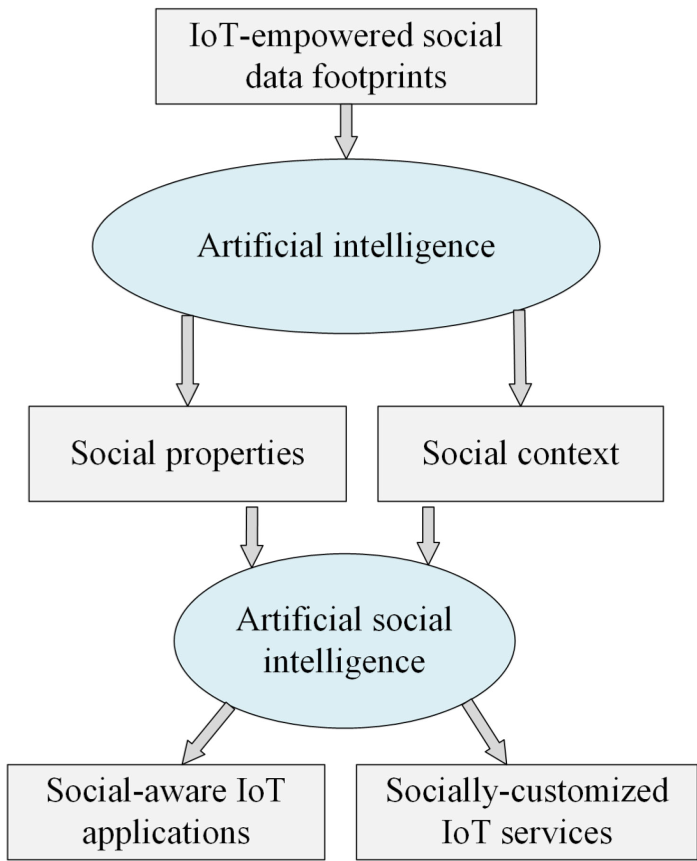
The authors differentiate between conventional AI (Thinking Intelligence) and ASI (Social Intelligence). While conventional AI excels at pattern recognition, ASI focuses on:
- Social Feature Extraction: Utilizing Affective Computing to detect mood and Personality Computing to match device behavior with user traits.
- Relationship Mapping: Categorizing links into Hierarchical, Functional, Spatial, Temporal, and Social types to streamline how data flows.
- Decentralized Intelligence: Using Edge and Mobile-Edge Computing (MEC) to process social interactions locally, avoiding the "Cloud delay."
Architectural Evolution: Smart to Social
The transition involves mapping physical world relationships into a "Cyber Space" where they can be logically manipulated.
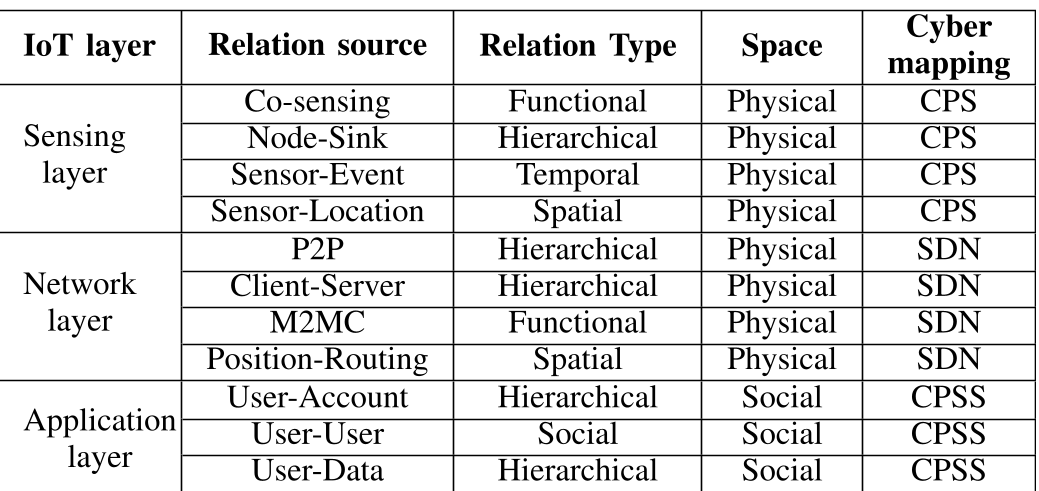
As shown in the table above, the Application Layer leverages Social Space mapping. For instance, a User-User relationship in the physical world becomes a CPSS cyber mapping, allowing the network to use "Friendship" as a routing metric—a concept known as Socially-Aware Routing.
Critical Use Cases
The paper presents compelling scenarios where ASI changes the game:
- Mental Healthcare: ASI-enabled robots that don't just monitor vitals but provide proactive psychological support based on the user's social context and perceived loneliness.
- Intelligent Transportation: Driverless cars that navigate not just by shortest path, but by "Social Common Sense," predicting traffic based on social media events (e.g., a nearby protest or concert).
- Smart Cities: Using crowdsensing to prevent physical attacks by analyzing social media-triggered events in real-time.
Deep Insights & Future Outlook
The most striking takeaway is the authors' warning: If we develop AI without ASI, we will eventually live in a world of highly intelligent but "unsocial" machines.
The transition to ASI-enabled IoT enables Trust Management. Instead of static security keys, devices can evaluate the "reputation" of a peer device by asking its "friend" devices—mimicking human social behavior to secure the network.
Potential Limitations
While the vision is robust, two major hurdles remain:
- Social Data Privacy: The more a device knows about your social context, the more dangerous a data leak becomes.
- Computational Overhead: Running personality and affective models on resource-constrained IoT sensors requires significant breakthroughs in "AI on Chips."
Conclusion
This paper successfully repositions IoT from a hardware-centric discipline to a social-centric science. By integrating ASI, the next generation of IoT will not just be a network of things, but a collaborative society of entities.