
IoT Environmental Analyzer: Turning Smart Homes into Early Warning Systems for Migraine Prevention
IoT Environmental Analyzer using Sensors and Machine Learning for Migraine Occurrence Prevention
This paper presents an IoT-based "Environmental Analyzer" that utilizes BME280 sensors and an iOS application to track migraine triggers. By employing and comparing five machine learning models, the research demonstrates that Linear Discriminant Analysis (LDA) achieves a SOTA classification accuracy of 93.8% in predicting migraine occurrences based on indoor and outdoor environmental data.
TL;DR
Researchers have developed an IoT-based prototype that combines real-time sensor data—temperature, humidity, and barometric pressure—with machine learning to predict migraine attacks. By integrating indoor telemetry with external weather data, the system achieved a 93.8% prediction accuracy using Linear Discriminant Analysis (LDA), effectively mapping a user's unique environmental "trigger profile."
The Misdiagnosis Gap: Why Environment Matters
Migraines are a leading cause of global disability, yet they are notoriously difficult to manage because triggers are highly individualized. Many patients suffer from environmental sensitivities where subtle shifts in room conditions act as "bio-chemical tipping points." Existing management strategies rely on subjective "migraine diaries," which are prone to human error and fail to capture high-resolution environmental fluctuations that truly cause the onset.
Methodology: From Sensors to Insight
The "Environmental Analyzer" architecture bridges the gap between hardware and predictive analytics through a robust three-tier stack:
- Hardware Layer: Particle Photon units equipped with BME280 sensors capture temperature (±1.0°C), humidity (±3%), and pressure (±1 hPa).
- Cloud Layer: Data is funneled through AWS Lambda and stored in DynamoDB, ensuring a clean, time-series dataset.
- Analytics Layer: Data was cleaned, normalized, and processed using Self-Organizing Maps (SOM) to visualize correlations and five classification algorithms to predict stability.
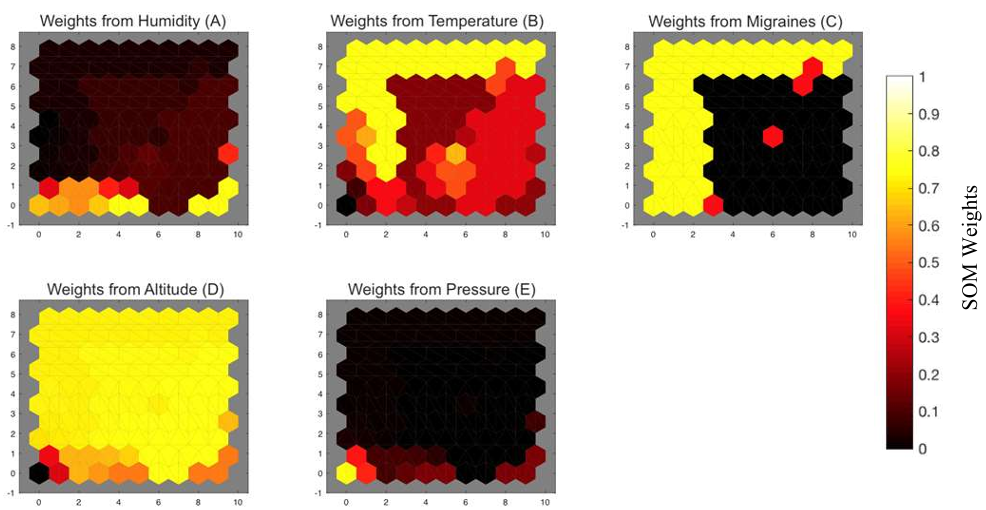 Figure 1: SOM Weight Planes revealing the high correlation between Input 2 (Temperature) and Input 3 (Migraine Occurrence).
Cracking the Code of Triggers
The study utilized piecewise cubic interpolation to estimate "migraine zones." The visualizations revealed that for the test subject, attacks weren't random but clustered in specific environmental states:
- Low Humidity Cluster: Varying temperatures in dry air.
- High Humidity Cluster: Moderate, stable temperatures.
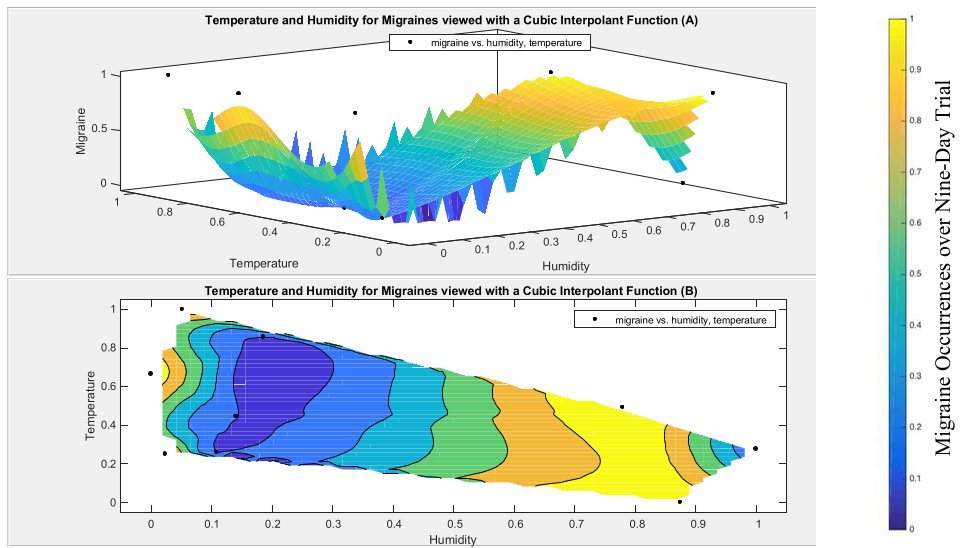 Figure 2: Cubic interpolation mapping temperature and humidity against migraine probability.
Performance Benchmarks: Why LDA Wins
The researchers tested five models: Logistic Regression, Linear Discriminant Analysis (LDA), K-Nearest Neighbors (KNN), Decision Tree, and Gaussian Naive Bayes. While single-source sensor data performed well (approx. 80-90% accuracy), the inclusion of external weather data (dew point, wind speed, visibility) pushed the accuracy to its peak.
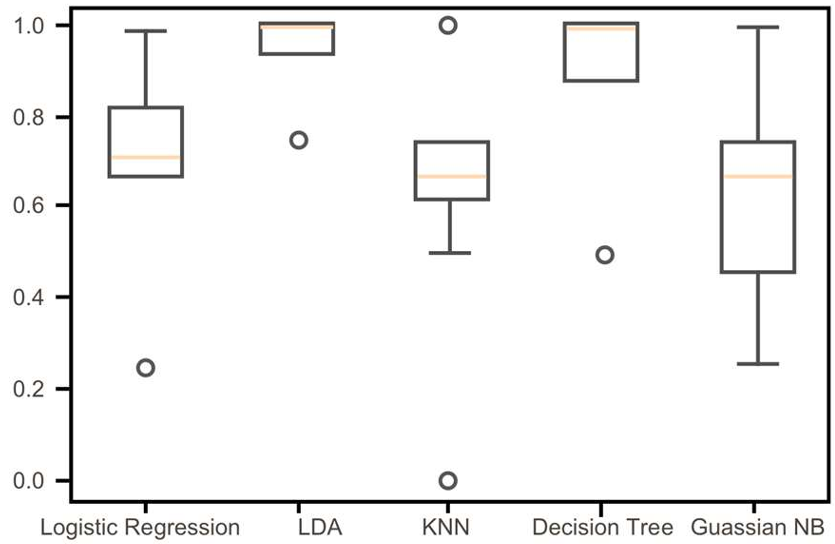 Figure 3: LDA outperformed all other models, especially when enriched with historical meteorological data.
Critical Analysis & Conclusion
Takeaway
The success of the Linear Discriminant Analysis (LDA) model (93.8% accuracy) suggests that migraine triggers are likely linearly separable in a high-dimensional feature space containing both localized and macro-environmental data.
Limitations
- Small Sample Size: The study was conducted on a single individual over nine days. To achieve clinical-grade reliability, large-scale multi-user trials are needed to account for different "biological thresholds."
- Sensor Breadth: While BME280 covers the basics, adding sensors for Volatile Organic Compounds (VOCs) and light intensity (Lux) could further refine the "trigger map."
Future Outlook
This work sets the stage for "Predictive Smart Homes" where IoT devices don't just react to commands—they proactively adjust HVAC systems or lighting to prevent a medical crisis before the patient even feels the first symptom.