
IPAWL: Leveraging Social Infrastructure to Solve the WSN Energy Crisis
IPAWL: An integrated power aware Wireless sensor network and Location-Based social network for incidence reporting
This paper introduces IPAWL, a novel integration of Wireless Sensor Networks (WSN) and Location-Based Social Networks (LBSN) designed to optimize energy consumption. By leveraging human-carried smartphones (LBSN nodes) as either mobile sinks (IPAWL I) or relay sensors (IPAWL II), the method provides dynamic routing shortcuts that bypass traditional multi-hop WSN bottlenecks.
Executive Summary
TL;DR: IPAWL (Integrated Power Aware WSN and LBSN) is a hybrid network architecture that uses the ubiquity of smartphones (LBSN nodes) to provide "shortcuts" for sensor data. By integrating mobile human users into the routing loop, the system achieves up to a 42% reduction in energy consumption, effectively delaying the death of critical sensor nodes in environmental monitoring tasks.
Academic Context: This work moves beyond purely algorithmic routing optimizations (like PSO or K-means) by introducing Architectural Heterogeneity. It treats the social layer not just as a data source, but as a functional component of the network's physical transport layer.
The Problem: The "Static Routing" Trap
In traditional Wireless Sensor Networks (WSN), energy is the scarcest resource. Most energy is wasted during multi-hop routing, where data from a distant sensor must "jump" through dozens of intermediate nodes to reach a fixed Base Station (BS). These intermediate nodes—especially those near the BS—deplete their batteries rapidly, leading to network fragmentation.
Existing solutions focus on better clustering, but they all share a fundamental flaw: they are limited by the fixed locations and finite energy of the sensors themselves.
Methodology: Human-in-the-Loop Routing
The core insight of IPAWL is that LBSN nodes (people with smartphones) are "free" sensors and relays. They possess their own power sources and move dynamically, providing opportunistic paths that don't drain the WSN's energy.
The authors propose two distinct modes of integration:
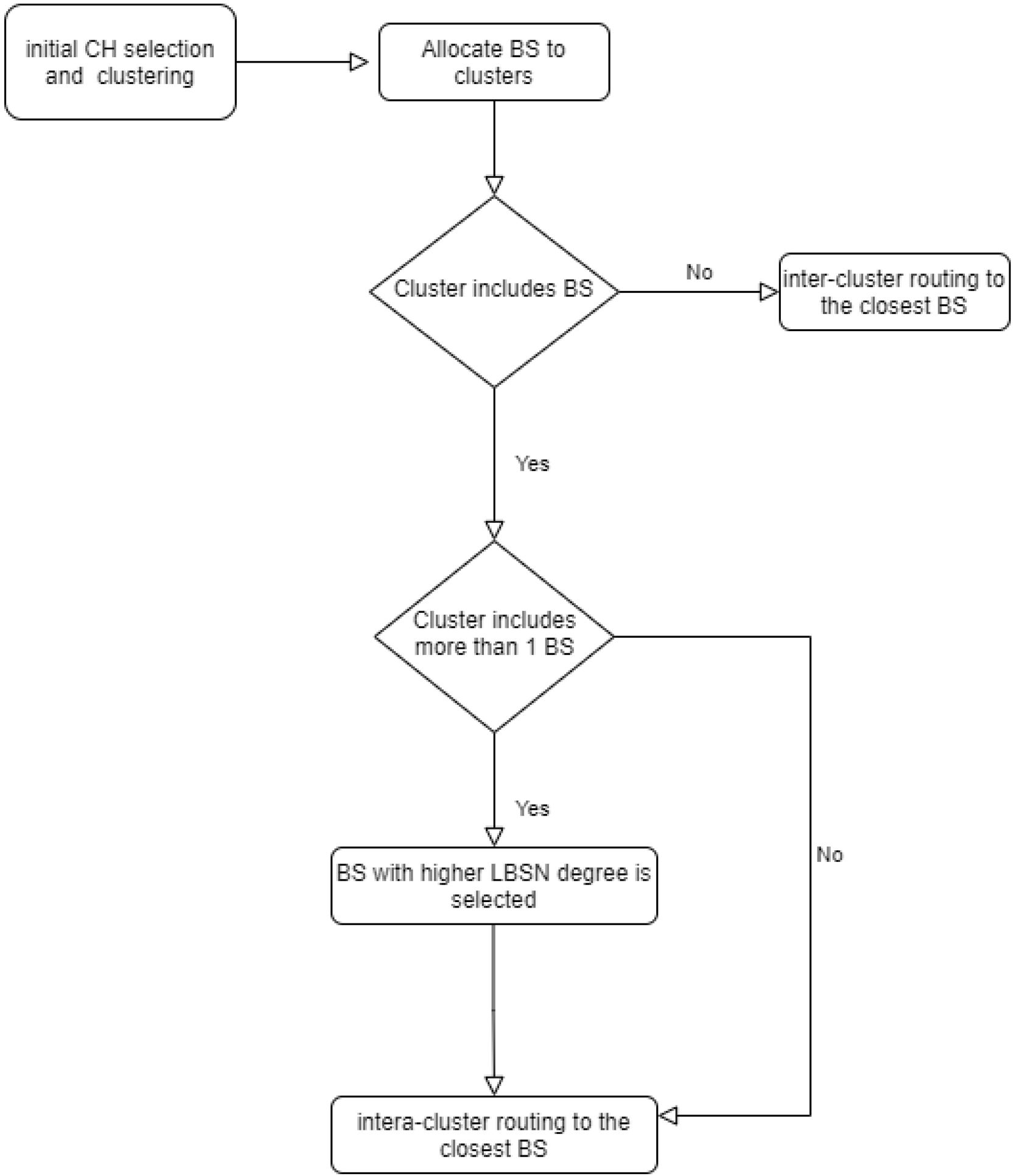
1. IPAWL I: LBSN as Mobile Sinks
In this mode, any smartphone user within range acts as a temporary Base Station. Sensors offload data directly to the user's phone, which then uploads the data to the cloud via cellular/Wi-Fi.
- The Benefit: It drastically reduces the number of "hops" a message needs to take.
- Optimization: A Multiple Attribute Decision Making (MADM) approach using TOPSIS handles the selection of Cluster Heads based on residual energy and proximity to these moving targets.
2. IPAWL II: LBSN as Relay Nodes
If privacy or security prevents direct cloud upload via a user's phone, the phone acts as a relay. It picks up a message from a sensor, carries it (or transmits it via the social network), and drops it off to a WSN node closer to the actual Base Station.
Experimental Results & Critical Analysis
The researchers simulated a smoke detection scenario at the University of Calgary campus, creating a "Patterns-of-Life" (PoL) dataset to model realistic human movement.
Key Findings:
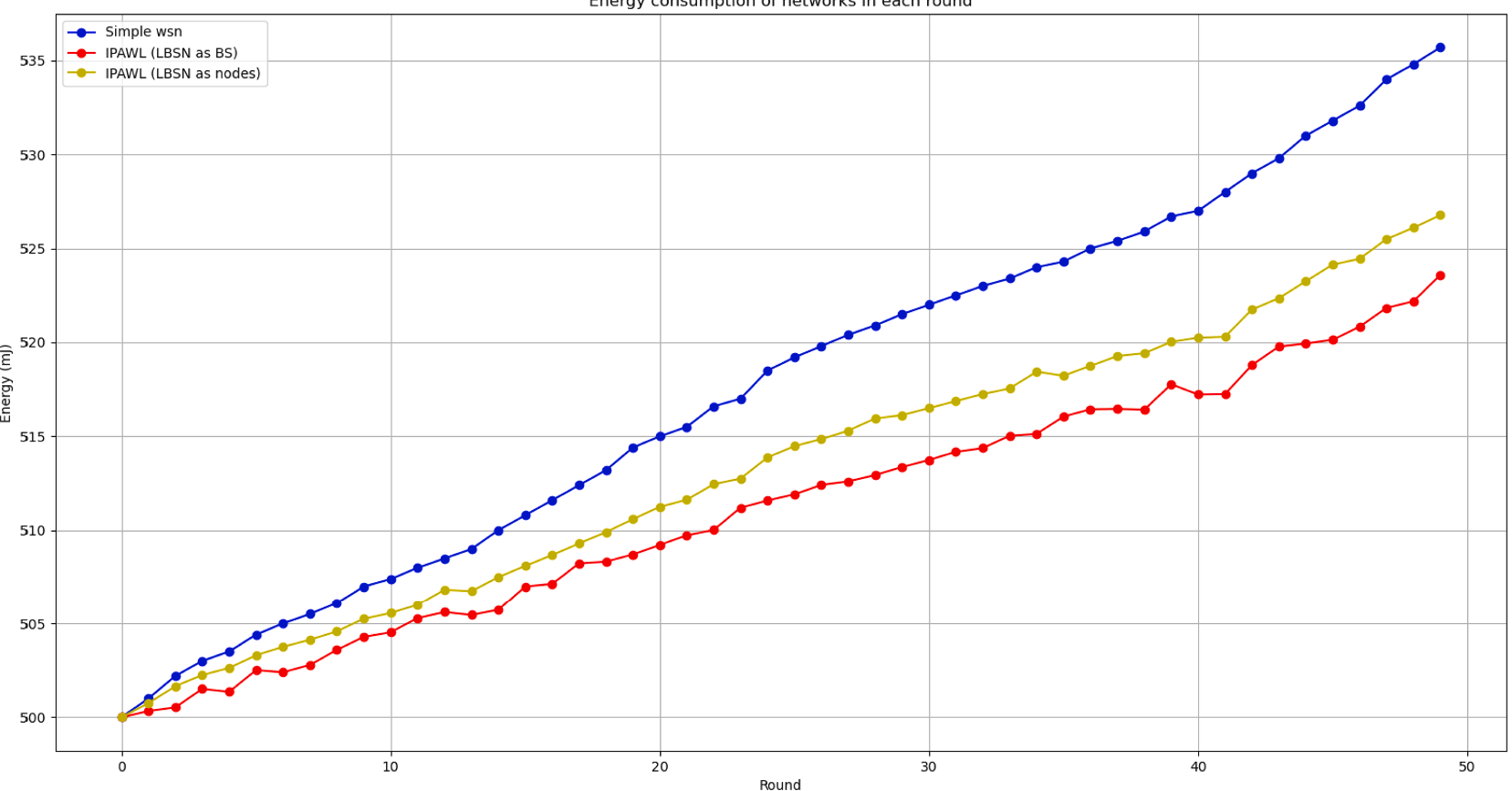
- Energy Efficiency: IPAWL I lead the pack with a 42% energy saving. This is intuitive as the "sink mobility" provided by humans effectively balances the load across the entire sensor field.
- Throughput & Lifetime: Unlike standard WSNs where throughput drops linearly as nodes die, IPAWL maintains higher throughput because human "relays" can fill the gaps left by dead sensors.
Critical Insights:
The "sawtooth" pattern observed in the energy consumption graphs is particularly interesting. It represents the opportunistic nature of the network; when a high density of social nodes is present (e.g., during class change hours), the energy cost per message plummets. This suggests that the system is most efficient exactly when and where human activity is highest—a perfect match for urban incidence reporting.
Conclusion & Future Outlook
IPAWL proves that the "Social-Physical" integration is a viable path for the next generation of IoT. However, the current model assumes homogenous sensors. A significant leap forward would be applying this to Heterogeneous WSNs (e.g., mixing low-power temperature sensors with high-power smart cameras), where the LBSN could intelligently prioritize relaying "heavy" data like images.
Takeaway for Practitioners: When designing urban sensor networks, don't build in isolation. The "infrastructure" isn't just the hardware you bolt to the walls; it’s the flow of people moving through the space.