
ISIAA 2017: Artificial Agents as the New Frontier for Understanding Human Sociality
8935_ISIAA 2017 1st international workshop on investigating social interactions with artificial agents (workshop summary).
This report summarizes the 1st International Workshop on Investigating Social Interactions with Artificial Agents (ISIAA 2017). It establishes an interdisciplinary framework involving Neuroscience, Linguistics, and Computer Science to study human-agent interaction and treat artificial agents as tools for probing human social cognition.
TL;DR
The 1st International Workshop on Investigating Social Interactions with Artificial Agents (ISIAA) marks a pivotal shift in how we view AI. Instead of merely asking "How can we make AI more human?", this workshop explores a more provocative question: "How can we use AI to understand what it means to be human?" By bridging Neuroscience, Linguistics, and Computer Science, the workshop positions artificial agents as the ultimate controllable variables for social science.
The Motivation: Moving Beyond the "Uncanny"
For decades, the benchmark for AI was the Turing Test—a binary measure of deception. However, the ISIAA 2017 organizers argue that this is too narrow. Current social interaction research faces a major hurdle: Naturalism vs. Control.
In human-to-human studies, you cannot perfectly control the behavior of one participant to see how the other reacts. This "noise" makes it difficult to map specific social signals to neural responses. The insight behind ISIAA is that artificial agents (robots and avatars) provide a "closed-loop" system. Because we can program every micro-expression and verbal stutter of an agent, we can finally conduct repeatable, high-precision experiments on the human social brain.
Methodology: The Triadic Interdisciplinary Framework
The core methodology presented is a triadic synergy between three major scientific domains:
- Biology (Neuroscience): Aiming to describe the physiology of social behaviors (e.g., using fNIRS to measure brain activity during interaction).
- Humanities (Linguistics): Characterizing the nuances of specifically human language and dialogic structures.
- Computer Science (AI & Robotics): Providing the "Embodied Agents" that serve as benchmarks and the "Social Signal Processing" (SSP) tools to analyze human responses automatically.
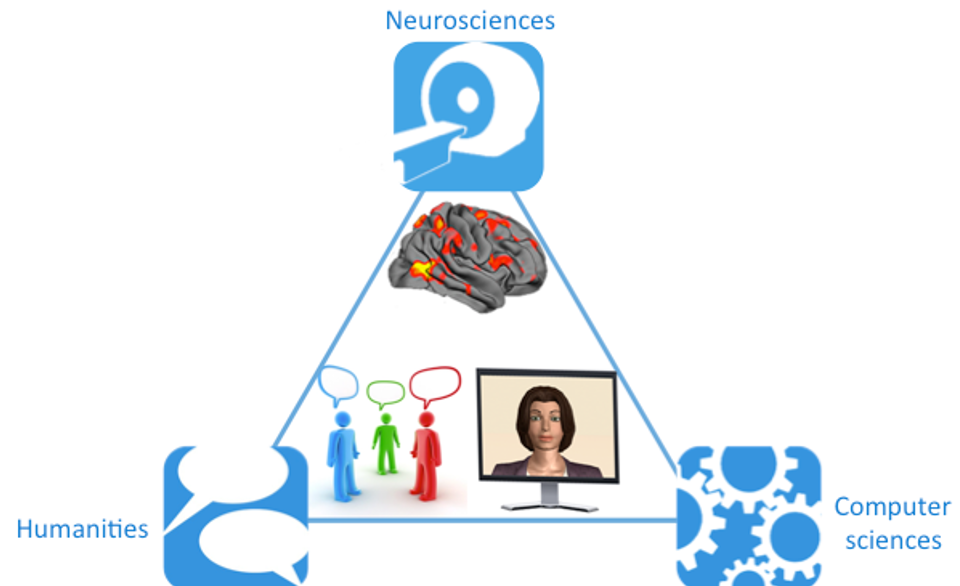 Figure 1: The synergy between Biology, Computer Science, and Humanities as proposed in the workshop.
Key Sessions & Technical Insights
1. The Neuroscience of Intentional Stance
A major highlight was the exploration of the Intentional Stance—the tendency for humans to treat an agent as having its own beliefs and desires. Researchers like Agnieszka Wykowska and Thierry Chaminade discussed using humanoid robots to trigger specific social-cognitive mechanisms in the brain, allowing us to see if the human brain "accepts" the robot as a social peer.
2. Social Signal Processing (SSP)
The workshop emphasized SSP as the interface between computer science and psychology. This involves the automatic extraction of:
- Physical signals: Gaze direction, interpersonal distance (proxemics).
- Affective signals: Facial micro-expressions and laughter/smile nuances.
3. Adaptive Dialogue & Real-World Application
The "Control of Social Artificial Agents" session moved from theory to practice. One notable application discussed was the KRISTINA project, which developed an adaptive information platform for migrants. This requires the agent not just to understand language, but to adapt to cultural nuances and emotional states in complex domains like healthcare.
Critical Analysis & Future Outlook
Takeaway
The true value of this work lies in the calibration of social competence. By using AI as a "mirror," we can quantify the specific behaviors (a smile, a pause, a gesture) that generate trust or engagement in humans.
Limitations
While the framework is robust, the workshop highlights a historical gap: these fields often speak different "languages." Neuroscientists focus on brain regions, while Computer Scientists focus on error rates. Integrating these into a unified model of Human-Agent Interaction (HAI) remains a significant challenge.
Future Work
The ISIAA 2017 summary suggests that the future of social AI isn't just in entertainment or virtual assistants, but in wellbeing and training. Examples include training doctors to deliver bad news by practicing with "socio-emotional" agents—a high-stakes social task that is now being safely simulated through technology.
Workshop Details:
- Published: November 03, 2017
- Venue: ICMI '17 (International Conference on Multimodal Interaction), Glasgow, UK.