
iSim: Revolutionizing Trust Prediction via Integrated Similarity and Efficient Collaborative Filtering
iSim: An Efficient Integrated Similarity Based Collaborative Filtering Approach for Trust Prediction in Service-Oriented Social Networks
The paper introduces iSim, an integrated similarity-based collaborative filtering approach for trust prediction in service-oriented social networks. It achieves State-of-the-Art performance by fusing explicit vector space similarity, implicit latent factor modeling, and propagated trust, outperforming existing benchmarks like SCMF and PROP in both accuracy and computational speed.
TL;DR
Trust prediction is a cornerstone of service-oriented social networks, yet existing methods are either accurate but slow, or fast but unreliable. iSim bridges this gap by integrating explicit vector similarity, implicit latent factors, and topology-based trust propagation. It reduces prediction errors (MAE/RMSE) by up to 30% while being nearly 30 times faster than preceding state-of-the-art methods.
Background & Positioning
In social networks like Advogato or Epinions, users rely on trust to filter high-quality services. However, trust matrices are notoriously sparse. The research landscape has been split into three camps:
- Propagation-based: Focuses on the "friend-of-a-friend" logic but ignores behavioral styles.
- Matrix Factorization (MF): Captures latent features but is computationally expensive and localized.
- K-NN: Simple and fast but struggles with data sparsity.
iSim serves as a unifying framework, positioning itself as an evolution of K-NN that uses Matrix Factorization and Graph Theory to enrich its similarity metrics.
The "Why": Motivation and Insight
The authors observe that trust is not just about direct interactions. For example, two users might have similar rating "standards" (Behavioral Similarity) even if they haven't trusted the same people yet. Conversely, the structural path between two users (Propagation) provides a natural baseline for how much they ought to trust each other.
The core insight of iSim is that trust follows a marginal effect law: as intimacy increases, it becomes progressively harder to further strengthen trust. This leads to the use of an exponential baseline () to weight behavioral similarities.
Methodology: The Three Pillars of Hybrid Similarity
The architecture of iSim is divided into three parallel tracks that feed into a final K-NN prediction engine.
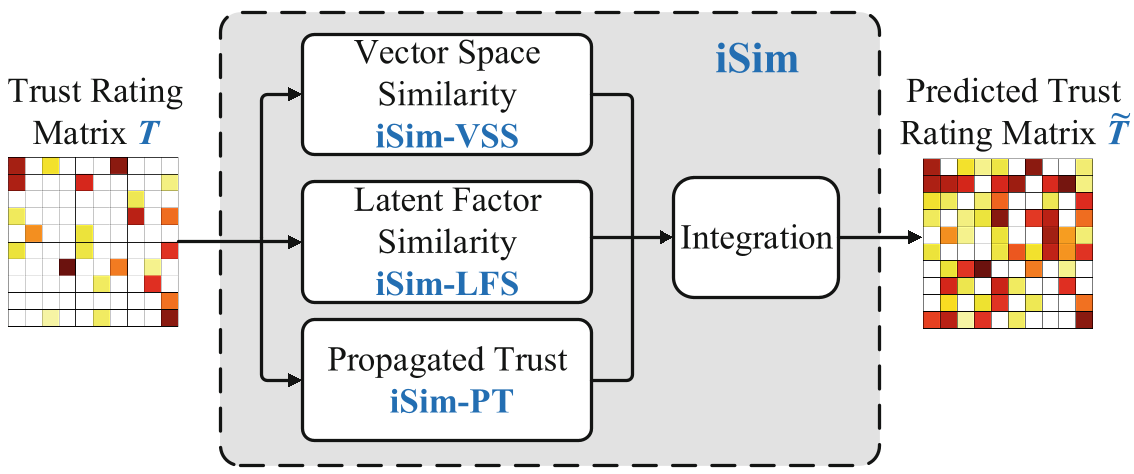
1. iSim-VSS (Vector Space Similarity)
This measures the explicit overlap in ratings. To solve the complexity, the authors implement Inverted Indexing. By only comparing users who have rated at least one common trustee, they drastically prune the search space.
2. iSim-LFS (Latent Factor Similarity)
To fight sparsity, iSim uses Probabilistic Matrix Factorization (PMF). It maps users into a -dimensional latent space. Similarity is then calculated as the cosine distance between these latent vectors, capturing "rating styles" (e.g., a "harsh" rater vs. a "lenient" rater).
3. iSim-PT (Propagated Trust)
Instead of complex path-finding in directed graphs, iSim transforms the network into an undirected graph and finds the Bottleneck Path using a modified Kruskal’s Algorithm. This ensures that the global trust structure is captured efficiently.
4. Hybrid Integration
The final similarity formula is a masterclass in balancing intuition: Here, the term in parentheses captures how similar they are, while the exponential term captures how connected they are.
Experiments and Performance
The model was validated on the Advogato dataset (7,425 users, 56,550 ratings).
Effectiveness
Compared to the state-of-the-art SCMF, iSim achieved an 18.8% improvement in MAE. The ablation study (shown below) confirms that adding LFS and PT progressively improves accuracy.

Efficiency: The Real Game Changer
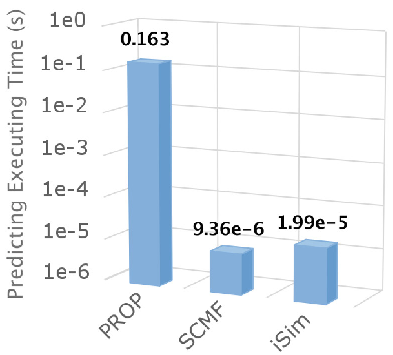
While MF-based methods like SCMF are slow due to complex regularization, and propagation methods like PROP are slow during inference, iSim dominates both.
- Pre-training: 15x faster than SCMF.
- Prediction: 1000x faster than PROP.
Critical Analysis & Conclusion
Takeaway
iSim proves that you don't need "heavy" deep learning to achieve SOTA results in trust prediction. By carefully engineering hybrid similarity and using classic data structures like inverted indexes and disjoint sets, one can achieve superior accuracy with minimal hardware requirements.
Limitations
- Parameter Sensitivity: While the model is robust to , it requires tuning the weights between explicit and implicit similarity. In very sparse datasets, LFS must be weighted more heavily () vs VSS ().
- Static Nature: The current Kruskal-based propagation assumes a static graph; real-time updates to trust links might require dynamic MST algorithms.
Future Outlook
The definition of "Implicit Similarity" through latent factors is a powerful concept. Future researchers might replace the PMF component with Graph Embeddings (Node2Vec) or Transformers to see if the "Hybrid Similarity" framework holds its efficiency at a billion-node scale.