
iSocialMash: When Social Networks Meet Service Composition
iSocialMash: Convergence of social networks and services composition on a mashup framework
iSocialMash is a novel mashup framework that converges services computing with social computing to assist end-users in rapid, on-demand service composition. By leveraging social networks and folksonomies, it transforms collective user experiences into reusable "mashup patterns" for personalized recommendations.
TL;DR
iSocialMash is an innovative framework designed to democratize the creation of web mashups (combining APIs like Google Maps, Twitter, and Yelp). By treating service composition as a social activity, it harvests "wisdom of the crowd" through social tagging and interaction histories to recommend the best services and connection patterns for non-expert users.
The Motivation: Why Complexity Kills Creativity
The modern web is a treasure trove of APIs, but for the average user, building a "situational application" (like a personalized travel planner) remains a technical nightmare. Traditional service composition requires understanding complex interfaces (WSDL, REST) and data schemas.
The authors argue that developers shouldn't have to start from scratch. If thousands of users have already connected "Maps" with "Hotel Search," that collective intelligence should be the foundation for the next user. The problem is that current tools treat composition as a solo, technical task rather than a collaborative, social one.
The Core Concept: Social-Empowered Mashups
iSocialMash bridges the gap between Services Computing and Social Computing. It doesn't just look at the code; it looks at the who, when, and why of a mashup.
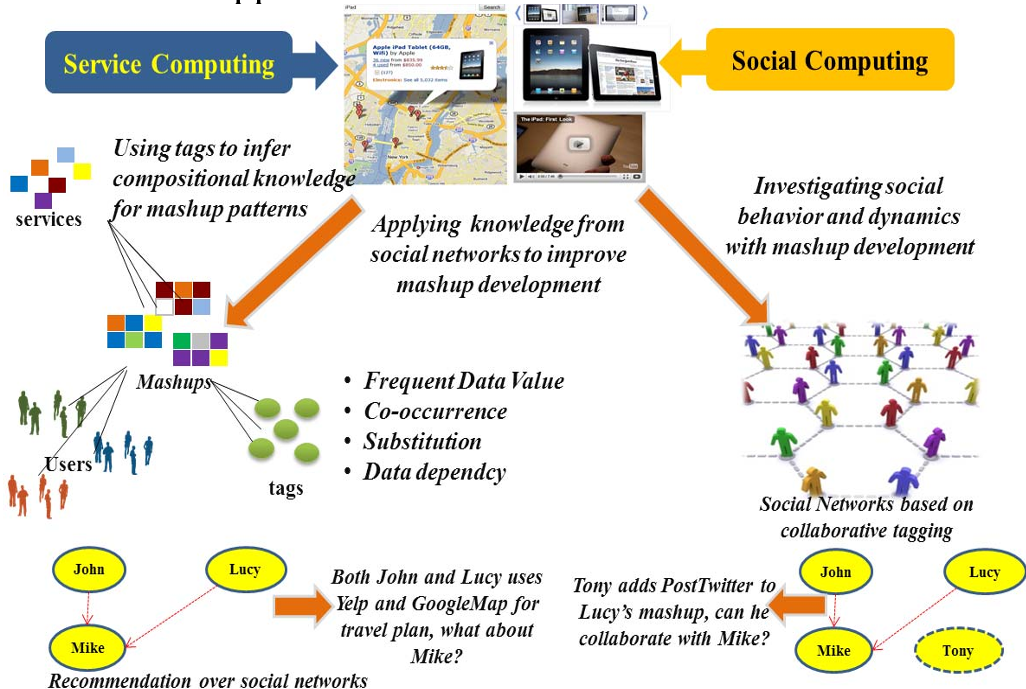
The framework revolves around a tuple: <mashup_task, user, time, tags>. By enriching services with social tags (folksonomies), the system can understand the "intent" behind a service link without requiring formal ontologies.
Methodology: Mining Mashup Patterns
The paper identifies four key patterns derived from social data:
- Frequent Data Value: Recommending default inputs based on common usage (e.g., current GPS location for traffic services).
- Co-occurrence Pattern: Identifying services that "frequently travel together" (e.g., Yelp and Google Maps).
- Data Mapping Pattern (Tag-Links): Using tags to bridge outputs and inputs. If Component A outputs
cityand Component B consumescity, a "Tag-Link" is born. - Substitution Pattern: Finding functional clones (e.g., replacing Yahoo! Local Search with Google Places) when a service fails.
The system uses association rule mining and clustering to build these patterns. For example, if a user selects a "Map" service, the Service Advisor scans the social graph to see what friends or users with similar backgrounds typically add next.
Experimental Results: Proving the "Social" Advantage
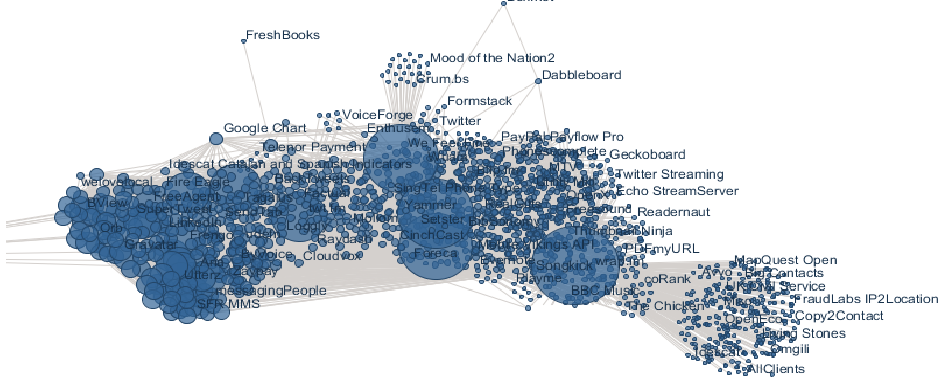
The researchers analyzed data from ProgrammableWeb, crawling over 18,000 tags.
- Social Convergence: They found that user background (geography) significantly influences service choice. American users preferred Flickr for photos, while Korean users trended toward eCommerce APIs.
- Recommendation Accuracy: The "Data-Mapping" pattern achieved high satisfaction, with 80% of desired components appearing in the Top-3 recommendations.
Architecture: The iSocialMash Engine
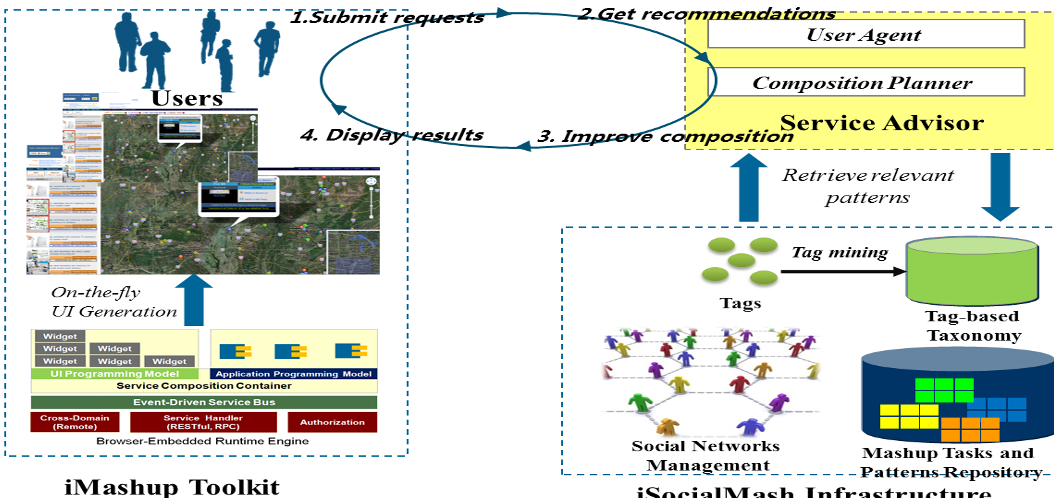
The system architecture includes a Service Advisor and a Composition Planner. These components sit on top of the browser-based iMashup Toolkit, providing a drag-and-drop interface where the "next step" is always suggested based on social patterns.
Critical Insight & Conclusion
The real value of iSocialMash lies in its Inductive Bias: the assumption that social relationships mirror functional requirements. While a powerful approach for mid-2010s web services, the modern perspective would see this as a precursor to AI-driven Co-pilots.
Takeaway: By moving the focus from "Service Documentation" to "User Behavior," iSocialMash effectively reduced the barrier to entry for the "Prosumer"—the user who produces the very tools they consume.
Limitations: The framework relies heavily on the quality of tags and the size of the social network. In cold-start scenarios (new services with no tags), its recommendation power significantly weakens.