
The Invisible Machine: How the User Interface Swallowed Computer History
What Do IT-People Know about the Nordic History of Computers and User Interfaces? - A Preliminary Survey.
This paper presents a preliminary empirical study investigating the historical knowledge of IT professionals and students regarding computers and user interfaces (UI). Using a free-association survey, the study reveals a significant generational gap and a shift where the "interface" has increasingly become the primary conceptual proxy for the "computer" itself.
TL;DR
Is the computer disappearing? According to a study by Anker Helms Jørgensen, the answer is a psychological "yes." While senior researchers remember vacuum tubes and mainframes, younger IT students almost exclusively equate "computer history" with the "Personal Computer" and its graphical interface. This study explores how our personal experiences define our technical reality and why the computer itself is becoming an "invisible" relic behind the screen.
Contextualizing the Knowledge Gap
History is often seen as a dry endeavor for IT professionals focused on the "next big thing." However, Jørgensen argues that a lack of historical perspective leads to a shallow understanding of modern systems. The primary motivation for this survey was the observation that students often believe history started with Windows and the PC, ignoring decades of foundational innovation in batch processing, time-sharing, and early tele-informatics.
Methodology: The Power of Free Association
To "probe" the minds of IT people, the author used a simple yet effective technique: Free Association.
- Participants: 4 Researchers (Generation X/Boomers) vs. 8 Students (Millennials/Gen Y).
- Task: List 5-10 names, events, or systems triggered by the phrase "history of computers" and "history of interfaces."
- Analysis: 222 associations were categorized to reveal differing mental maps of the digital world.
Key Findings: The Generational Shift
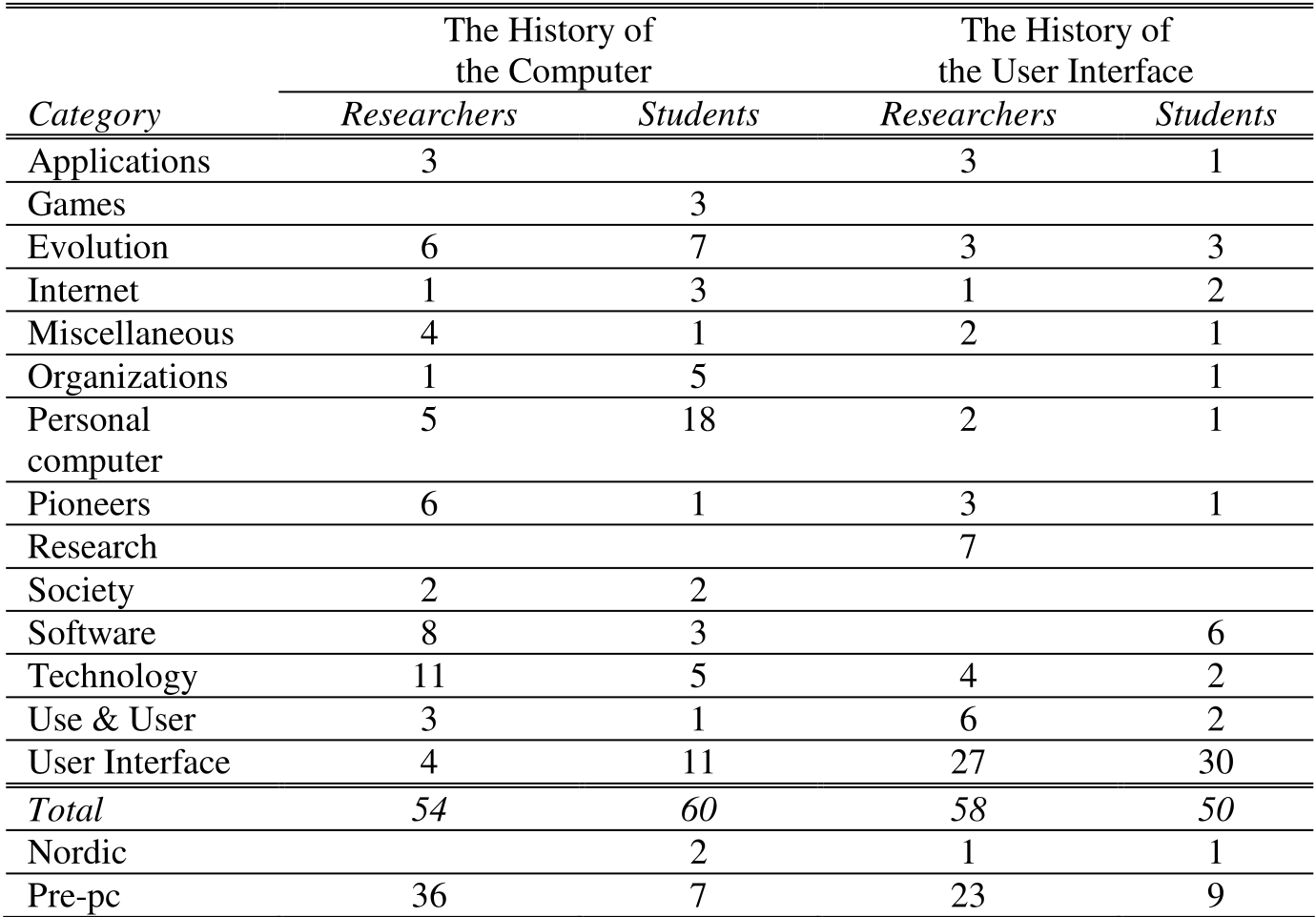
The results, summarized in Table 1, highlights a stark contrast in how these two groups perceive the evolution of technology.
1. The Death of the "Pre-PC" Era
For researchers, history is deep. They mentioned Eniac, Univac, punch cards, and the transition from vacuum tubes to transistors. For students, history starts with the PC.
- Researchers: 36 pre-PC responses.
- Students: Only 7 pre-PC responses. To the younger group, "Old" means a 286 processor or a Commodore 64, not a room-sized mainframe.
2. Interface as the Icon
The most profound insight is that for students, the UI is the Computer. When asked about computer history, students frequently listed "GUI," "Windows," and "Desktop Metaphor." To them, the hardware and software layers have merged into a single "Interface" experience. The computer as a physical, calculating entity has become "invisible"—a core goal of early HCI research that has finally been realized in the minds of the next generation.
3. The Missing Nordic Identity
Despite the study taking place in Denmark, Nordic contributions were non-existent in the participants' minds. Out of 222 items, only 4 were regional (like the Regnecentralen Piccoline). This suggests that IT culture is effectively globalized—or perhaps "Americanized"—with Silicon Valley (Xerox PARC, Apple, Microsoft) acting as the undisputed origin myth of the digital age.
Deep Insight: A Cautionary Tale
The author concludes with a humbling twist: even the "expert" researchers were unaware that "Computer" originally referred to a human job title (people who calculated manually), and many didn't know that the first programmers were women.
This highlights that technical knowledge is autobiographical. We don't learn the "History of Computing"; we remember the "History of Our First Interaction with Computing."
Conclusion & Future Outlook
This preliminary study serves as a wake-up call for IT educators. If we lose the distinction between the interface and the system, we risk oversimplifying our understanding of complexity.
- Takeaway: Historical literacy in IT isn't just about trivia; it's about understanding the "Why" behind the "How."
- Limitation: The sample size is small (12 people), but the trends are symptomatic of a broader cultural shift towards the "invisibility" of technology.
As technology moves toward AR, VR, and "Surface-less" interfaces, the computer will likely disappear even further from our conscious thought—making the study of its origins more important than ever.