
PETER: Bootstrapping Precision Medicine with Italian Healthcare Knowledge Graphs
Towards an Italian Healthcare Knowledge Graph
The paper proposes an end-to-end framework for constructing an Italian Healthcare Knowledge Graph (KG) using the PETER (Pattern-Exploiting Training for Named Entity Recognition) method. It integrates Transformer-based language models with few-shot learning to overcome the data scarcity inherent in low-resource medical NLP.
TL;DR
Building specialized Knowledge Graphs (KGs) for healthcare is often hindered by the "data desert" of low-resource languages. This paper introduces a specialized pipeline—headlined by PETER (Pattern-Exploiting Training for NER)—to extract medical entities and relations from Italian clinical notes using few-shot learning, eventually consolidating them into a navigable Knowledge Graph for precision medicine.
Problem & Motivation: The Low-Resource Barrier
While English-centric AI has made leaps in processing Electronic Health Records (EHRs), languages like Italian face a structural disadvantage. Precision medicine requires a deep understanding of symptoms, treatments, and lifestyle factors. However:
- Data Scarcity: There is a lack of large-scale, annotated Italian biomedical corpora.
- Linguistic Nuance: Clinical notes are rife with negations, non-standard abbreviations, and polysemous words that general-purpose models (like GilBERTo) struggle to parse.
- Annotation Cost: Labeling medical data requires rare and expensive expert knowledge.
The author's insight is that we can bypass the need for massive labeled datasets by leveraging the "latent knowledge" already present in Transformer models through few-shot learning and semantic matching.
Methodology: From Clinical Notes to Knowledge Graphs
1. PETER: Few-Shot NER through Pattern Exploitation
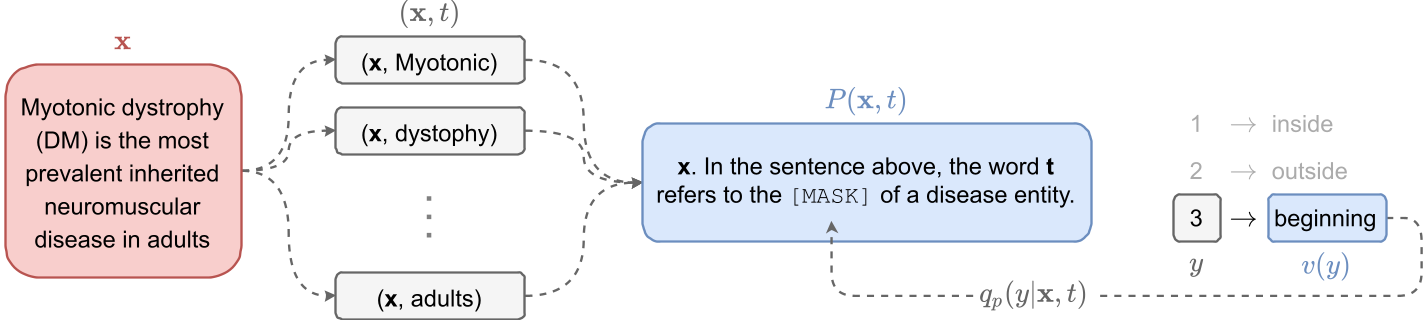
The core innovation is PETER. Traditional NER treats the task as token classification (assigning a label to each word). PETER instead transforms NER into a "cloze task."
- It applies a "pattern" to each token, creating a masked input.
- The model predicts the word that fits the mask, which corresponds to the entity label (Beginning, Inside, or Outside of an entity).
- This allows the model to use its pre-trained linguistic intuition, requiring significantly fewer examples to reach high accuracy.
2. Entity Linking and Graph Analysis
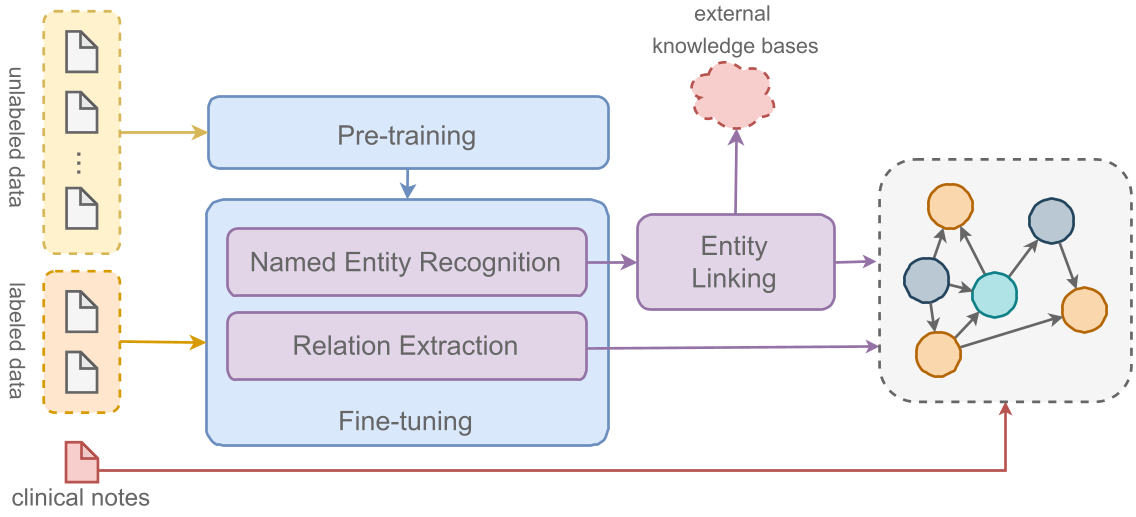
Once entities are extracted, they are matched against external knowledge bases (like Wikidata) using semantic similarity. The resulting graph isn't just a static database; it uses Graph Convolutional Networks (GCNs) to learn node embeddings.
- Equation for Insight: The framework uses a weighted GCN layer to aggregate information from neighboring symptoms or diseases: This formula effectively means a patient's risk profile () is updated based on the weight () of their specific symptoms and history.
Experiments & Results: Proving the Few-Shot Advantage
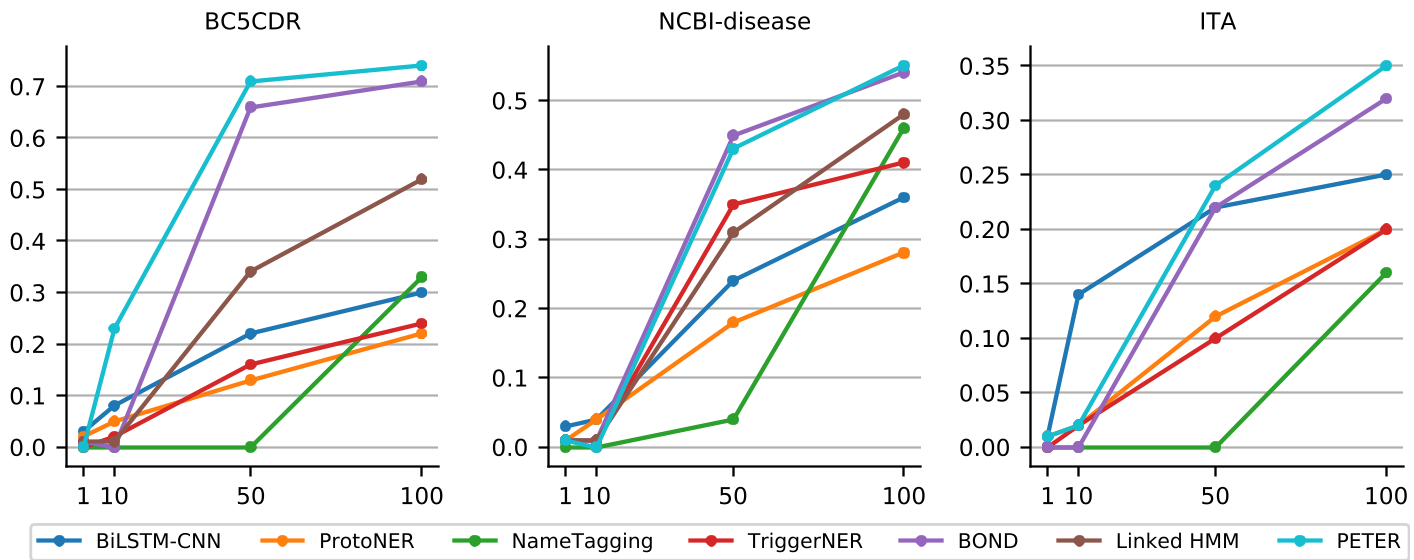
The study compared PETER against several SOTA few-shot NER techniques across three datasets: BC5CDR, NCBI-disease, and a proprietary Italian dataset.
Key Findings:
- Superiority of PETER: It consistently achieved higher F1 scores in low-sample regimes compared to established baselines.
- Pre-training is King: Models initialized with GilBERTo (general Italian) performed poorly compared to those initialized with BioBERT (biomedical English), underscoring the author's current efforts to pre-train a dedicated Italian Biomedical BERT.
Critical Insight & Future Outlook
The value of this work lies in its generalizability. While focused on Italian, the architecture—combining prompt-based few-shot learning (PETER) with GCN-based structural analysis—provides a blueprint for any region attempting to build medical AI with limited data.
Limitations: The current results are "early." The full Italian Biomedical Transformer is still in the pre-training phase, and the downstream integration of EHR-derived facts into a production-ready Graph remains the next big hurdle.
The Takeaway: Knowledge Graphs are the "connective tissue" of AI in healthcare. By using few-shot learning to extract the data and GCNs to analyze it, we can bring the benefits of precision medicine to languages that the "Big Tech" giants have largely overlooked.