
Who Should Share What? Unlocking Item-Level Social Influence with HF-NMF
Who should share what?: item-level social influence prediction for users and posts ranking
This paper introduces the Hybrid Factor Non-Negative Matrix Factorization (HF-NMF) for predicting item-level social influence in online social networks. By modeling the interactions between users and specific web posts, the method significantly outperforms traditional regression and basic factorization baselines in tasks like user and post ranking.
TL;DR
Social influence isn't just about who you are; it's about what you share. This paper moves beyond general "influencer" scores to item-level prediction, answering exactly how many clicks a specific post will generate when shared by a specific user. Using a Hybrid Factor Non-Negative Matrix Factorization (HF-NMF) approach, the researchers combine social tie strength and content semantics to overcome massive data sparsity, outperforming traditional regression models.
Background & Motivation: Moving Beyond "Who Influences Whom"
Most early social network research focused on a macro perspective: Who are the most influential nodes in a graph? While useful for understanding network topology, it ignores the reality of the "What." A fashion icon might influence thousands regarding a new brand of shoes but have zero influence regarding a technical whitepaper.
The authors argue that true social influence is user-post specific. They identify three core challenges:
- Granularity: Influence must be discriminative at the item level.
- Sparsity: In a network like Renren (China's Facebook-like site), a user might share only 6 posts out of 43k available—leading to a 99.9% empty interaction matrix.
- Complex Factors: Influence is a cocktail of tie strength (how close friends are), user activity, and the "stickiness" of the content itself.
Methodology: The HF-NMF Architecture
The core innovation lies in the Hybrid Factor approach. Instead of a vanilla Matrix Factorization (NMF), the authors constrain the latent spaces of users () and posts () using side information.
1. User-Specific Priors
They construct a similarity matrix based on:
- Percentage of Active Friends: How likely is the audience to click anything?
- Friend Tie Strength: Interaction frequency between the sharer and the followers.
2. Post-Specific Priors
They apply Latent Dirichlet Allocation (LDA) to the content of 43k posts to extract topic distributions. This ensures that posts with similar themes are mapped closely in the latent space.
3. Joint Optimization
The objective function minimizes the reconstruction error of the observed clicks while simultaneously forcing the latent vectors to stay consistent with the user similarity and post topic matrices.

The solution is derived using an improved Projected Gradient (PG) method, which ensures non-negativity (essential for interpreting "influence strength" which cannot be negative) and faster convergence via the Armijo rule.
Experiments & Results
The researchers tested their model on four dataset scales, ranging from 500 to 10,000 users.
Performance vs. Baselines
HF-NMF was compared against Logistic Regression (LR), Cox Proportional Hazards, and basic NMF.
- The Findings: Regression models failed significantly because they couldn't capture the latent interaction between the user and the post.
- Sparsity Resilience: HF-NMF’s advantage was most pronounced when training data was scarce (50% training set), proving that the "Hybrid Factors" act as vital anchors when data is thin.
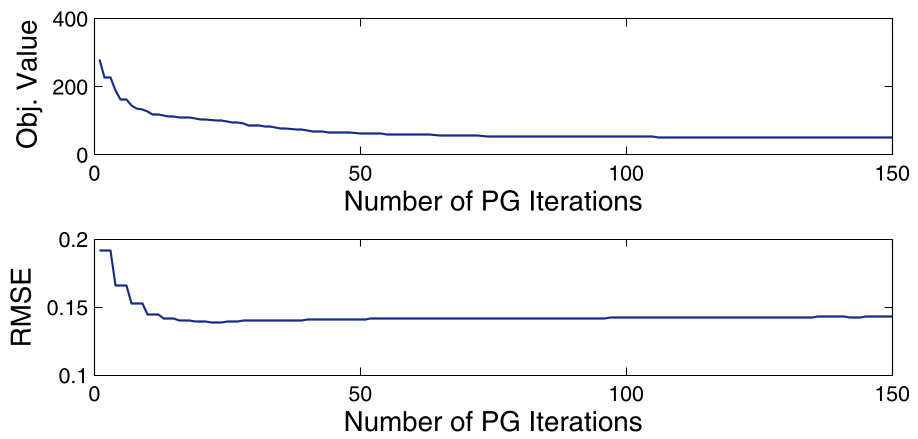 The figure above shows that the Projected Gradient method reaches optimal RMSE near the 15th iteration, demonstrating high efficiency and generalization.
Ranking Accuracy
In practical scenarios (Ranking Users or Ranking Posts), HF-NMF achieved a T-measure (η) near 0.89. This means that if an advertiser wants to pick the best segment of users to "seed" a viral post, this model predicts the resulting click-through volume with high precision.
Critical Insight: Why This Matters
The shift from Topological Influence to Item-Level Influence marks a transition in Information Retrieval. This work proves that factors like "Friend Tie Strength" are not just social metrics—they are primary predictive signals for information diffusion.
Limitations: The model currently assumes a static snapshot of the network. In reality, social influence is temporal—users' interests shift and tie strengths fluctuate. Future work would likely need to incorporate Temporal Dynamics to keep the latent space "fresh."
Conclusion
By blending content semantics (LDA) with structural social ties through a unified Matrix Factorization framework, HF-NMF provides a robust answer to "Who should share What?" It remains a foundational strategy for modern recommendation engines and viral marketing systems.