
Signed-ILT: Modeling the Evolution of Friends and Foes in Social Networks
Iterated local transitivity model for signed social networks
This paper introduces the Iterated Local Transitivity (ILT) model for signed social networks, generalizing a deterministic growth model to account for both positive (friendship) and negative (enmity) relations. By employing a cloning mechanism and neighborhood-based marking, the authors provide a framework for analyzing structural properties like balance, clusterability, and sign-compatibility in evolving networks.
TL;DR
Researchers have expanded the Iterated Local Transitivity (ILT) model to signed networks, creating a mathematical framework that mimics how friendship and enmity evolve in online social platforms. By adding "clone" vertices that mirror local connections, the model reveals the strict conditions required to maintain social balance and community stability.
The Social Tension: Why Signs Matter
In the digital age, social interactions aren't just about who you follow; they are about who you trust and who you oppose. Most network models treat all links as positive (0 or 1), ignoring the "Anti-social" link. This paper tackles the Signed Social Network, where edges carry a (+) or (-) sign.
The core challenge is understanding network growth. When a new user (a clone) joins a community because of an existing member, how do they inherit the parent's friends and enemies?
Methodology: The Cloning Mechanism
The ILT model is deterministic. At every time step , for every existing vertex , a new clone vertex is born.
- Connection: connects to and all of 's neighbors.
- Marking Rule: A vertex is marked Positive if the majority of its neighbors are friends, and Negative otherwise.
- Edge Signing: The sign of the new edge between a clone and a neighbor depends on the neighbor's current "mark."
 Equation (1): The decision logic for vertex marking based on positive/negative degree density.
Structural Integrity: Balance and Clustering
The authors dive deep into the "Social Psychology" of the graph through three mathematical lenses:
1. Balance Theory
A network is balanced if "the friend of my friend is my friend" and "the enemy of my enemy is my friend." The paper proves that if the initial network (the seed) satisfies specific marking conditions—where positive edges only link similar minds—the entire evolving network remains balanced.
2. Clusterability
Can the network be divided into "echo chambers"? The research provides an algorithm to detect if a growing network will eventually fracture into disjoint clusters where all internal relations are friendly and all external ones are hostile.
3. Sign-Compatibility
This is a stricter requirement where negative relations only exist if both parties are "negative" types. A fascinating takeaway is Corollary 12: In a diverse (heterogeneous) network, you cannot have both Social Balance and Sign-Compatibility. You must choose between a balanced society or a strictly compatibility-based one.
Experimental Validation: Algorithmic Checkpoints
The authors present several algorithms to verify these properties.
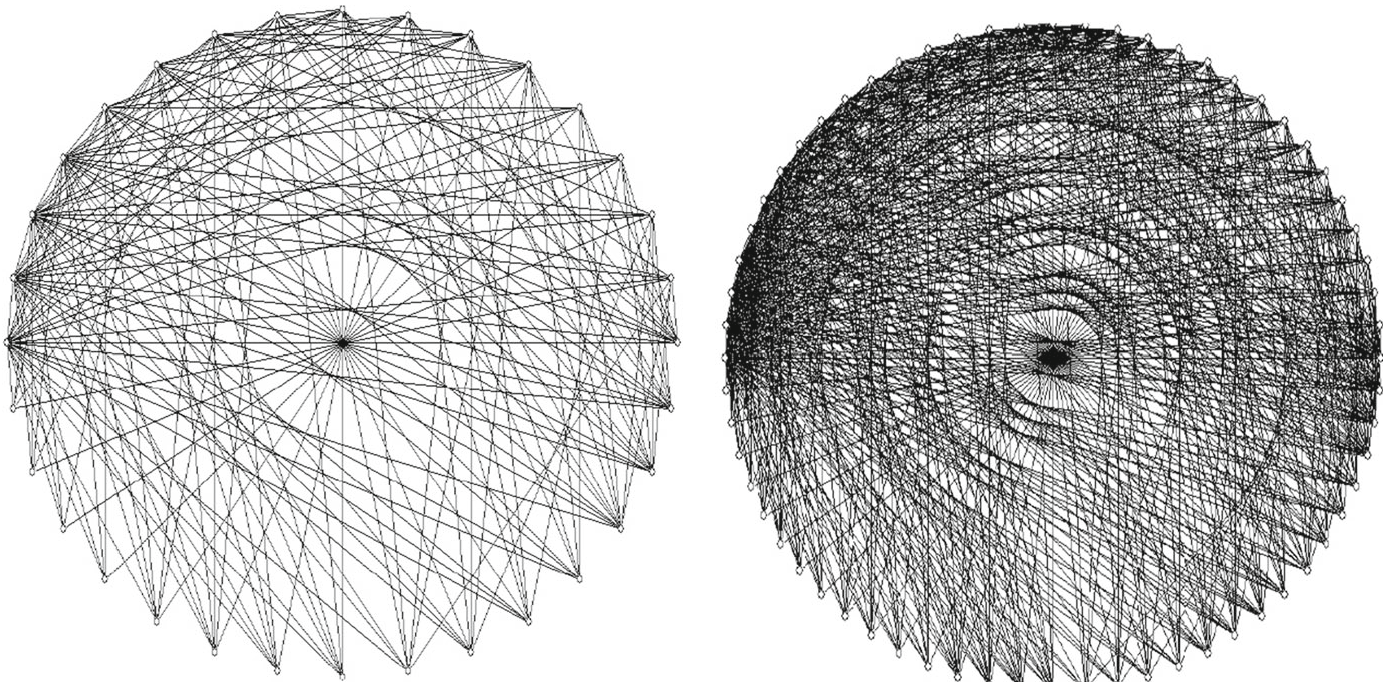 Visual representation of the ILT growth from t=2 to t=3, demonstrating how the complexity of connections explodes through local transitivity.
The algorithms operate with an adjacency matrix . By iterating through the matrix to count neighborhood signs, the system can predict with efficiency whether a specific starting configuration will lead to a "toxic" or "balanced" giant component.
Critical Insight: The Limitation of Cloning
While the ILT model captures the clustering coefficient and densification of real social networks (like Facebook or LinkedIn), it is a deterministic model. In reality, humans are stochastic—we don't always befriend all our friends' friends.
However, the "Cloning" metaphor is a powerful proxy for homophily: the tendency of individuals to associate with others who are similar. This model proves that even with simple local rules, a network's global "vibe" (balanced vs. chaotic) is determined almost entirely by its earliest members.
Conclusion
This generalization of the ILT model provides a robust mathematical foundation for analyzing signed ties. For researchers in community mining and social computing, it offers a way to simulate how the introduction of new "copy-cat" users affects the long-term stability and polarity of online groups.