
Stability in Liquid Democracy: Will Your Vote Ever Find a Home?
The Convergence of Iterative Delegations in Liquid Democracy in a Social Network
The paper investigates the stability of iterative delegation in Liquid Democracy (LD) within social networks, formalizing the process as a strategic game where voters aim to minimize the rank of their delegation "guru." The authors determine that while Nash equilibria are not guaranteed in general or complete networks, they always exist in tree-structured networks. The study provides polynomial-time algorithms for finding optimal equilibria in trees.
Executive Summary
TL;DR: This paper explores whether the "liquid" in Liquid Democracy—the ability to transitively delegate your vote to others—eventually settles into a stable state. By framing delegation as a game on social networks, the authors reveal a stark divide: while tree-structured networks guarantee stability and offer efficient optimization, general networks (even those with low connectivity) lead to computational nightmares (NP-completeness) and potential infinite loops in delegation.
Background: Liquid Democracy sits between direct and representative democracy. But when everyone starts picking their "guru" (proxy) based on personal preferences, can the system reach a Nash Equilibrium? This work provides the first rigorous complexity analysis of this stability problem in social network contexts.
The Core Conflict: Preference vs. Transitivity
In Liquid Democracy, if A delegates to B and B delegates to C, A’s vote weight eventually goes to C. However, A’s preference is usually for B. If B then changes their mind and delegates to someone A dislikes, A might want to change their move.
The authors identify two major issues:
- Existence: There might be no configuration where everyone is happy with their current guru.
- Convergence: Even if a stable state exists, a step-by-step update process might circle forever.
Hardness in General Networks
In a complete network (where anyone can delegate to anyone), the search for a stable set of gurus is equivalent to finding a Kernel in a directed graph. A kernel is a set of nodes that are independent (don't point to each other) and absorbing (everyone else points to at least one of them). Since finding a kernel is NP-complete, so is finding a stable delegation state.
 Table 1: The complexity of existence across different graph types.
The "Tree" Haven
The most significant positive result is that Tree Social Networks are the only structures that guarantee an equilibrium regardless of voter preferences. Using a dynamic programming approach, the authors show we can not only find an equilibrium but also optimize for:
- MINMAXVP: Preventing any single guru from having too much power.
- MINDIS: Minimizing the total rank-based dissatisfaction of voters.
- MINABST: Reducing the number of people whose votes are lost to delegation cycles or abstention.
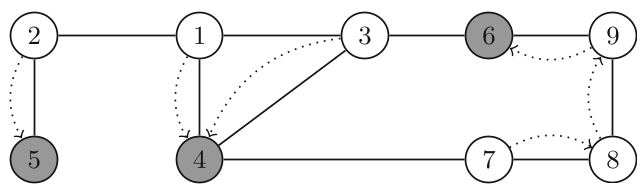 Figure 1: Visualizing how delegation paths form in a social network.
The Dynamics Problem: Why it Loops
Even when an equilibrium exists, getting there is hard. The paper proves that Best Response Dynamics (BRD)—where voters pick their favorite available option one by one—can fail to converge even on a simple Path graph. Only in Star graphs (a central hub) does the system reliably settle down under BRD.
Strategic Insights & Conclusion
This research highlights a fundamental trade-off in democratic design. If we allow "liquid" delegation across a complex, loopy social network:
- We risk eternal instability.
- We make it computationally hard to find fair power distributions.
Future Outlook: For practitioners building Liquid Democracy platforms (like LiquidFeedback), the findings suggest that enforcing hierarchical or tree-like delegation paths, or providing algorithmic "suggestions" for delegation, might be necessary to ensure system stability.
Limitations: The model assumes voters have clear, static preference lists. In reality, preferences change as the "political weather" shifts, which would make the stability problem even more volatile.