
SPORT: Self-Evolving Multimodal Agents via Step-wise Preference Tuning
Iterative Tool Usage Exploration for Multimodal Agents via Step-wise Preference Tuning
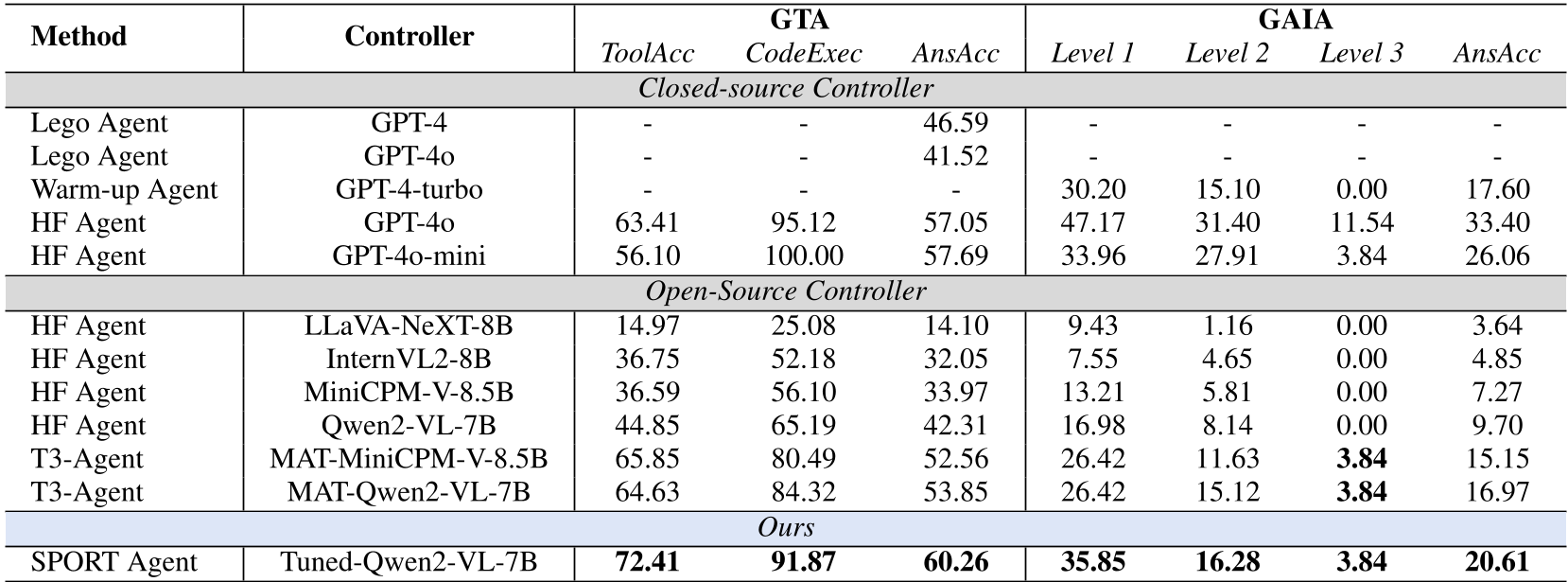
The paper introduces SPORT, an iterative tool usage exploration framework for multimodal agents that utilizes step-wise preference tuning. By combining task synthesis, step-level sampling, and AI-driven verification, the SPORT agent achieves a 60.26% answer accuracy on the GTA benchmark and 20.61% on GAIA, setting a new SOTA for open-source multimodal controllers.
Executive Summary
Multimodal agents are the next frontier in AI, but their training is currently shackled by the high cost of human-annotated tool usage data. To address this, SPORT (Step-wise Preference Optimization for Refining Trajectories) introduces a paradigm shift: an iterative, self-supervised loop where agents learn to use tools by exploring, failing, and receiving AI-generated "preference" feedback. By moving from whole-trajectory learning to fine-grained step-level optimization, the SPORT agent significantly outperforms standard Supervised Fine-Tuning (SFT) methods on benchmarks like GTA and GAIA, demonstrating that models can "teach themselves" how to interact with the world.
The Problem: The Annotation Bottleneck and Sparse Rewards
Building an agent that can navigate web pages, analyze PDFs, and execute Python code requires precise "thought" and "action" sequences. Current methods face two major hurdles:
- Data Scarcity: Creating expert trajectories for complex tasks like "Find the cheapest smartphone in this PDF and compare its specs with a web search" is painstakingly slow for humans.
- Credit Assignment: In a 10-step task, if the agent fails, it’s hard to know if the failure happened at Step 2 (wrong tool choice) or Step 9 (wrong parameter). Trajectory-level rewards are too "blunt" for effective learning.
Methodology: The SPORT Loop
The authors propose an iterative framework that avoids human labels entirely. The SPORT pipeline consists of four distinct stages:
1. Task Synthesis
The system uses an LLM (Qwen2.5) to generate diverse queries and then produces the necessary multimodal files (images, Excel, PDFs) using Python scripts. This ensures the training data matches the target environment.
2. Step-wise Sampling & Verification
Instead of running a full trajectory and hoping for the best, the agent explores multiple potential actions at each step.
- Sampling: The controller samples candidate actions (Thought + Code).
- Verification: A multimodal verifier (AI Feedback) evaluates these candidates and picks the best one.
- Preference Pair: The chosen action becomes the "Preferred" sample, and the others become "Dispreferred," creating a rich dataset for optimization.

3. Preference Tuning via DPO
Using the collected triplets (State, Preferred Action, Dispreferred Action), the model is tuned using the Direct Preference Optimization (DPO) algorithm. This forces the model's policy to lean toward successful tool calls and away from hallucinations or code errors.
Experimental Results: Breaking the SFT Ceiling
The researchers tested SPORT on GTA (General Tool Agents) and GAIA (General AI Assistants) benchmarks.
- SOTA Performance: SPORT-tuned Qwen2-VL-7B reached 60.26% accuracy on GTA, surpassing even some closed-source agents using GPT-4o-mini (57.69%).
- Code Reliability: One of the most significant jumps was in
CodeExec(code execution success rate), which climbed from 84.32% to 91.87%, proving the agent learned to write more syntactically correct and logical code. - Efficiency: SPORT achieved a 4.75x speedup in overall compute time compared to generating long-form SFT data, primarily because it extracts more learning signal from every single step, including failed ones.
Deep Insight: Why Step-wise Matters
The core "Aha!" moment of SPORT is the realization that failed trajectories are gold mines. In a traditional SFT setup, if an agent fails a task, the data is useless. In SPORT, even if an agent eventually fails the whole task, it might have performed Step 1 and Step 2 perfectly. By isolating these steps and comparing them to "worse" alternatives, the model learns the nuances of tool selection and parameter passing much faster than it would by looking at the outcome alone.
Critical Analysis & Future Outlook
While SPORT is a leap forward, it currently relies on a Verifier model (AI Feedback). The authors acknowledge that if the Verifier has biases or limited reasoning, the agent might learn suboptimal behaviors.
The next step for this research is "learning to verify"—where the Verifier itself evolves alongside the agent. As multimodal models become more powerful, this "self-play" style of agentic training could lead to systems that can master any new software or interface within hours of autonomous exploration.
Conclusion
SPORT provides a robust blueprint for the next generation of autonomous agents. By shifting the focus from "collecting expert data" to "enabling autonomous exploration," it opens the door for specialized AI agents that can adapt to custom business tools and private datasets without needing a human to hold their hand.