
iTest: Optimizing Software Quality via Context-Aware Mobile Crowdsourcing
iTest: testing soware with mobile crowdsourcing
iTest is a mobile crowdtesting framework designed to evaluate web services and mobile applications by leveraging a distributed network of real-world testers. It introduces a greedy algorithm for tester selection to minimize redundant test tasks and provides a specialized SDK for automated logging and visual crash reporting.
TL;DR
iTest is a framework designed to bridge the gap between laboratory testing and real-world deployment. By leveraging the ubiquity of smartphones, it allows developers to test web services and Android apps across diverse locations and network configurations. Its core innovation lies in the GAFTS algorithm, which optimizes tester selection to reduce redundant costs, and an automated logging SDK that removes the manual burden from crowd testers.
Problem & Motivation: The "Fragmented Reality"
Modern software development faces a "fragmentation crisis." A web service might perform perfectly in a developer's high-speed office in Beijing but fail or lag significantly for a user on an EDGE network in Hangzhou.
The authors identify that manual crowdtesting (like uTest) is slow and expensive. The fundamental problem is twofold:
- Environmental Sensitivity: QoS (Quality of Service) is highly dependent on the invocation context (Location + Network Type).
- Selection Inefficiency: Randomly assigning testers leads to "Information Redundancy," where you pay for multiple tests in the same environment without gaining new insights.
Methodology: Smart Selection and Automated Feedback
1. The GAFTS Algorithm
To solve the selection inefficiency, the authors model tester selection as a Set Cover Problem. They define an Effective Radius (R)—an empirical distance (e.g., 5km) within which testers are considered "homogeneous."
The GAFTS (Greedy Algorithm for Tester Selection) works as follows:
- Filtering: Group online testers by network type.
- Deduplication: Remove testers near locations where results already exist.
- Greedy Coverage: Iteratively select the "center point" (tester) who covers the largest number of neighboring testers until the entire geographic map is covered.
2. The iTest Architecture
The system utilizes a client-server architecture. The iTestClient (based on PhoneGap/Android) probes the device's environment and executes tasks. The iTestServer manages the software repository and aggregates results.

3. Automated Logging SDK
Unlike platforms where users write manual bug reports, iTest provides a .jar SDK.
- Logging Tool: Wraps Log4j for Android to capture system states and application crashes silently.
- Visual Info Collector: Captures UI snapshots when fatal errors occur, ensuring developers see exactly what the tester saw.
Experiments: Proving the Context Gap
The authors deployed a demo service in Shanghai, Qingdao, and Hangzhou. The results confirmed their hypothesis:
- Network Influence: A replica that performs best under HSDPA might be surpassed by another replica when accessed via EDGE.
- Geographical Layout: Response times fluctuate drastically based on the physical distance between the mobile tester and the server node.
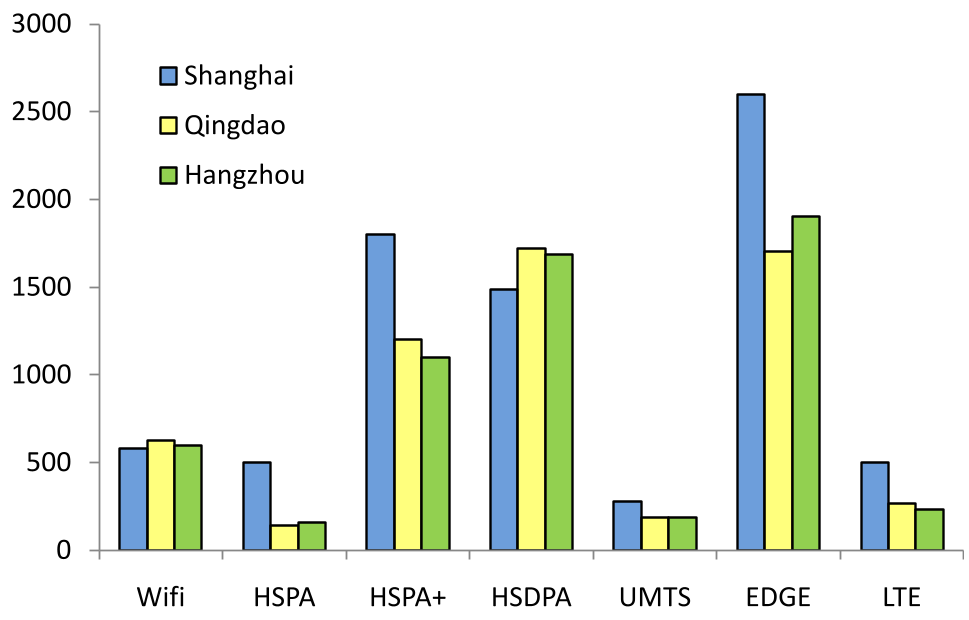 Figure: Performance variance across different network access types.
Critical Analysis & Conclusion
Takeaway
The primary value of iTest is its recognition that testers are sensors. By treating software testing as a geospatial sampling problem, the authors move crowdtesting from a subjective "human-in-the-loop" process toward an objective "device-in-the-loop" data collection stream.
Limitations
- Incentive Gap: The paper acknowledges that without a robust financial or gamification model, scaling to millions of users is difficult.
- Privacy: Automating logs and snapshots raises significant privacy concerns, which the paper mentions but does not fully solve technically (e.g., via on-device differential privacy).
Future Work
The next frontier for iTest is Adaptive Service Recommendation. By using historical data from the crowd, the system could automatically route users to the specific service replica that currently offers the best QoS for their exact coordinates and network carrier.