
JetStream: Infusing Social Intelligence into Gossip Protocols for Predictable P2P Networks
JetStream: Achieving Predictable Gossip Dissemination by Leveraging Social Network Principles
JetStream is a novel gossip protocol framework that optimizes peer-to-peer message dissemination by replacing random target selection with social network principles, specifically Reciprocity and Structural Holes. It achieves a significantly more uniform workload distribution and reduces system-wide traffic by up to 50% compared to canonical gossip.
TL;DR
Gossip protocols are the "gold standard" for scalable, reliable communication in distributed systems, but their randomness is a double-edged sword. JetStream transforms this chaotic randomness into "ordered efficiency" by applying two core social network principles: Reciprocity and Structural Holes. The result? A protocol that is 25% faster, 50% leaner on traffic, and strikingly more balanced in workload than traditional random gossip or DHT-based overlays like Chord.
The Problem: The Chaos of Randomness
In a standard "flat" gossip protocol, nodes pick targets at random. While this ensures high reliability, it creates a massive indegree imbalance. Statistical variance means some "unlucky" nodes get bombarded with 30+ copies of the same message, while others are barely reached. This isn't just a fairness issue; it's a bandwidth disaster for modern applications like streaming or high-frequency web feeds.
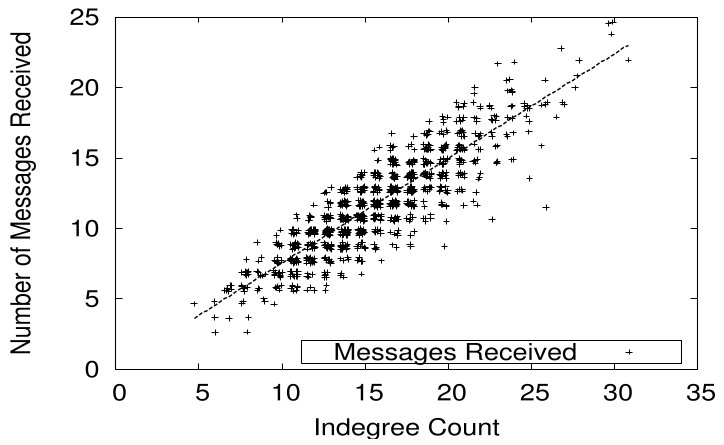 Figure 1: The "randomness tax" — nodes with higher indegree are forced to process significantly more redundant traffic.
Methodology: The "Social" Solution
JetStream argues that we don't need a central coordinator to fix this. Instead, nodes can act like "entrepreneurial actors" in a social network to optimize their own connections.
1. Reciprocity: "I'll listen to you if you listen to me"
If node A gossips to node B, and B gossips back to A, the network becomes symmetric. Mathematically, this forces a node's indegree to equal its outdegree.
- Benefit: This eliminates hotspots. If every node has 10 outgoing targets and those relationships are reciprocal, every node receives exactly 10 messages.
2. Structural Holes: The Information Broker
In social science, a "structural hole" exists between two groups that aren't talking to each other. A node that fills this hole becomes a bridge.
- Benefit: In gossip, this means avoiding "cliques" where everyone tells the same people the same thing. By seeking out nodes that aren't already connected to your other neighbors, you maximize the "freshness" of your gossip spread.
The JetStream Algorithm
Each node periodically runs a local Utility Function check. It looks at its current neighbors and asks: "If I swapped neighbor X for neighbor Y, would I have more reciprocal links and fewer redundant connections?"
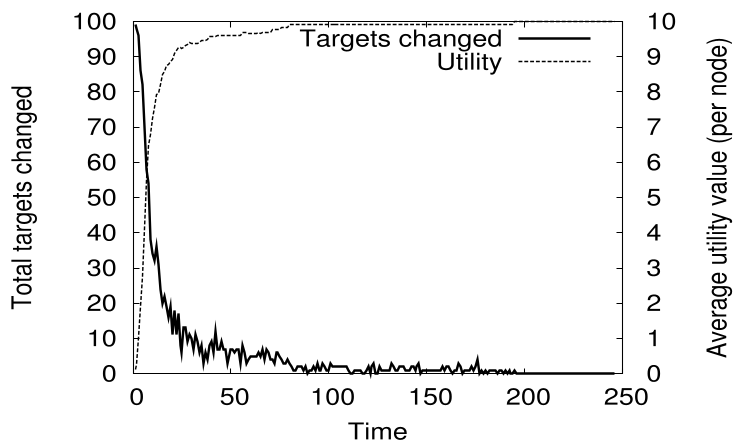 Figure 2: The evolution of the overlay. Nodes move from random chaos (left) to a structured, balanced utilitarian state (right).
Experimental Mastery
The authors tested JetStream against Flat Gossip and Chord (a popular DHT overlay) across 5,000 nodes.
- Efficiency: JetStream cut the number of messages required for full coverage by half. Because nodes don't send messages back to people they share reciprocal links with (who likely already have the data), the protocol effectively "self-prunes."
- Speed: By leveraging the "broker" insight of Structural Holes, the message reached the entire network 25% faster.
- Resilience: Remarkably, this structured approach didn't sacrifice gossip's famous robustness. When 50% of the nodes were suddenly killed (simulating a massive crash), JetStream reconverged and maintained nearly 100% coverage.
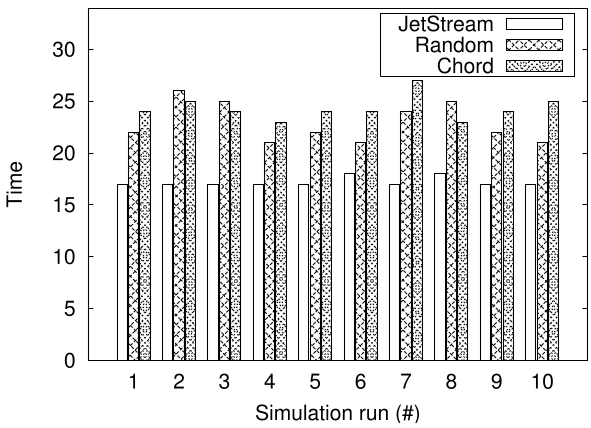 Figure 3: Comparison of message variance. Note how JetStream (bottom) clusters tightly, indicating a highly predictable and fair workload.
Critical Analysis & Conclusion
Takeaway
JetStream proves that local optimization can lead to global efficiency. By borrowing algorithmic heuristics from sociology, the authors managed to tame the variance of gossip protocols without introducing a single point of failure or high-cost coordination.
Limitations
- Computation Overhead: Calculating the utility function requires nodes to know who their neighbors are talking to (O(s*l) memory). While the authors localized this to a small "candidate set," it still adds complexity compared to purely random selection.
- Convergence Time: The network takes time to "warm up" and reach its optimal utilitarian state. For extremely short-lived networks, random gossip might still be simpler.
Future Outlook
As decentralized web technologies (Web3) and large-scale edge computing continue to grow, the "utilitarian overlay" logic of JetStream provides a blueprint for making P2P traffic as efficient as centralized CDNs while staying resilient.