
Job Alerts in the Wild: Solving the Engagement Crisis in Mobile Crowdsourcing
8206_Job Alerts in the Wild Study of Expectations and Effects of Location-based Notifications in an Existing Mobile Crowdsourcing Application.
This study investigates the integration of location-based notifications ("job alerts") in "appJobber," a real-world mobile crowdsourcing application. Using two surveys (n=335) and database analysis, the research evaluates user expectations, acceptance factors, and the impact of alerts on contribution quantity and quality, proving that proximity-based alerts significantly reduce travel distances for workers.
TL;DR
To survive, mobile crowdsourcing apps need active users. This paper explores Job Alerts—location-based push notifications—as a way to keep users engaged. By studying 335 real users of the appJobber platform, the researchers discovered that while users fear battery drain, they are highly receptive to alerts that save them travel time. Crucially, the study reveals a counter-intuitive finding: paying more for a task often leads to worse results.
Problem & Motivation: The "Effort-Reward" Imbalance
Mobile crowdsourcing (e.g., taking photos of speed signs for money) suffers from a high abandonment rate. Why? Because the "Return on Investment" (ROI) for the user is often negative once you factor in:
- Search Time: Manually checking a map for tasks.
- Travel Distance: Walking or driving to a specific waypoint.
- Physical Resources: Battery life and mobile data.
The authors argue that location-based notifications could solve this, but they face a "Privacy-Utility" paradox. Probing a user's location continuously drains the battery and exposes sensitive data. This paper is the first to measure if the benefits (more money, less walking) actually outweigh the costs in a real-world, commercial setting.
Methodology: High Precision, Low Impact
The researchers didn't just build a prototype; they modified a live app with 300,000 users. To balance accuracy with battery life, they used the Significant-Change Location Service.
The Notification Logic
- Threshold: Alerts only trigger if the user moves significantly.
- Radius: Tasks within 500m (a 5-minute walk).
- Frequency Cap: Maximum 8 alerts per day to prevent "notification fatigue."
 Note: The study combined user surveys with real-time server database analysis to verify if what users said matched what they did.
Key Results: Faster, Closer, but Messier?
The results confirm several critical hypotheses while debunking others:
- Distance Reduction: Alerts worked. Users who followed a notification covered 42% less distance (median 136m) compared to those searching manually (235m).
- The Reward Paradox: Higher rewards (>$4) led to tasks being reserved faster and users being willing to travel much further. However, the acceptance rate (quality) dropped. Users attracted by high rewards tended to rush or "game" the system.
- Privacy vs. Battery: Surprisingly, users cited battery drain and disturbance as their primary reasons for disabling alerts—not privacy. Location monitoring was viewed as a "price" users were willing to pay for a better UX.
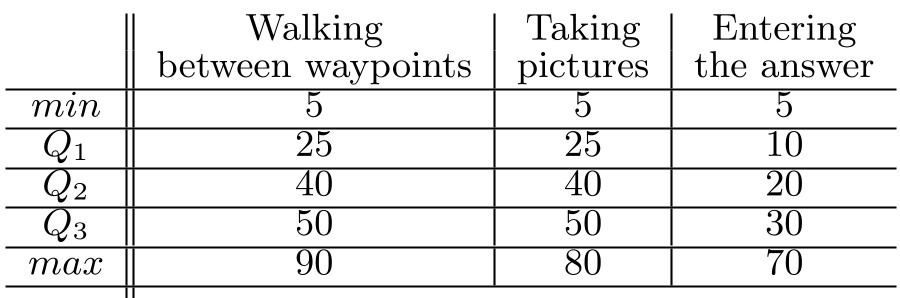 Figure: Analysis showed that users value the 'act of walking' and 'taking photos' at similar monetary levels (approx. 0.40 Euro each), suggesting they underestimate the cost of their own mobility.
Critical Insight: The Gender & Knowledge Gap
The data revealed that women were significantly more likely to activate job alerts than men. The authors speculate this is because they were less likely to visit the "Technical Information" menu, which detailed the background monitoring. Furthermore, users with high IT knowledge were the most likely to opt-out, reinforcing that "transparency" can sometimes lead to lower feature adoption in privacy-sensitive apps.
Conclusion & Future Outlook
This work demonstrates that location-based engagement is a net positive for crowdsourcing. For future developers, the "takeaway" is clear:
- Empower the User: Provide a slider to adjust notification frequency (e.g., "1 per day" vs. "1 per hour").
- Quality Control: If offering high rewards, implement stricter verification steps, as these tasks are magnets for low-quality contributions.
- Battery is King: Users care more about their phone staying alive than their location being tracked.
While the study is limited to European users and a specific app type, its "in the wild" nature provides a rare, grounded look at how the gig economy and mobile sensors intersect.