
Harmony in the Cluster: Beyond Slot-Blind MapReduce Scheduling
Job Aware Scheduling Algorithm for MapReduce Framework
This paper introduces a "Job Aware" MapReduce scheduling framework that characterizes tasks using multidimensional TaskVectors (CPU, RAM, Disk, Network). It proposes two novel scheduling strategies—Heuristic-based and Incremental Naive-Bayes Machine Learning—to optimize task placement, significantly outperforming Yahoo’s Capacity Scheduler in heterogeneous environments.
TL;DR
Standard MapReduce schedulers often overlook the specific "diet" (resource needs) of individual tasks, leading to performance-killing resource contention. This paper introduces a Job-Aware Scheduler that profiles tasks as vectors (CPU, Memory, Disk, Network) and use Machine Learning to predict task compatibility. The result? A 27% reduction in runtime and a far more stable cluster.
The Problem: The High Cost of "Resource Blindness"
In a typical Hadoop environment, the scheduler treats "slots" as generic containers. If three CPU-intensive tasks are assigned to the same node just because slots are free, the node chokes, and the jobs crawl. This is the Race Condition for resources. Existing SOTA solutions like Yahoo's Capacity Scheduler focus on queue management but fail to prevent these micro-level hotspots on TaskTrackers.
Methodology: High-Dimensional Task Profiling
The authors argue that a task is not just "a task"; it is a weighted combination of its resource footprint.
1. The TaskVector Concept
Before fully deploying a job, the scheduler runs a small sample of tasks (e.g., 5 map tasks) to capture their "DNA" using the atop utility. This creates a TaskVector ():
2. Intelligent Task Assignment
Once the scheduler knows what a task requires, it uses two distinct strategies to decide where it belongs:
- The Heuristic Approach: It calculates the "Unused" resource vector of a node and uses Cosine Similarity. The goal is to maximize the similarity between what a task needs and what the node has left, effectively filling resource gaps like Tetris.
- The Machine Learning Approach: An Incremental Naive-Bayes Classifier predicts a "Compatibility Score."
- Inputs: Hardware specs, Network distance, Incoming TaskVector, and the Compound TaskVector of currently running tasks.
- Feedback Loop: If a node reports an "overload" after a task is scheduled, the classifier is re-trained immediately to avoid the same mistake.
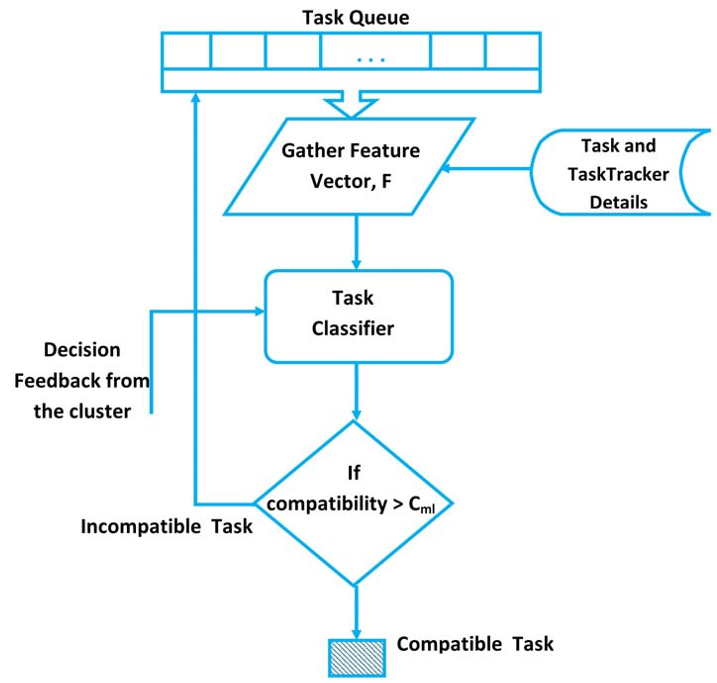 Figure 1: The Machine Learning-based Task Assignment logic flow.
Experiments & Results: Efficiency Gains
The authors tested their plugins against the industry-standard Capacity Scheduler on a 12-node heterogeneous cluster running real-world jobs like Terasort and Web Crawling.
Performance Boost
As the number of jobs increases, the "Job Aware" scheduler performs even better because it has a larger pool of diverse tasks to mix and match.
- Heuristic Savings: ~21% reduction in runtime.
- ML Savings: ~27% reduction in runtime.
Cluster Stability
The most striking evidence is found in the CPU requirement graphs. Under the Capacity Scheduler, CPU demand frequently spiked to 250% (leading to massive context switching and thrashing). The Job-Aware algorithms successfully capped demand near 100%, maintaining a healthy equilibrium.
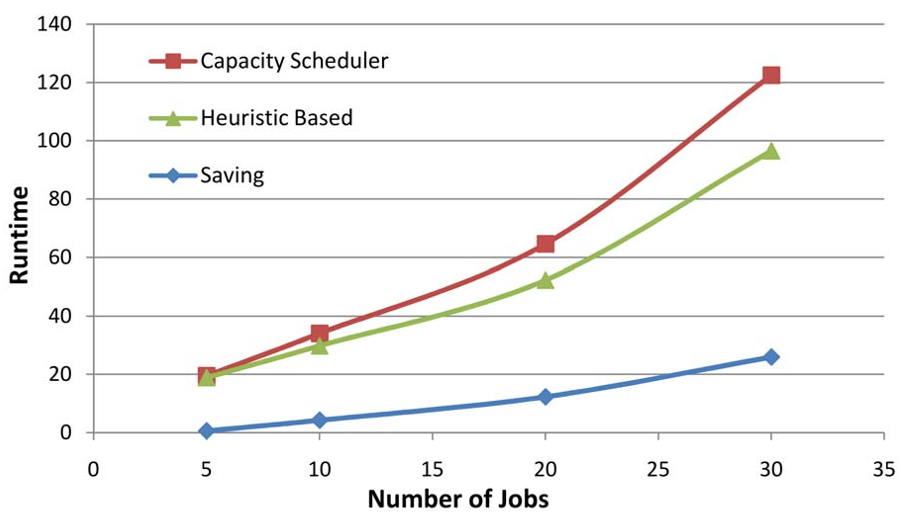 Figure 2: The Capacity Scheduler (jagged spikes) vs. the proposed Heuristic approach (stable usage below 100%).
Critical Insights & Takeaways
Why does it work? The fundamental win here isn't just about scheduling; it's about interoperability. By ensuring that a CPU-heavy task is paired with a Network-heavy task rather than another CPU-heavy one, the "harmony" of the node is preserved.
Limitations:
- Cold Start: The system requires running sample tasks to generate the TaskVector, which might add overhead for extremely short jobs.
- Averaging Risks: Using an average TaskVector assumes all map tasks in a job behave similarly. While often true in MapReduce, data skew could lead to inaccurate profiling.
The Future: This vector-based approach is a precursor to modern "Cloud-Native" scheduling. The authors suggest this logic could be applied to Virtual Machine placement, allowing providers to pack more VMs onto physical hardware without sacrificing performance—a critical step toward energy-efficient, green computing.