
The AI Gatekeeper: Why Candidates Embrace or Abandon AI-Enabled Recruiting
Job candidates’ reactions to AI-Enabled job application processes
This study investigates job candidates' behavioral intentions toward AI-enabled job application processes. Utilizing structural equation modeling (SEM), the authors demonstrate that organizational attractiveness, intrinsic rewards, and novelty are key drivers of a candidate's intent to complete an AI-driven application.
TL;DR
As AI becomes the "new face" of corporate recruiting, success depends less on the algorithm's accuracy and more on the applicant's psychology. This study reveals that while intrinsic motivation and novelty draw candidates in, anxiety acts as a silent killer of application intent, mediating the perceived attractiveness of the organization.
Background: The Shift from Selection to Attraction
For decades, HR tech research focused on selection—how companies pick winners. But as human capital becomes the ultimate intangible asset, the battleground has shifted to recruitment—how to get the best people to apply in the first place. With 79% of companies expected to deploy AI-enabled recruiting tools, the interface itself has become a critical signal of brand value.
The "Double-Edged Sword" of AI Newness
The researchers posit that the "newness" of AI creates a tension between positive attraction and negative repulsion:
- Positive Signals: Using AI signals that a firm is "leading-edge" and "innovative."
- Inherent Satisfaction: For some, interacting with a cognitive game or a bot provides a sense of accomplishment and curiosity.
- The Anxiety Barrier: Mistrust or fear of making an uncorrectable mistake can paralyze a candidate’s intent to finish.
Methodology: Mapping the Candidate's Mind
The study utilized Structural Equation Modeling (SEM) to analyze a sample of 532 adults. Participants were presented with a scenario where they were interested in a job but had to navigate an AI-enabled application.
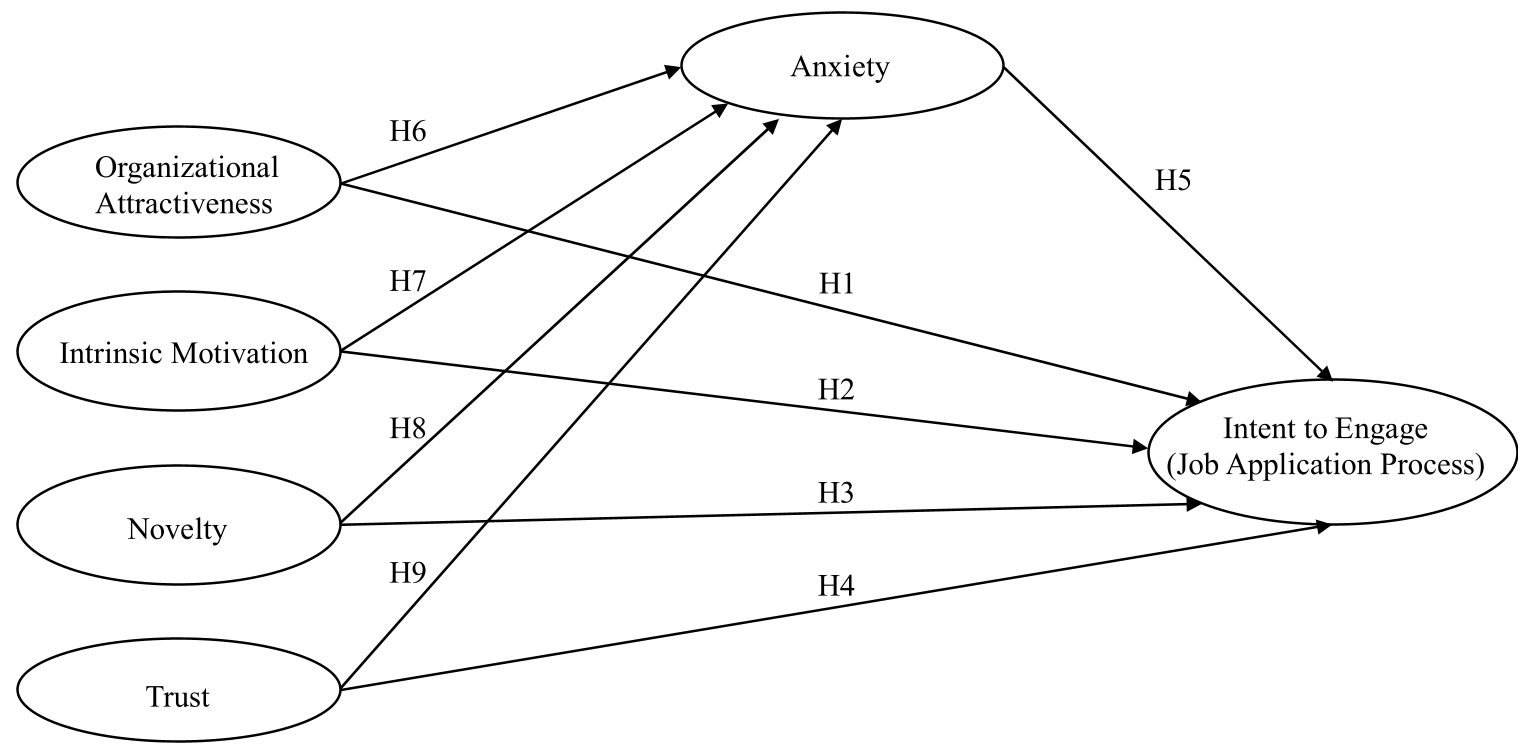
Figure 1: The theoretical model testing the influence of Organizational Attractiveness, Intrinsic Motivation, Novelty, Trust, and Anxiety on the intent to engage with AI processes.
Key Finidings: What Actually Moves the Needle?
The results provided several counter-intuitive insights for the tech-driven HR industry:
- The Power of Intrinsic Motivation: Candidates are most likely to complete an application if they feel the process itself is rewarding or "fun" ().
- The Trust Paradox: Interestingly, Trust did not have a significant direct effect on the intent to complete the application. Trust only mattered when it was filtered through Anxiety. If a candidate isn't anxious, high or low trust in the AI's dependability has surprisingly little impact on their willingness to apply.
- Anxiety as the Mediator: Anxiety significantly dampens the positive vibes generated by a "cool" organizational image. It effectively "steals" the mental bandwidth required to process a firm's innovative signals.
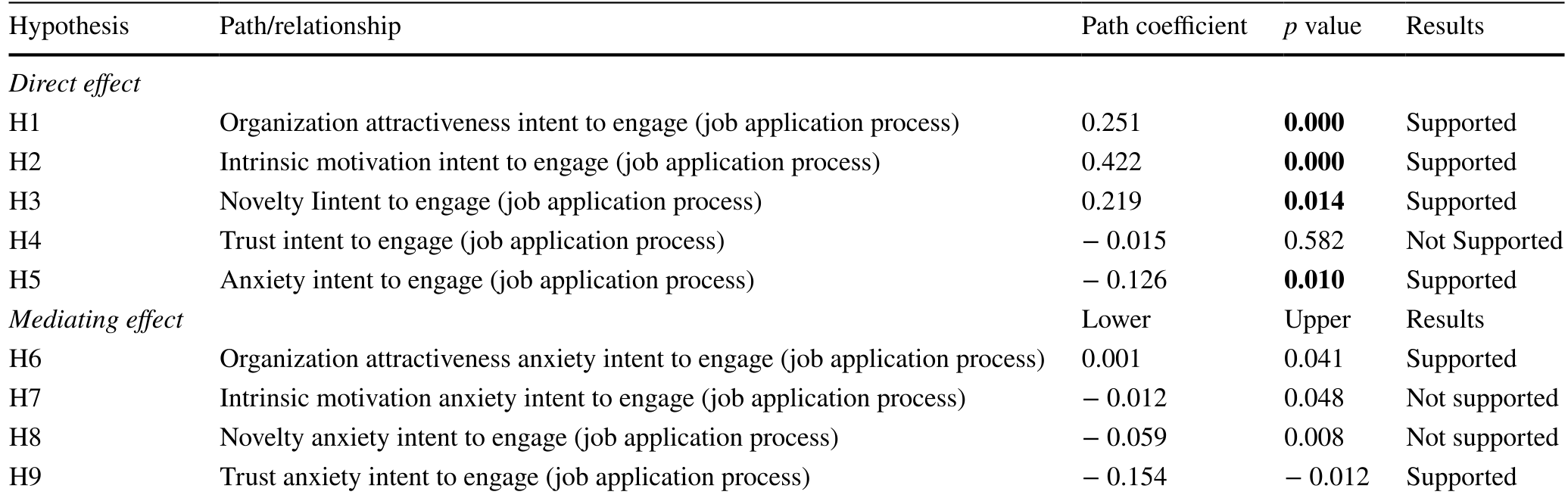
Table 3: Statistical path coefficients showing which factors supported the researchers' hypotheses.
Actionable Insights for Tech Leaders
- Don't Hide the AI—Market It: If your target audience values innovation, highlight the AI as a sign of being a "leading-edge" employer.
- Gamify the Experience: To boost intrinsic reward, use interactive elements (like cognitive games) rather than static, bot-led interrogation.
- The "Safety Net" Protocol: To lower anxiety, explicitly state that a human manager reviews the final output and that "protected characteristics" (age, race, gender) are treated as neutral by the system.
Conclusion
The paper concludes that while investment in AI recruiting is skyrocketing (hitting $50B+ levels), the human element remains the bottleneck. To win the talent war, companies must design AI systems that don't just "process" candidates, but "attract" them by reducing friction and spark curiosity.
Future Outlook
While this study used cross-sectional data, the next frontier is neuroimaging—understanding the literal brain-state of a candidate as they interact with a hiring bot. As researchers catch up to practice, the goal is clear: building AI that feels less like a cold gatekeeper and more like an inviting entry point.