
The Weakness of Too Many Ties: Why Your 500+ LinkedIn Connections Might Be Hindering Your Career
Getting a job via career-oriented social networking markets The weakness of too many ties
This research paper presents an extension of the UTAUT2 model to investigate job search success within Career-oriented Social Networking Markets (CSNM) like LinkedIn and XING. By integrating the "Number of Contacts" as a key variable, the author discovered a significant non-linear relationship where excessive ties actually hinder job offer success, achieving a model predictive quality (R²) of 80.5%.
TL;DR
Is a massive professional network always an asset? Specifically focusing on Career-oriented Social Networking Markets (CSNM) like XING and LinkedIn, this research by Ricardo Buettner challenges the "more is better" dogma. By extending the UTAUT2 model, the study finds that the peak efficiency for getting job offers sits at approximately 157 contacts. Beyond this "Dunbar’s Number" threshold, the quality of your network degrades into "noisy information," leading to a sharp decline in actual job offer success.
Problem & Motivation: The "More is Better" Fallacy
For years, we’ve been told that social capital is a numbers game. Theories like Metcalfe’s Law suggest that the value of a network increases with every new member. However, professional headhunters have long suspected a "noise" factor in massive contact lists.
The author identifies a critical gap: traditional technology acceptance models (like TAM or UTAUT) explain why we use a site, but they don't explain if that usage actually results in a job. The motivation here was to bridge the gap between Technology Acceptance and Social Network Theory, specifically questioning if "collecting contacts" is a productive use of time or merely an "illusion of community."
Methodology: Extending UTAUT2
The researcher surveyed 523 participants and applied Partial Least Squares Structural Equation Modeling (PLS-SEM). The core innovation was treating "Number of Contacts" not just as a result of usage, but as a predictor of success.
The Research Model
The study integrated classic drivers (Performance Expectancy, Habit, Facilitating Conditions) with social metrics.
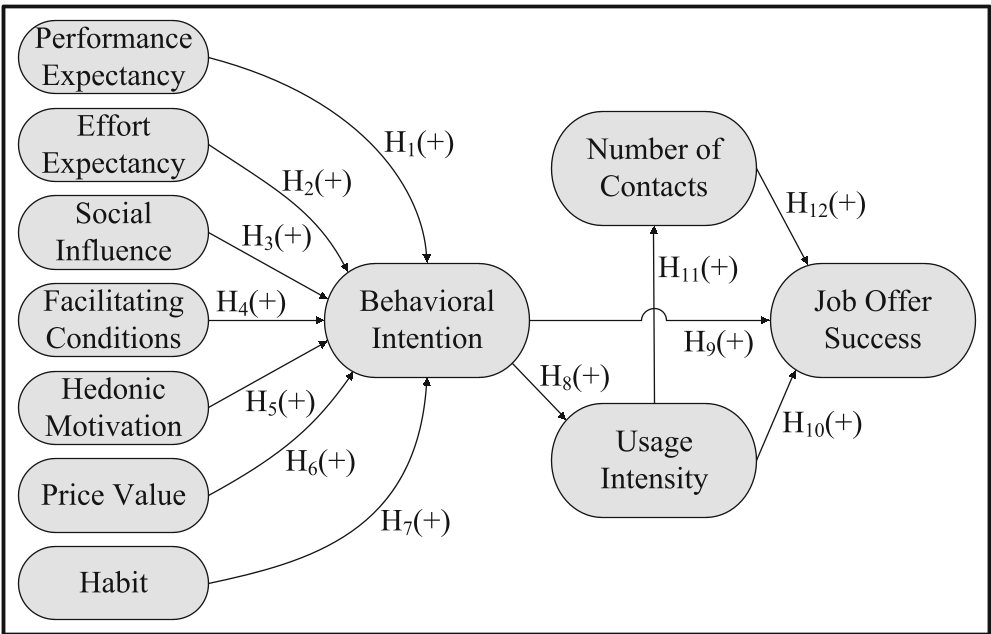
Surprisingly, the study found that:
- Facilitating Conditions (having the resources/knowledge) and Habit are the strongest drivers of intention to use these sites for job searching.
- Social Influence and Price Value had negligible effects, suggesting job seekers are driven more by routine and ability than by peer pressure.
The Dunbar Peak: Quality over Quantity
The most striking finding is the non-linear relationship between network size and success.
The 157-Contact Threshold
As shown in the data below, job offer success rises rapidly until it hits a peak at roughly 157 contacts. This almost perfectly mirrors Dunbar’s Number (150)—the theoretical cognitive limit to the number of people with whom one can maintain stable social relationships.
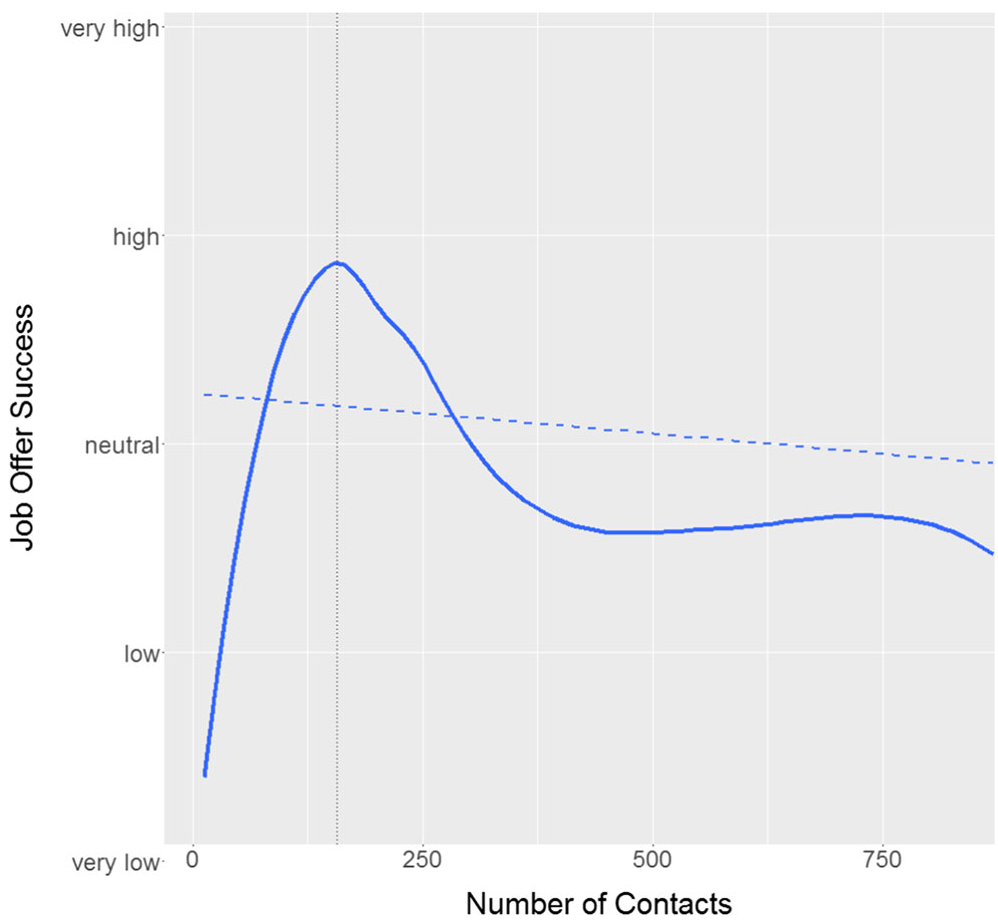
When a user exceeds 400 contacts, their "Job Offer Success" score drops below the neutral point. Why?
- Signaling Theory: Too many contacts may signal to recruiters that the user is a "random collector" rather than a focused professional.
- Tie Strength: After 150 ties, the "weak ties" become "empty ties." You lose the ability to effectively leverage the network because the relationships lack even the basic level of mutual recognition required for a referral.
Experimental Results & SOTA Comparison
By adding the "Number of Contacts" variable, the model’s explanatory power for job success jumped from a mediocre 19.0% to a robust 80.5%.
| Metric | Original UTAUT2 | Extended Model (This Paper) |
|---|---|---|
| Predictive Quality (R²) | 19.0% | 80.5% |
| Key Driver of Intention | Performance Expectancy | Facilitating Conditions & Habit |
| Impact of High Tie Count | Unmeasured | Negative (p = -0.521) |
This suggests that scholars who ignore the structural characteristics of a user's network are missing 60% of the picture when evaluating the success of career platforms.
Critical Analysis & Conclusion
Takeaways for Professionals
- Prune Your Network: If you are nearing 500+ contacts on LinkedIn, your profile might be becoming "noisy."
- Focus on Facilitating Conditions: Success is driven by knowing how to use the search and networking features effectively, not just by how often you log in.
Limitations & Future Outlook
The study primarily looked at XING (popular in DACH regions) and relied on self-reported success. Future research should leverage API data from LinkedIn to see if these "Dunbar Limits" hold true across different cultures and industries.
Final Insight: The "Strength of Weak Ties" is real, but there is a "Weakness of Too Many Ties." In the digital age, the most valuable skill isn't just connecting—it's knowing when to stop.
Reference: Buettner, R. (2017). Getting a job via career-oriented social networking markets: The weakness of too many ties. Electronic Markets.