
Predicting the Pulse of a Supercomputer: Power-Aware Job Classification via Log Analysis
Job Classification Through Long-Term Log Analysis Towards Power-Aware HPC System Operation
The paper presents a comprehensive study on HPC job classification using long-term log analysis from the K computer. It introduces a machine learning-based framework to categorize jobs into high and low power consumers to optimize power-aware scheduling for the supercomputer Fugaku.
TL;DR
To ensure stable operations for the next-generation supercomputer Fugaku, researchers from RIKEN and Fujitsu analyzed two years of logs from the legendary K computer. By leveraging machine learning, they successfully classified HPC jobs into different power-consumption profiles based on their I/O and computational intensity, achieving classification accuracy (F1-score/PR-AUC) as high as 0.96.
The Power Wall in Exascale Computing
As we push toward Exascale performance, the sheer volume of power consumed by millions of CPU cores and massive storage subsystems becomes a management nightmare. The primary risk? Hot-spots. If a scheduler inadvertently clusters power-hungry, computation-intensive jobs together, it can exceed the local power supply capability or thermal limits, leading to system instability or hardware degradation.
Historically, system administrators relied on simple heuristics. However, the diverse nature of HPC workloads—ranging from computation-heavy simulations to I/O-intensive data processing—requires a more nuanced approach. The authors hypothesized that by looking at historical job stats, we could predict a job's "power fingerprint" before it even starts.
Methodology: From Correlation to Classification
1. The Correlation Insight
The researchers analyzed several key metrics:
- RF (FLOPS Ratio): Computational intensity.
- RM (Memory Bandwidth Ratio): Data movement intensity.
- RD/RI/O: File system I/O intensity.
- P_max: Predicted peak power per node.
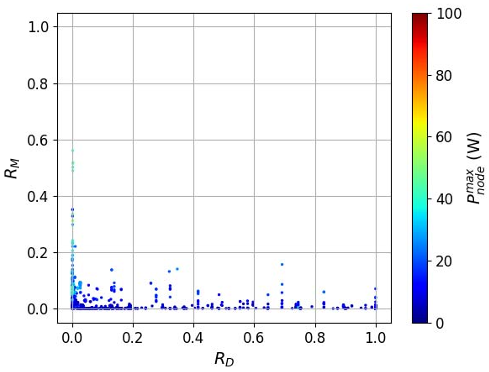
The "Aha!" moment came from observing the inverse relationship between I/O and Power. Generally, when a job is waiting on I/O (high RD), the CPU utilization (RF) and memory bandwidth (RM) drop, leading to lower power consumption. This negative correlation is particularly visible in specific 3D node layouts where I/O interference is minimized.
2. Machine Learning Framework
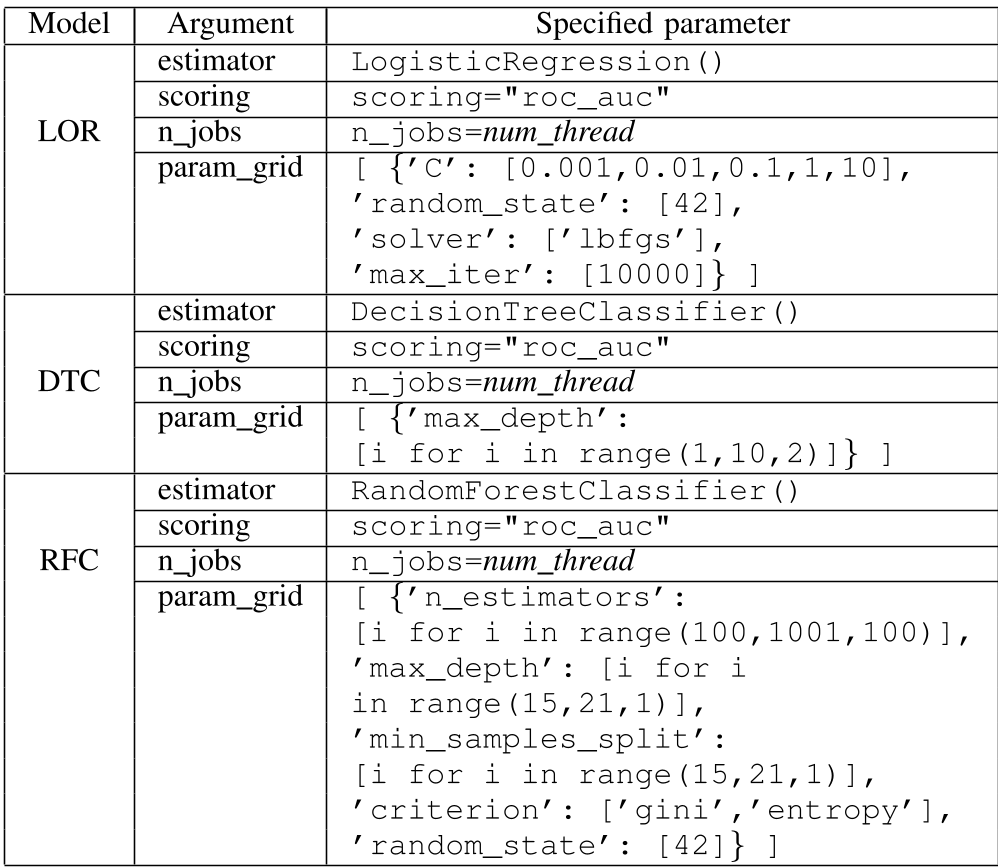
The paper evaluates three primary models to classify jobs as "High Power" (≥60W or ≥30W) or "Low Power":
- Logistic Regression (LOR): A baseline linear approach.
- Decision Tree Classifier (DTC): To capture non-linear decision boundaries.
- Random Forest Classifier (RFC): An ensemble method to improve robustness and accuracy.
Because high-power jobs are relatively rare in the dataset, the authors used PR-AUC (Precision-Recall Area Under Curve) to ensure the models weren't just guessing the majority class.
Experimental Battleground: Which Model Wins?
The results were clear: Random Forest is King.
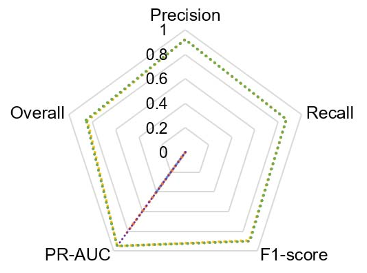
In the 1D job layout (the most common), the RFC model achieved an overall score of 0.96, significantly outperforming Logistic Regression, which struggled unless multiple metrics were combined. Even in more complex scenarios (the 30W threshold), RFC maintained a strong score of 0.86.
- Key Finding: Just two metrics—FLOPS (RF) and Memory Bandwidth (RM)—are often sufficient to predict power consumption with high accuracy. Adding I/O data (RD) provides a marginal "polish" to the results but isn't always strictly necessary for a baseline prediction.
Critical Insight & Future Outlook
This work demonstrates that the "Ghost of K Computer" still has much to teach us. By using historical logs to train models for Fugaku, the researchers have paved the way for "Power-Aware Scheduling."
The Takeaway: Future HPC schedulers should not be "black boxes" that only look at node counts. They must become application-aware. By predicting whether a job is an "Energy Hog" or an "I/O Specialist," we can interleave them on the system grid to balance the load, much like a tetris game where the goal is thermal and electrical equilibrium.
Limitations: The study relies on thermal-derived power predictions because the K computer lacked per-node power meters. While Fugaku has built-in hardware sensors, the methodology of using RM and RF as proxies remains a highly valid and efficient shortcut for real-time classification.
Conclusion
The transition from the K computer to Fugaku marks a shift from "raw power" to "intelligent power." This research proves that machine learning isn't just for the applications running on the supercomputer—it's essential for the software running the system itself.