
P2CF: Solving the Graduate Job Search Dilemma with Campus Big Data and Personalized CF
Job recommendation algorithm for graduates based on personalized preference
The paper proposes P2CF (Personalized Preference Collaborative Filtering), a hierarchical job recommendation algorithm specifically designed for new graduates. It combines graduate group clustering based on campus big data with Bayesian Personalized Ranking (BPR) to overcome the lack of historical employment records, achieving a Hit Ratio (HR) twice that of traditional CF methods.
TL;DR
Finding a first job is a daunting task for graduates who lack work experience and professional networks. The P2CF (Personalized Preference Collaborative Filtering) algorithm addresses this by using Campus Big Data—such as canteen consumption and grades—to cluster students and recommend jobs. It moves beyond simple resume matching by incorporating deep preferences for job locations and employer types, doubling the accuracy (Hit Ratio) of standard recommendation models.
The Problem: The "Cold Start" of Career Paths
Traditional recommendation systems, like those used by Netflix or Amazon, rely on your history. If you've never had a job, how can an algorithm know what you'd like?
- The Cold Start Trap: Most graduates have zero occupational history.
- Subjectivity: Resumes and questionnaires are self-reported and often biased or inaccurate.
- Preference Neglect: Standard models often ignore "soft" factors like a student’s desire to stay close to home or their family's economic pressure to find high-paying (but perhaps less stable) roles.
Methodology: The P2CF Framework
The P2CF algorithm operates in two distinct phases to turn "Campus Big Data" into actionable insights.
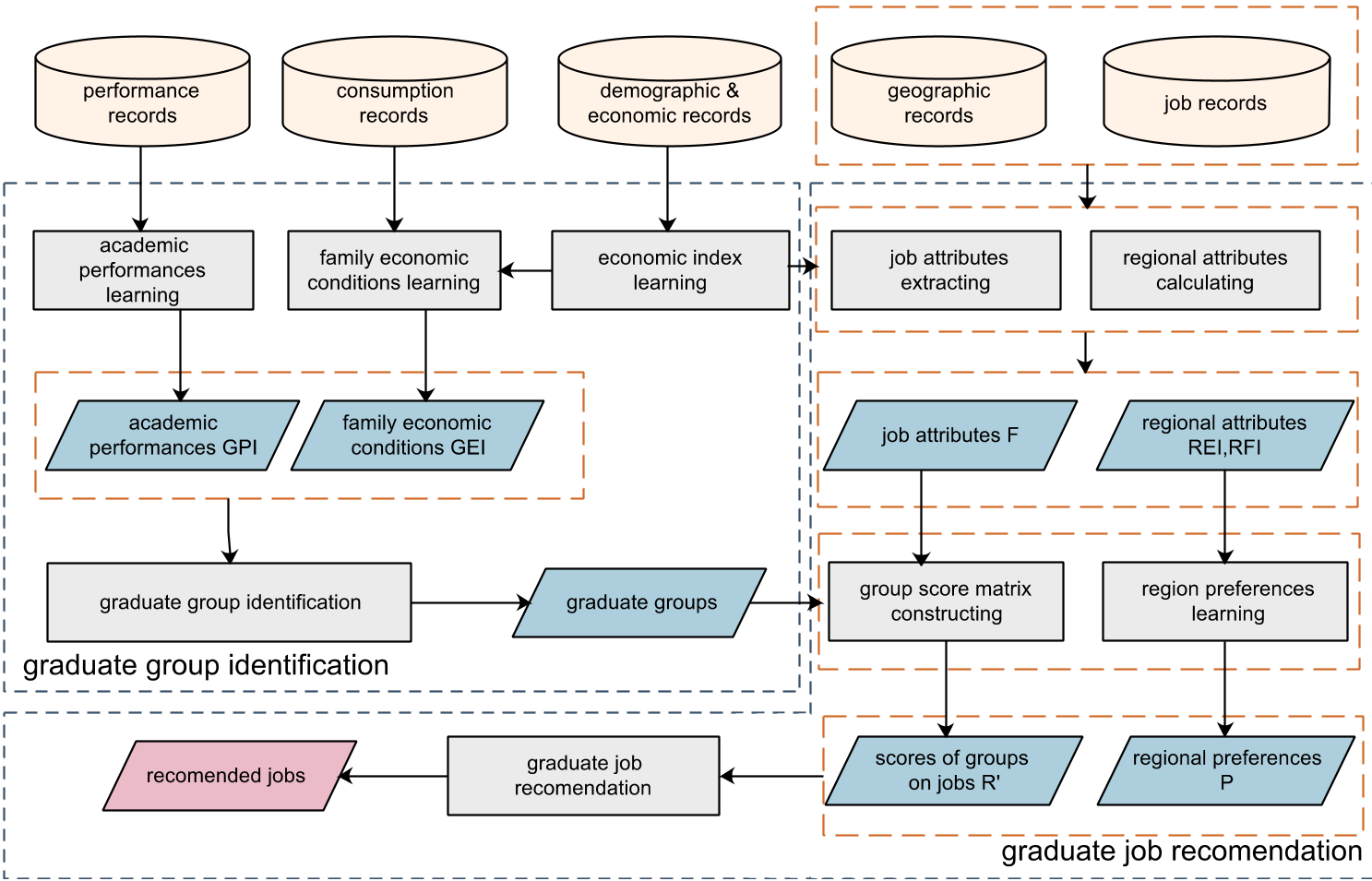
1. Objective Group Identification
Instead of asking students what they are good at, the model looks at:
- GPI (Academic Performance Index): Derived from grades and failed course counts.
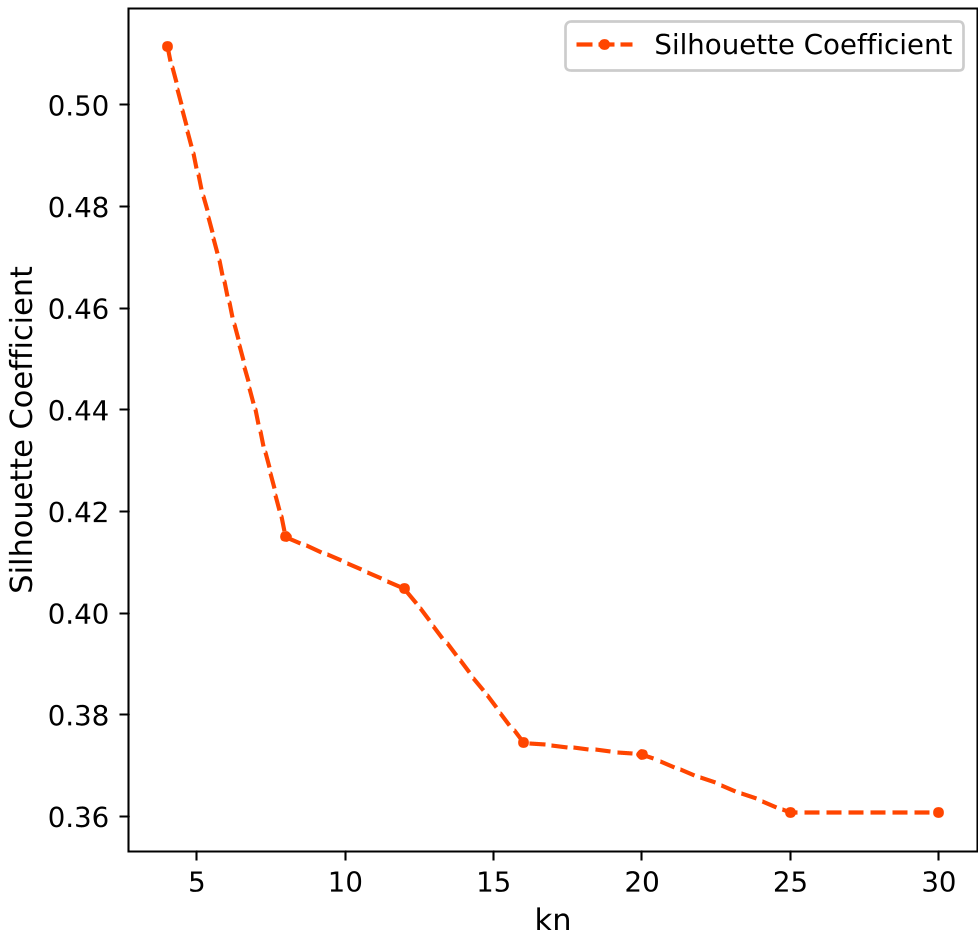
- GEI (Family Economic Index): Inferred from campus card consumption patterns (e.g., frequency of eating at the canteen vs. average cost per meal). By using K-means clustering, the authors group graduates into 20 archetypes (e.g., "High-performing, wealthy males" or "Average-performing, economically constrained females").
2. The Hierarchical Scoring Model
The core of P2CF is its scoring function, which combines three unique components:
- Latent Factor Model (BPR): Predicts what a group is likely to choose based on historic data from similar graduates.
- Job Attribute Preference (A): Maps preferences for specific sectors like "Civil Servant" or "Engineer."
- Job Location Preference (P): Uses a Multivariate Gaussian distribution to model the trade-off between Regional Economic Index (REI) and Regional Familiarity Index (RFI).
Experiments and Insights
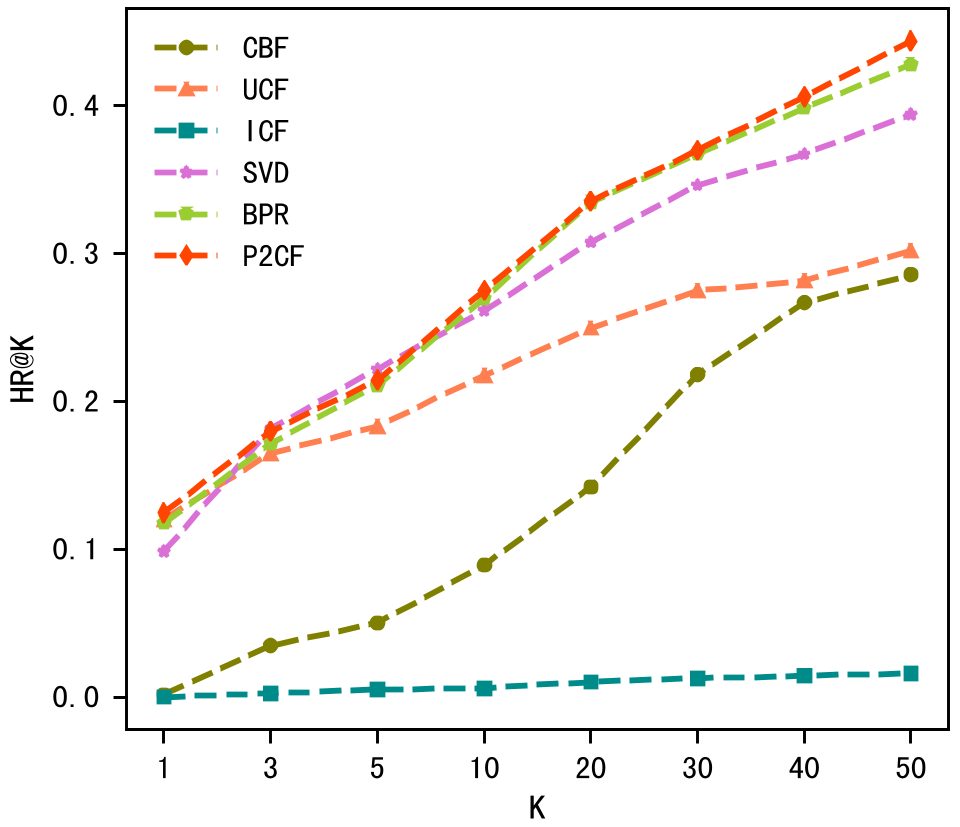
The researchers tested P2CF against standard baselines like SVD (Singular Value Decomposition) and standard BPR.
Key Performance Metrics
P2CF achieved a Hit Ratio of 44.37% at K=50, outperforming Content-Based Filtering (CBF) by nearly 2x. This proves that "group behavior" is a much stronger predictor of job success for graduates than simple keyword matching in resumes.
Visualizing Preferences
The study revealed fascinating socio-economic patterns:
- Location vs. Gender: Female graduates showed a much higher preference for "Familiar Regions" (RFI), whereas male graduates were more willing to move to unfamiliar but economically developed cities (REI).
- Economic Status: Students with higher GEI (wealthier) were significantly more likely to choose "Going Abroad" or "Further Study" over immediate employment.
Critical Analysis & Conclusion
The true innovation of P2CF lies in its data source. By treating campus life as a simulation of professional behavior, the authors find a proxy for the missing "history" of the user.
Limitations: The current model is heavily localized to the Chinese recruitment ecosystem (focusing on State-owned enterprises vs. Private). Its performance might vary in Western markets where the job-hunting culture is less centralized around "campus recruitment" seasons.
Future Work: Integrating real-time sentiment analysis from social media or internships could further refine the "Personalized Preference" component. However, as it stands, P2CF is a SOTA framework for career centers looking to automate and improve the accuracy of graduate placements.