
Job Recommendation with Hawkes Process: Decoding the Winning Strategy of RecSys 2016
Job recommendation with Hawkes process: an effective solution for RecSys Challenge 2016
This paper presents the winning solution for the RecSys Challenge 2016, focusing on job recommendation for the professional social network Xing. The authors proposed a hierarchical ensemble framework that integrates semantic relevance, temporal user patterns via Hawkes Processes, and a semantic-based strategy for cold-start users and items.
Executive Summary
In the world of professional networking, timing is everything. Recommending a job to a user who just started a new role is a wasted impression, while missing a user in an active search phase is a lost opportunity. This paper, authored by a team from Alibaba Group, details the winning approach for the RecSys Challenge 2016. By treating user-item interactions not just as binary signals but as a temporal sequence of events, they built a system that captured both "what" a user wants and "when" they want it.
The Core Challenge: Beyond Static Matching
Most recommendation systems rely on Collaborative Filtering (CF) or Content-Based filtering. While effective, these methods often suffer from:
- Temporal Neglect: They don't account for the fact that user interests fluctuate over time.
- Data Sparsity: With millions of jobs and users, the interaction matrix is mostly empty.
- The Cold Start Wall: New job postings and new users have zero history, rendering behavior-based models useless.
The Alibaba team recognized that job seeking is a self-exciting process. A single click often triggers a flurry of related activities (bookmarks, applications) within a short window.
Methodology: The Hierarchical Ensemble
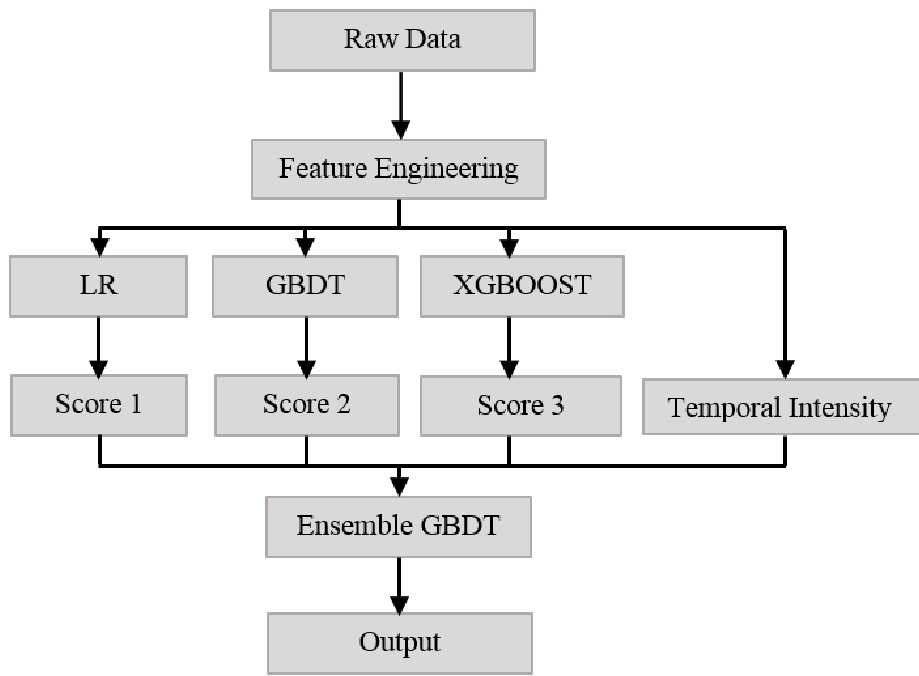
The architecture is a sophisticated two-layer stack designed for maximum robustness and accuracy.
1. The Multi-Model Layer
The first layer acts as a feature extractor. It employs a diverse set of learners:
- Logistic Regression: For linear baselines.
- GBRT & XGBoost: To capture non-linear interactions between professional attributes (Education, Experience, Industry).
- Pairwise Ranking: Instead of predicting a "score," the model learns to rank clicked items above deleted ones, which aligns perfectly with the competition's evaluation metric.
2. The Temporal Layer (The "Secret Sauce")
This is where the Hawkes Process comes in. A Hawkes Process is a self-exciting point process where past events increase the probability of future events.
The team modeled the intensity as: Where:
- is the base interest.
- is the self-exciting coefficient.
- captures the decay over time.
By using a low-rank structure, they could estimate the "temporal intensity" even for user-item pairs that had never interacted before, effectively predicting the momentum of user interest.
Tackling the Cold Start
To handle the "new user" problem, the team pivoted to a Semantic Based Strategy:
- Topic Modeling (LDA): Extracting latent professional interests from job descriptions and CVs.
- TF-IDF & Jaccard Similarity: Comparing the overlap between user profiles and job tags.
- Two-way Nearest Neighbor: Bridging the gap between content and behavior.
Experiments and Results
The evaluation focused on Precision at K (P2, P4, P6, P20) and Recall. The team's strategy delivered a "full score" performance on the leaderboard.
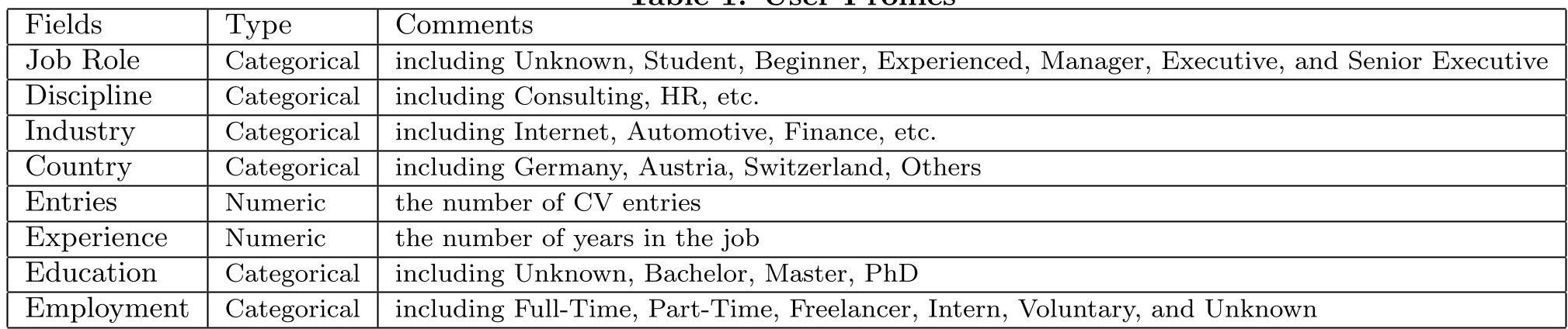 Table 1: Key categorical and numeric features used in the first-layer boosting models.
Key findings from their success:
- Ensemble Power: Combining XGBoost with temporal features provided a significant boost over single-model approaches.
- Behavioral Dynamics: The Hawkes Process feature was pivotal in identifying "active" seekers vs. "passive" browsers.
Critical Insight & Conclusion
This paper is a masterclass in Feature Engineering meets Stochastic Processes. While modern RecSys research has shifted heavily toward Graph Neural Networks (GNNs) and Transformers, the fundamental insight here remains evergreen: Time is a first-class citizen in recommendation.
Limitations: The Hawkes process assumes a specific decay function (usually exponential), which might not capture extremely long-term career cycles (e.g., the "7-year itch"). However, for the 1-week prediction window of the challenge, it proved to be the winning edge.
Future Outlook: Integrating Hawkes Processes into the attention mechanisms of Transformers (e.g., Temporal Point Process Transformers) is currently a high-impact research area that directly descends from the logic presented in this winning 2016 strategy.