
Job Recommendation with Hawkes Process: Mastering the Art of Timing in RecSys
Job recommendation with Hawkes process: an effective solution for RecSys Challenge 2016
This paper presents the winning solution for the RecSys Challenge 2016, focusing on job recommendation for the Xing platform. The authors propose a hierarchical ensemble framework that integrates content-based features, behavioral signals, and a temporal point process—specifically the Hawkes Process—to achieve SOTA performance on the leaderboard.
TL;DR
RecSys Challenge 2016 presented a complex task: predicting which job postings users would click on within a career-oriented social network (Xing). The winning solution from Alibaba Group bypasses the limitations of static collaborative filtering by introducing a hierarchical ensemble framework that treats time as a first-class citizen. By leveraging the Hawkes Process to model self-exciting temporal intensities, the team achieved the #1 spot on the global leaderboard.
Problem & Motivation: Beyond Static Matching
Most recommendation systems treat user behavior as a static collection of interests. In the job market, however, interest is highly bursty. A user might ignore job postings for months and then suddenly interact with several in a single week.
Existing SOTA methods at the time suffered from:
- Data Sparsity: User-item interaction matrices are extremely empty.
- Ignoring Recency: A click from six months ago is weighted similarly to a click from yesterday.
- Cold Start: How to recommend a brand-new job posting to a brand-new user?
The Alibaba team hypothesized that the "when" is just as important as the "what." They sought to transform the recommendation problem from a binary classification task ("will they click?") into a temporal intensity estimation task ("when will they click next?").
Methodology: The Hierarchical Powerhouse
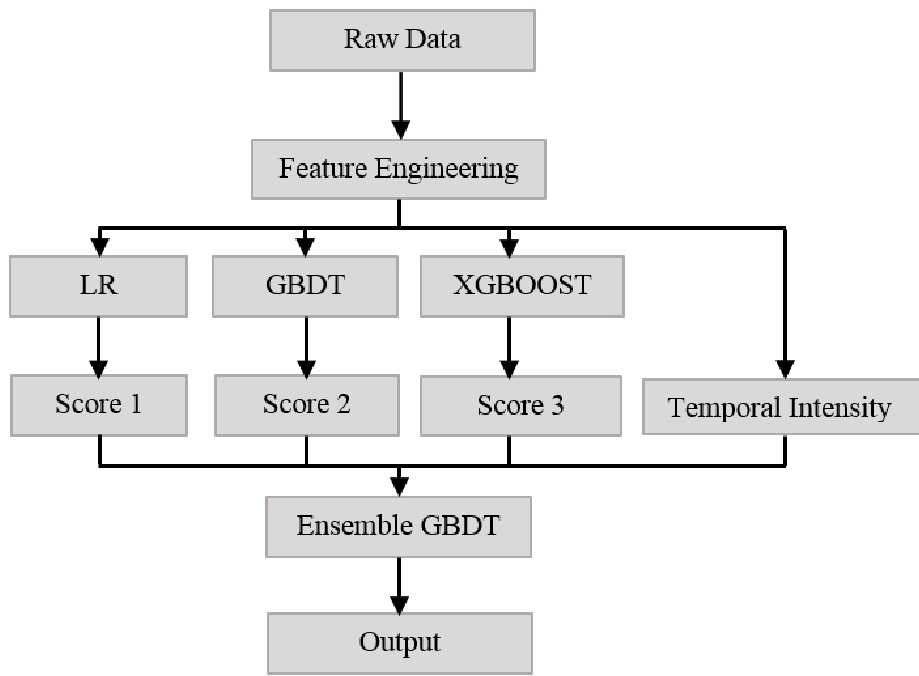
The architecture is split into two distinct layers, ensuring that different types of patterns (behavioral vs. semantic) are captured and reconciled.
1. The Ensemble Framework
Instead of relying on a single "silver bullet" model, the authors built a two-layer hierarchy:
- Layer 1 (The Base Learners): Utilizes Logistic Regression, GBDT, and XGBoost to generate initial relevance scores. They even developed a custom pairwise version of GBDT to better handle the "Learning to Rank" objective.
- Layer 2 (The Meta-Learner): An ensemble layer that takes the scores from Layer 1 and fuses them with temporal intensity features.
2. The Hawkes Process: Modeling the "Itch"
The standout feature of this work is the use of the Hawkes Process. A Hawkes Process is a self-exciting point process where past events increase the probability of future events in the near term.
The conditional intensity is defined as:
- : The baseline "long-term" interest.
- : The "self-exciting" term where each past interaction increases the likelihood of a new interaction, decaying over time.
By imposing a low-rank structure on the intensity matrices, the authors could transfer "temporal patterns" from active users to sparser ones, effectively predicting the probability of interaction for unseen user-item pairs at a specific moment in time.
3. Solving the Cold Start
To handle the 580,000 new users in the dataset, the team pivoted to a Semantic Hybrid Approach:
- Feature Engineering: Bag-of-Words (BoW) representations for job roles and tags.
- Topic Modeling: Using LDA (Latent Dirichlet Allocation) to map users and jobs into a shared latent space.
- Similarity Measures: Jaccard and Cosine similarity facilitated a two-way nearest neighbor search.
Experiments & Results: The Winning Edge
The challenge used a complex evaluation metric weighing Precision (at K=2, 4, 6, 20), Recall, and "User Success" (hits within the top 30).
The data was massive:
- 1.5 Million Users
- 1.35 Million Job Posts
- 8.8 Million Interactions
The team's success was rooted in the diversity of features:
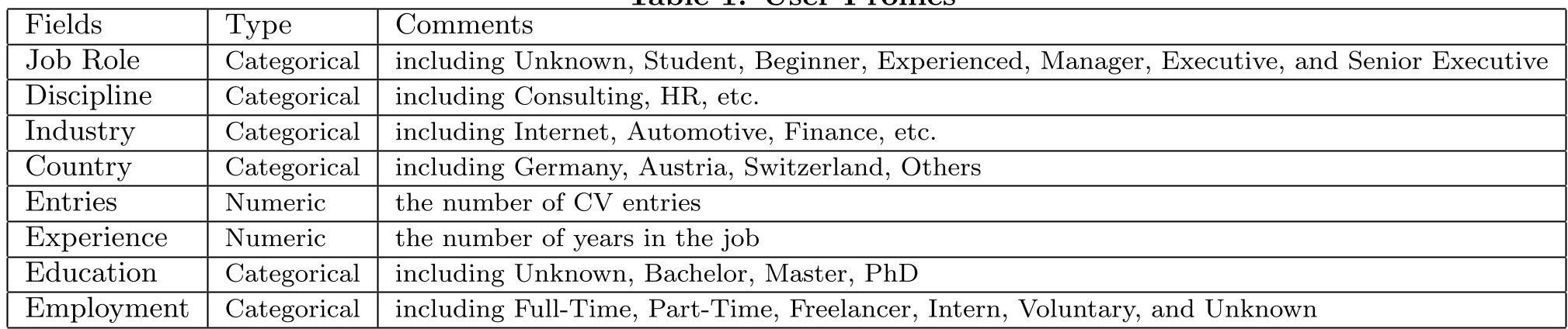
- User/Post features: Demographic and categorical data (converted to binary/numeric).
- User-Post interactions: Behavioral matrices capturing "clicks," "bookmarks," and "replies."
- Temporal Features: The intensity scores derived from the Hawkes Process.
| Field | Type | Comments |
|---|---|---|
| Job Role | Categorical | Career level (Student to Senior Executive) |
| Experience | Numeric | Years in job |
| Education | Categorical | Degree level |
The combined strategy achieved the highest full score on the leaderboard, proving that integrating temporal dynamics provides a significant uplift over static content matching.
Critical Insight & Conclusion
The beauty of this solution lies in its balance. While many contestants likely focused purely on gradient boosting (XGBoost), the addition of the Hawkes Process allowed the Alibaba team to model the fluidity of human intent.
Key Takeaways for Practitioners:
- Ensemble is King: Multiple weak learners addressing different aspects (linear vs. non-linear) provide the stability needed for competition-grade results.
- Time is a Signal, Not Just a Filter: Don't just filter by "last 30 days." Use mathematical models like Point Processes to quantify the decay and recurrence of intent.
- Semantic Fallbacks: For cold starts, simple NLP techniques (TF-IDF, LDA) paired with nearest-neighbor searches are still more robust than trying to force a behavioral model to guess.
The discrepancy between offline metrics and online A/B testing remains a challenge, but this work provides a robust blueprint for intent-heavy recommendation tasks.