
Beyond FCFS: Boosting Mesh Multicomputer Performance via Reservation-Based Scheduling
Job scheduling in mesh multicomputers
This paper introduces a novel dynamic job scheduling strategy for mesh-connected multicomputers that integrates submesh reservation with a priority-based aging mechanism. By combining these two techniques, the approach significantly mitigates the "blocking" issues inherent in standard FCFS policies, achieving SOTA performance in throughput and processor utilization.
TL;DR
In the world of mesh-connected supercomputers (like the Intel Paragon or Cray T-3D), the way we schedule jobs is just as important as where we place them. This paper breaks the traditional First-Come-First-Serve (FCFS) bottleneck by introducing a Reservation and Priority-based scheduler. By allowing smaller jobs to "jump the queue" and others to "reserve" future space, it slashes waiting times by up to 98% without causing job starvation.
The Problem: The "Big Job" Blockade
Imagine a 2D grid of processors. A user requests a huge 8x8 submesh, but only a 7x8 area is free. In a standard FCFS system, this job sits at the head of the line, blocking every other incoming request—even if those requests only need a single processor and could run immediately. This is temporal fragmentation.
Prior research focused heavily on Submesh Allocation (finding the best coordinates for a job to reduce spatial gaps), but they all used FCFS for scheduling. The authors argue that even the best allocator is crippled by a poor scheduler.
The Core Insight: Reservation + Priority
The authors propose a two-pronged attack on temporal fragmentation:
1. The Reservation Mechanism
If a job cannot be allocated immediately, the system looks for the "best" submesh to reserve.
- Minimum Free Processors: It chooses a spot that minimizes the number of idle processors that will be blocked while waiting for the reservation to clear.
- Overlap Optimization: It prefers spots that overlap with the fewest currently running jobs to ensure the submesh becomes free sooner.
- The FREE_FRAC Guard: To prevent the system from idling too many resources, a reservation is only granted if the ratio of free-but-blocked processors is below a threshold (
FREE_FRAC).
2. The Priority (Aging) Mechanism
To prevent "starvation" (where a massive job is bypassed forever by small jobs), they introduce MAX_PRI.
- Every time a newer job skips ahead of the oldest job in the queue, a counter (
no_supercede) increments. - Once this counter hits
MAX_PRI, the scheduler stops all new allocations/reservations until the "old person" in the queue is served.
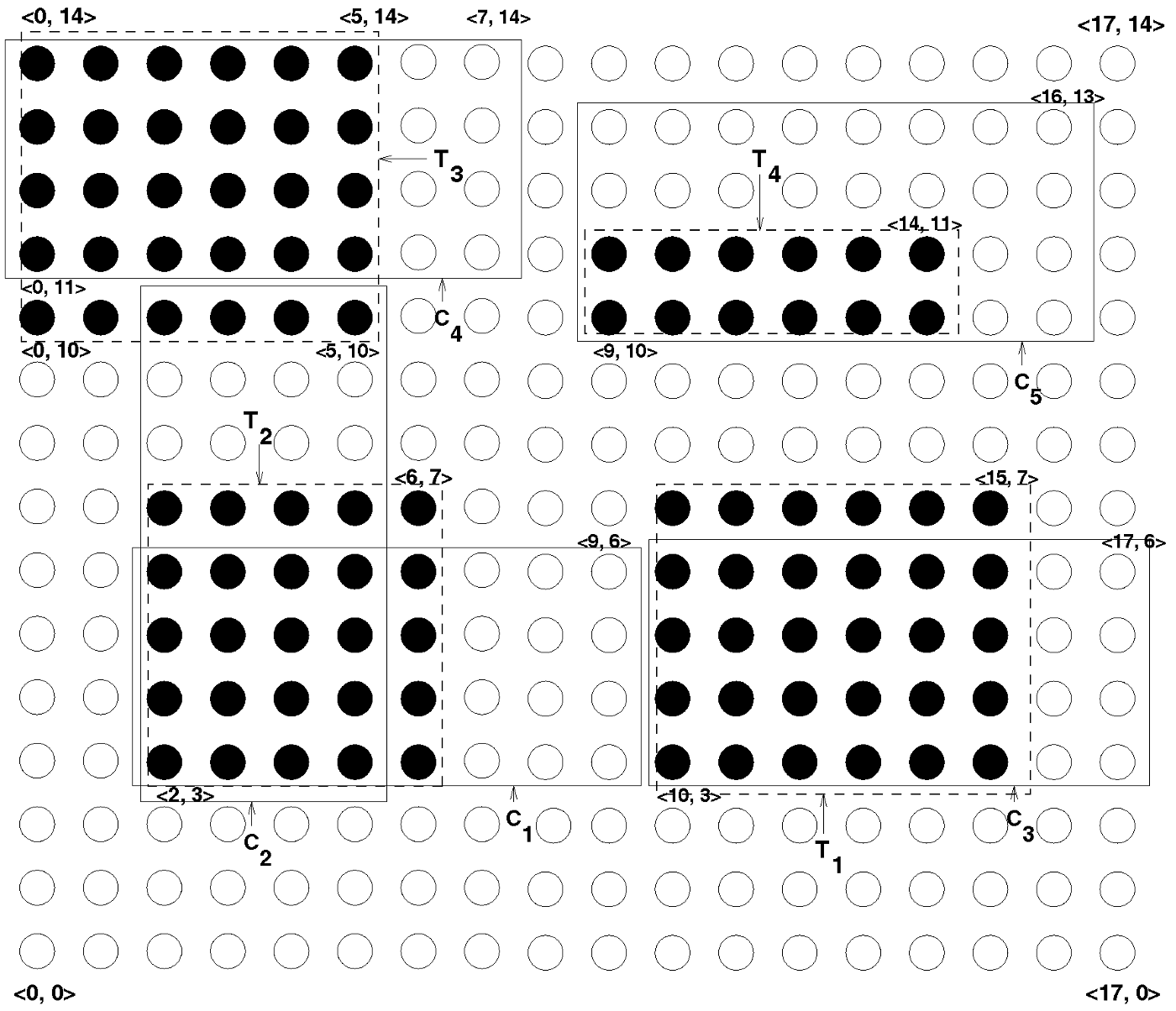 Figure 1: Comparison of candidate submeshes for reservation, balancing overlap and free processor idling.
Methodology: The Three-Phase Deallocation
The real "magic" happens when a job finishes and releases its processors. The scheduler doesn't just look at the head of the queue; it executes a three-phase recovery:
- Direct Allocation: Check if any reserved jobs can now run because their specific submesh is now free.
- Optimistic Allocation: See if other reserved jobs can be "relocated" to the newly freed area.
- Queue Processing: Try to allocate or reserve the oldest jobs from the waiting list in the remaining space.
Experimental Results: A 98% Reduction in Delay
The authors compared their method against FCFS across various mesh sizes and traffic loads.
- Waiting Time: In high-utilization scenarios, the average delay dropped by 68% to 80% on average, reaching over 98% in hyperexponential distributions.
- Stability: Unlike FCFS, which "saturates" (waiting times go to infinity) at relatively low loads, the Reservation-based scheme keeps the system responsive at much higher utilization levels.
- Low Overhead: Despite the added complexity, the "Busy-List" implementation keeps allocation time nearly constant regardless of mesh size.
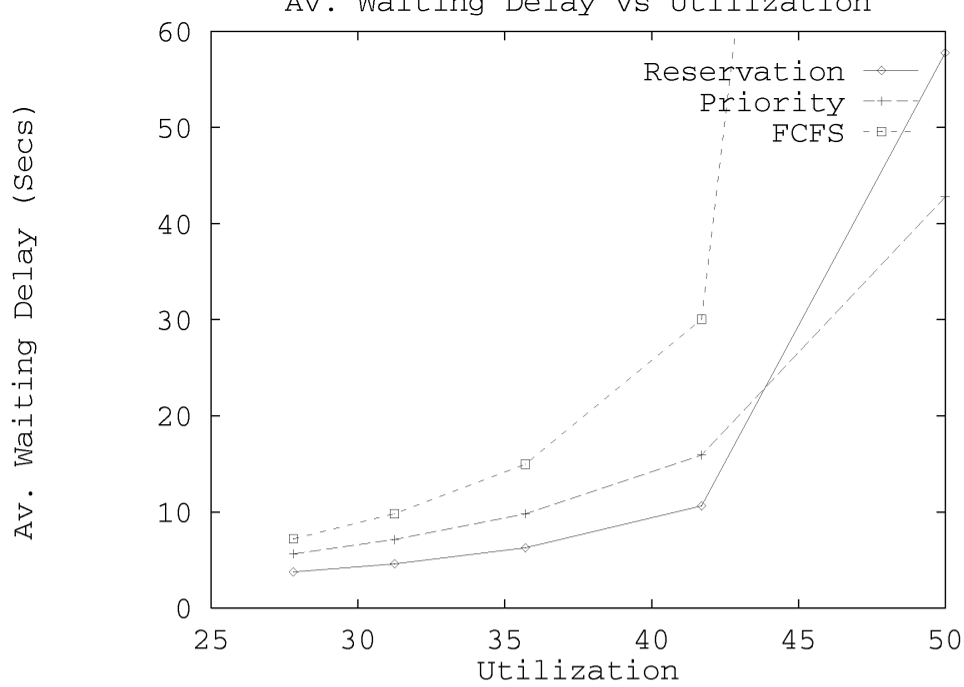 Figure 2: Average delay vs. utilization. Note how FCFS (upper curve) spikes much earlier than the Priority and Reservation schemes.
Critical Perspective
Why it works
The genius of this paper is the parameterization of fairness. By adjusting FREE_FRAC and MAX_PRI, a system admin can decide exactly how much "unfairness" (allowing jobs to skip ahead) they can tolerate to maximize throughput. It proves that strict FCFS is actually less fair to the community because it makes everyone wait longer on average.
Limitations
While highly effective for 2D meshes of that era, modern high-performance computing (HPC) often deals with non-contiguous allocation (where a job doesn't need a perfect rectangle). The authors mention this could be extended, but the physical constraints of 1990s hardware interconnects made contiguity a more pressing issue then than it is in some modern virtualized environments.
Conclusion
This work remains a seminal example of how Time Compaction (reordering jobs) is a powerful lever for system performance. It reminds us that in complex resource management, "first come" isn't always "best served."