
Enhancing JSSP Solvers: The Synergy of Neural Networks and Dispatching Rules
13444_Job Shop Scheduling Problem Neural Network Solver with Dispatching Rules.
This paper presents a hybrid Artificial Neural Network (ANN) solver for the Job Shop Scheduling Problem (JSSP) that leverages classical Dispatching Rules to resolve operation priority ties. By training a multi-layered perceptron (MLP) on optimal GA-generated schedules and integrating rules like FDD/MTWR, the authors achieve a significantly lower optimality gap across standard benchmarks (LA, FT, ABZ, ORB) compared to standalone neural approaches.
TL;DR
Solving the Job Shop Scheduling Problem (JSSP) requires balancing computational speed with solution quality. This paper introduces an ANN-based solver that predicts operation priorities but introduces a critical safety net: Dispatching Rules. By using rules like FDD/MTWR to break ties in neural predictions, the system achieves a significant reduction in makespan, reaching a low 14.96% optimality gap across diverse benchmarks.
Background & Motivation: The NP-Hardness Wall
The Job Shop Scheduling Problem is a classic nightmare in operations research. With jobs and machines, the search space explodes into possible permutations. Traditionally, we've relied on:
- Exact Methods: Finding the global optimum but taking "forever" for large instances.
- Heuristics/Dispatching Rules: High-speed decisions (like "Shortest Process Time First") that often land far from the optimum.
Recent shifts toward Artificial Neural Networks (ANN) aimed to "learn" the intuition of an expert scheduler. However, a persistent problem remained: The Tie-Breaking Dilemma. When a neural network predicts the same priority for two different tasks, how does the machine choose? Arbitrary choices lead to poor makespans.
Methodology: The Hybrid Architecture
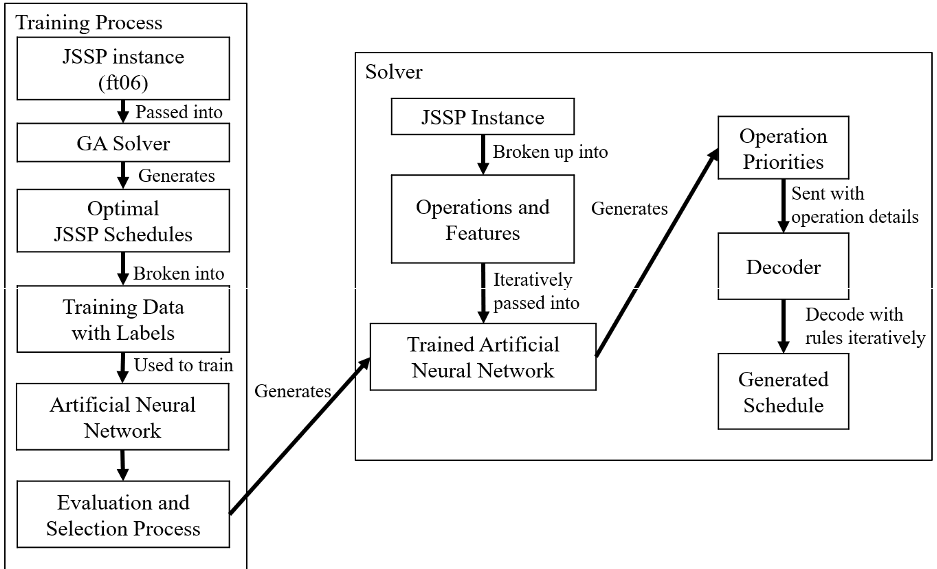
The researchers proposed a multi-stage pipeline that marries the predictive power of deep learning with the logical consistency of heuristics.
1. Feature Engineering
Instead of raw data, the model uses categorized features for each operation:
- Operation Index: Location in the job sequence (First, Middle, Last).
- Process Time & Remaining Time: Relative duration (Short, Medium, Long).
- Machine Load: Current stress on the target resource (Light, Heavy).
2. The ANN Core
The architecture is a compact 12-12-10-6 Multi-Layered Perceptron (MLP). It was trained on 1,147 optimal schedules (over 41,000 operations) generated by Genetic Algorithms. The goal is simple: given an operation's state, predict its priority class (0 to 5).
3. Tie-Breaking with Dispatching Rules
The "Secret Sauce" of this paper is the Decoder. If the ANN predicts that Job A and Job B both have "Priority 1," the system doesn't flip a coin. It applies a dispatching rule (like FDD/MTWR - Flow Due Date / Most Total Work Remaining) to decide the sequence.
Experimental Results: Breaking SOTA Records
The authors tested their hybrid approach against a variety of benchmarks including the LA (Lawrence), FT (Fisher and Thompson), and ABZ (Adams) sets.
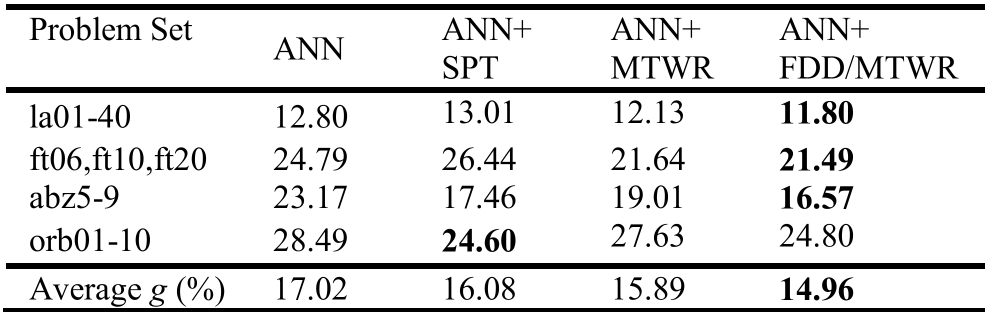
- Average Optimality Gap: The pure ANN sat at 17.02%. By adding FDD/MTWR, the gap dropped to 14.96%.
- Comparison with Legacy Systems: Compared to the landmark 2008 Weckman study, this PyTorch-based hybrid system demonstrated massive improvements, reducing gaps from 40.78% down to 18.17% on complex instances like
la24.
Deep Insights & Critical Analysis
The efficacy of this method highlights an important trend in AI: Guided Learning. Pure black-box models often struggle with the rigid constraints of combinatorial optimization. By embedding Dispatching Rules (which represent human/mathematical intuition) into the decoding phase, the model gains an inductive bias that prevents it from making "stupid" mistakes during tie-breakers.
Limitations:
- The model was primarily trained on the
ft06problem. While it generalizes well, performance on significantly larger or differently distributed job shops might degrade without broader training sets. - The feature set is still relatively "hand-crafted."
Conclusion
This research proves that we don't need to choose between the speed of heuristics and the intelligence of AI. By using an ANN to provide the strategic direction (priorities) and Dispatching Rules to handle the tactical details (ties), we can build schedulers that are both fast and remarkably close to optimal.
Future work involving Convolutional Neural Networks (CNNs) to process 2D feature correlations, as suggested by the authors, could be the next step in narrowing the optimality gap further.