
Joint Content Replication and Request Routing: Leveraging Social Cliques for Cloud CDN Optimization
Joint Content Replication and Request Routing for Social Video Distribution Over Cloud CDN: A Community Clustering Method
This paper proposes a community-based social video replication and request routing framework for Cloud CDNs. By clustering users based on social relationships, geolocations, and viewing interests, the authors optimize content placement using a Lyapunov-based stochastic framework, achieving SOTA results in balancing operational costs and latency.
TL;DR
Social video distribution is inherently different from traditional TV or movie streaming because it spreads through "micro-cliques" on Online Social Networks (OSNs). This paper introduces a Community Clustering method that leverages social relationships, geolocation, and interests to optimize Cloud CDN efficiency. By using a Lyapunov-based dynamic algorithm, the authors achieved a 30% reduction in monetary costs compared to standard LFU/LRU baselines while strictly honoring latency constraints.
Background & Motivation: The Volatility of Social Videos
Unlike Netflix or YouTube "Top Trending" lists, social videos are characterized by a highly volatile, long-tail popularity distribution. Most videos receive 80% of their views within the first 3 hours of being shared on a platform like microblogging.
The authors observed two critical insights from Sina Weibo data:
- Geographical Skew: User interests vary significantly by region (less than 24% similarity between most regions).
- Social Propagation: Information flows in small cliques where social ties, proximity, and interests overlap.
Traditional CDNs fail because they rely on long-term popularity metrics. Cloud CDNs offer the flexibility of "on-demand" scaling, but without an intelligent replication strategy, the cost of storage and inter-node bandwidth can spiral out of control.
Methodology: Community Clustering & Stochastic Optimization
1. Community Classification
The authors don't just look at where a user is. They build a weighted graph where edges are defined by:
- Social Relationship: Are they followers/friends?
- Geodistance: How far apart are they physically?
- Interest Similarity: Do they watch the same types of videos?
Using Affinity Propagation, they identify quasi-stable communities that serve as the fundamental unit for request routing.
2. The Cloud CDN Architecture
The system utilizes a Cloud-centric infrastructure where "CDN Nodes" are actually Virtual Machines (VMs) rented from providers like Amazon S3/EC2.
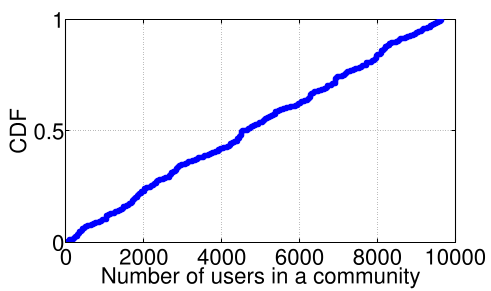 Figure: The proposed community-based request scheduling and Cloud CDN infrastructure.
3. Dynamic Optimization via Lyapunov
The core innovation is formulating the cost-latency tradeoff as a constrained optimization problem. Since future traffic is unknown, they use the Lyapunov Drift-plus-Penalty framework:
- Virtual Queues: A virtual queue tracks the cumulative "delay debt." If grows, the algorithm prioritizes lower latency in the next time slot.
- Dynamic Decisions: In each 1-hour time slot, the system decides which videos to replicate () and where to route requests ().
Experimental Insights
The method was tested against real traces from Sina Weibo (50,000 users, 5,000 videos).
Cost vs. Latency Tradeoff
As the control parameter increases, the system shifts focus from "user experience (latency)" to "budget (monetary cost)." The algorithm converges to the optimal cost once hits a certain threshold.
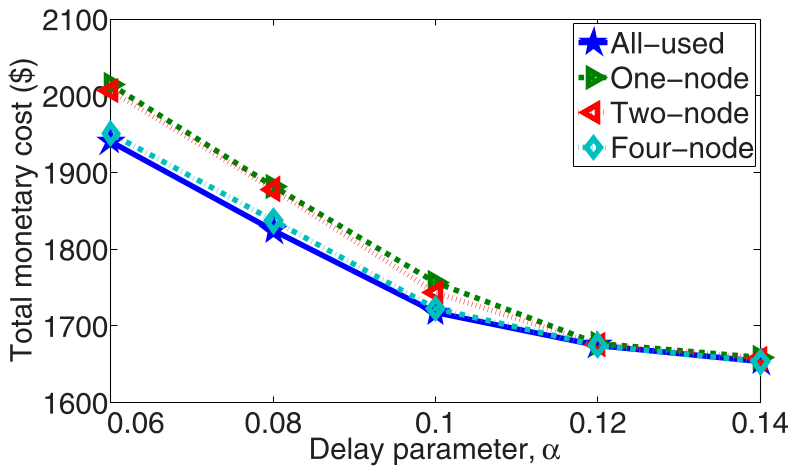 Figure: Total monetary cost comparison. The "All-used" strategy significantly outperforms LFU and Social-aware baselines.
Key Results:
- 30% Cost Saving: Compared to LFU.
- 43% Cost Saving: Compared to SocialCascade (which only looks at social trees).
- Reduced Variance: Unlike LFU, which has extreme "local hit" or "remote miss" delay swings, the community-based approach allows for "cross-region" hits, smoothing out the latency distribution.
Critical Analysis & Conclusion
The strength of this work lies in its online nature—it doesn't need to predict which video will go viral. By clustering users into communities, it "pre-calculates" the likely pool of interest.
Limitations:
- The complexity of solving the Integer Linear Program (ILP) in every time slot may scale poorly if the number of videos reaches millions.
- The paper assumes fixed cloud pricing, whereas real-world spot instances and regional pricing vary dynamically.
Future Outlook: Integrating this with Deep Reinforcement Learning (DRL) could potentially handle the high-dimensional state space of millions of videos more effectively than traditional ILP solvers. However, this paper remains a foundational study on how social "big data" can directly translate into hardware cost savings for internet infrastructure.
Takeaway for Industry
If you are building a social media or UGC platform, don't just cache based on global popularity. Cluster your users by their social "neighborhoods" and use stochastic control to keep your Cloud bills under a strict latency SLA.