
Social Video Distribution: Slashing Cloud CDN Costs via Community Clustering
Joint Content Replication and Request Routing for Social Video Distribution Over Cloud CDN: A Community Clustering Method
This paper introduces a community-aware social video replication and request routing framework for Cloud CDNs. By clustering users based on social relationships, geolocations, and viewing interests, the authors optimize content placement and request dispatching using a Lyapunov-based stochastic optimization approach, achieving a 30% reduction in operational costs while maintaining service latency targets.
TL;DR
Social video consumption (UGC) is inherently volatile and follows social propagation patterns that traditional "popularity-based" CDNs fail to capture. This paper proposes a joint optimization of video replication and request routing by clustering users into "communities" based on social ties, location, and interest. By applying a stochastic Lyapunov optimization, the system achieves a 30% reduction in operational costs compared to traditional methods like LFU.
Problem & Motivation: The Volatility of Social UGC
The rise of Online Social Networks (OSNs) has shifted video consumption from search-based to propagation-based. Most social videos are User Generated Content (UGC) with two painful characteristics:
- Massive Volume & Long Tail: Most videos have low but unpredictable popularity.
- High Volatility: 80% of comments (and thus views) occur within the first 3 hours of a video's life.
Traditional CDNs rely on "hotness" (LFU/LRU), but by the time a video is identified as "hot" in a social context, its peak traffic has often already passed. Furthermore, information spreads in "cliques"—groups of users with shared interests and physical proximity. Ignoring this social structure leads to sub-optimal replication where replicas are either in the wrong place or unused.
Methodology: Community-Aware Optimization
The authors propose a two-step solution: Community Classification followed by Dynamic Optimization.
1. Multi-Dimensional Community Clustering
Instead of just looking at location, the authors define a weighted graph where edges represent a mix of:
- Social Relationship: Are they followers/friends?
- Geodistance: How physically close are they?
- Interest Similarity: Do they watch the same types of videos?
Using Affinity Propagation, users are grouped into quasi-stable communities. This "smooths" the volatility because while an individual's behavior is erratic, a community's collective interest is more predictable.
2. The Lyapunov Optimization Framework
The core technical contribution is the formulation of a constrained optimization problem (). The goal is to minimize: Subject to:
The authors use a virtual queue to track the "debt" of the system regarding latency. If grows too large, the algorithm prioritizes low-latency routing (local CDN) over cost-saving (remote source). This allows the system to make optimal decisions per time slot without needing to "see the future."
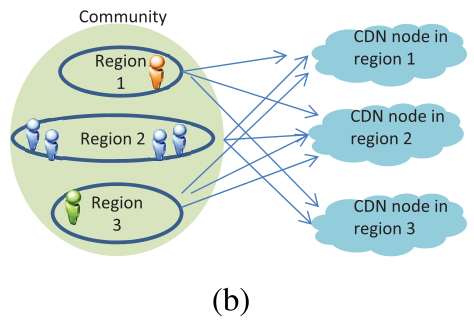 Figure 1: The community-based request scheduling where users are mapped to specific sets of CDN nodes.
Experiments & Results
The authors tested their algorithm on real traces from Sina Weibo (50,000 users, 5,000 videos) using Amazon S3/EC2 pricing models.
Cost Efficiency
The "All-Used" strategy (dispatching requests within the union of a community's regions) outperformed all baselines. It reduced costs by:
- 30% vs. LFU
- 43% vs. SocialCascade
- 89% vs. SocialInterest
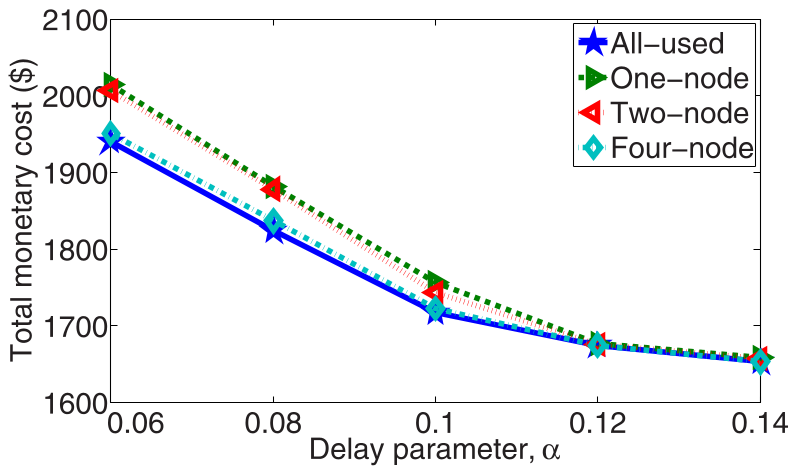 Figure 2: Comparison of monetary costs and latency distributions. Note the lower variance and mean cost for the proposed methods.
The V-Tradeoff
The control parameter allows operators to tune the system:
- High V: Minimizes cost (but pushes latency close to the limit ).
- Low V: Minimizes latency (but increases rental and bandwidth bills).
Critical Insight & Conclusion
The true value of this work lies in the synergy between cross-region CDN collaboration and community interest. By allowing users of a community to access replicas in neighboring regions rather than just their local node or the content source, the system increases the "hit rate" of replicated content across the cloud.
Takeaway: In the era of UGC, social context isn't just metadata—it's a critical signal for network infrastructure optimization. For cloud-native video platforms, shifting from "popularity-based" to "community-based" caching is the key to managing both QoS and the bottom line.