
Like Like Alike: Synchronizing Friendship and Interest in Social Networks
Like like alike: joint friendship and interest propagation in social networks
The paper introduces the Friendship-Interest Propagation (FIP) framework, a unified latent factor model designed for social networks. It jointly tackles service recommendation (interest targeting) and link prediction (friendship suggestion) by exploiting the principle of homophily and achieved significant SOTA improvements on the Yahoo! Pulse dataset.
TL;DR
The FIP (Friendship-Interest Propagation) model bridges the gap between Collaborative Filtering and Social Network Analysis. By assuming that our friends' interests reflect our own (homophily), it uses a unified latent factor framework to predict both the next person you'll follow and the next app you'll download, significantly outperforming models that look at these signals in isolation.
Background: The Homophily Insight
In social networks, "birds of a feather flock together." This sociological principle, known as homophily, suggests that users with similar interests tend to form connections, and existing friends tend to develop similar tastes.
The technical challenge is that information is often scattered. Interest networks (user-item) and friendship networks (user-user) are usually sparse and high-dimensional. Most SOTA methods like Matrix Factorization or Random Walks focus on only one side of the coin, leading to the notorious "cold-start" issue where new users cannot be effectively served.
Methodology: The FIP Framework
FIP's core innovation is the "Shared Latent Factor." Instead of learning separate embeddings for "User as a Consumer" and "User as a Friend," FIP forces a single latent vector to explain both behaviors simultaneously.
1. Unified Architecture
The model integrates:
- Interest Targeting: A bipartite latent factor model where .
- Friendship Prediction: A unipartite random walk model where .
- Feature Integration: It uses observable features (demographics, profile text) via regression to regularize the latent factors, helping bridge the gap for new users.
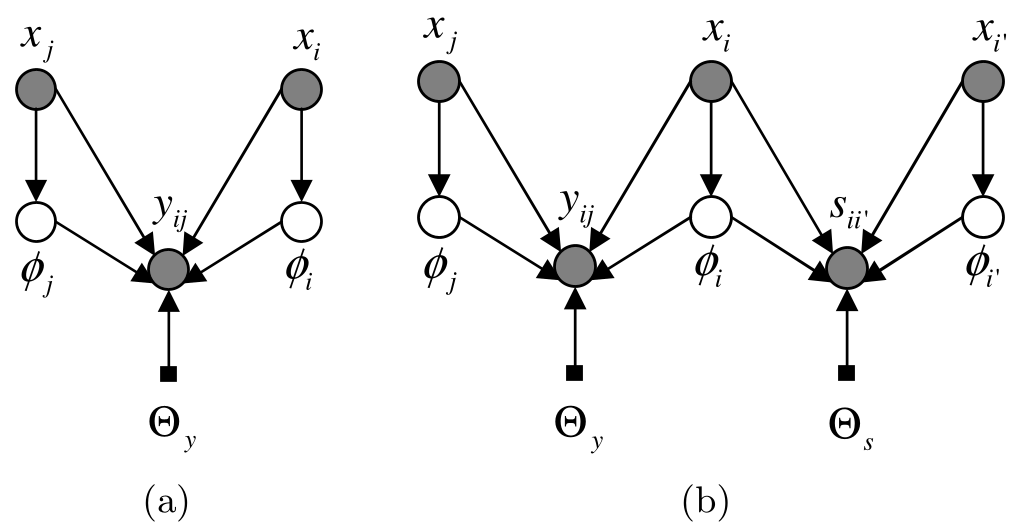 In the figure above, (a) shows the standard RLFM, while (b) demonstrates the FIP model where latent factors are shared across friendship (s) and interest (y) networks.
2. Bias Correction & Scaling
Social data is almost exclusively "positive" (we know who you liked, but not who you ignored). FIP solves this using pseudo-negative sampling, randomly treating unobserved interactions as weak negative signals. To handle hundreds of millions of users, the authors implemented the model using Parallelized Stochastic Gradient Descent and Feature Hashing on Hadoop.
Experiments and Results
The authors benchmarked FIP against Yahoo! Pulse data (1.2M users, 29M interactions).
Key Metrics:
- Service Recommendation: FIP achieved an nDCG@5 of 0.797, outperforming standard neighborhood models (0.698) and pure latent factor models (0.737).
- Friendship Prediction: This is where FIP truly shined. Because friendship networks are extremely sparse, bringing in interest data led to a 40% performance boost.
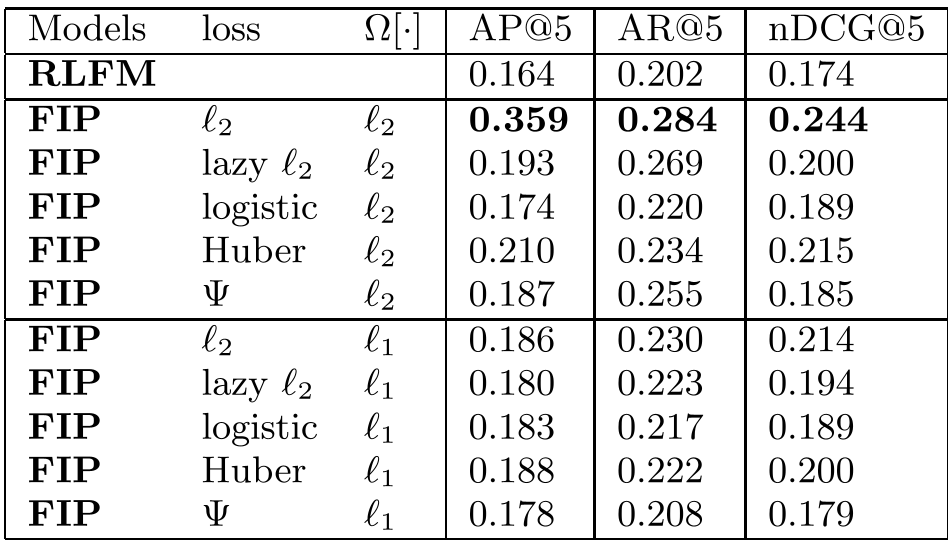 The table above shows that while pure interest models (RLFM) struggle with sparse friendship data, FIP variants leverage cross-domain evidence to achieve drastically higher precision.
Critical Insights from Ablation
- Credibility Balance: As shown in the sensitivity analysis, there is a "sweet spot" for friendship weight. Too little, and you lose the social signal; too much, and the social noise "pollutes" the user's personal interest profile.
- Regularization: L1 (Sparse) regularization generally outperformed L2, suggesting that users' interests are best represented by a few key latent dimensions rather than a dense spread.
Critical Analysis & Future Outlook
While FIP is a landmark in joint modeling, it has its limitations. Its reliance on a linear bilinear form assumes that the interaction between friendship and interest is relatively straightforward. Modern Graph Neural Networks (GNNs) could potentially capture higher-order "friends-of-friends" interests more effectively.
The Takeaway: For any developer building a social platform, the lesson is clear: don't silo your recommendation engine. Your user's social graph is the best regularizer for their shopping cart, and vice-versa.
Conclusion
"Like like alike" isn't just a catchy title—it's a mathematical reality. By propagating evidence across heterogeneous network edges, FIP provides a more holistic, robust, and scalable way to understand human behavior in digital spaces.