
SenHint: Bridging the Gap Between Deep Learning and Linguistic Intuition in Sentiment Analysis
Joint Inference for Aspect-level Sentiment Analysis by Deep Neural Networks and Linguistic Hints
The paper introduces SenHint, a joint inference framework for Aspect-Level Sentiment Analysis (ALSA) that combines Deep Neural Networks (DNNs) with explicit linguistic hints. By utilizing a Markov Logic Network (MLN), it integrates neural feature representations with symbolic reasoning to achieve SOTA performance on both ACSA and ATSA tasks.
TL;DR
While Deep Neural Networks (DNNs) are powerful at feature extraction, they often stumble over the "common sense" of language, such as the word "but" reversing a sentiment. SenHint is a joint framework that uses Markov Logic Networks (MLN) to stitch together the raw power of DNNs with explicit linguistic rules (linguistic hints). The result? A significant jump in accuracy (up to 7%) across standard benchmarks by letting logic correct neural errors.
Background: The 80% Ceiling
In Aspect-Level Sentiment Analysis (ALSA), models must determine the sentiment toward specific entities (e.g., "the battery life is great, but the screen is dim"). Despite the arrival of advanced architectures like Gated CNNs and LSTMs, accuracy has plateaued. Why? Because neural networks are statistical "black boxes" that often miss:
- Discourse Relations: Knowing that "However" implies a polarity flip.
- Long-distance Negation: Connecting "don't" at the start of a sentence to a "good" at the end.
- Implicit Context: Recognizing that two sentences in the same review usually share a sentiment trajectory.
Methodology: The Power of Joint Inference
SenHint doesn't replace DNNs; it augment them. The workflow consists of three major stages:
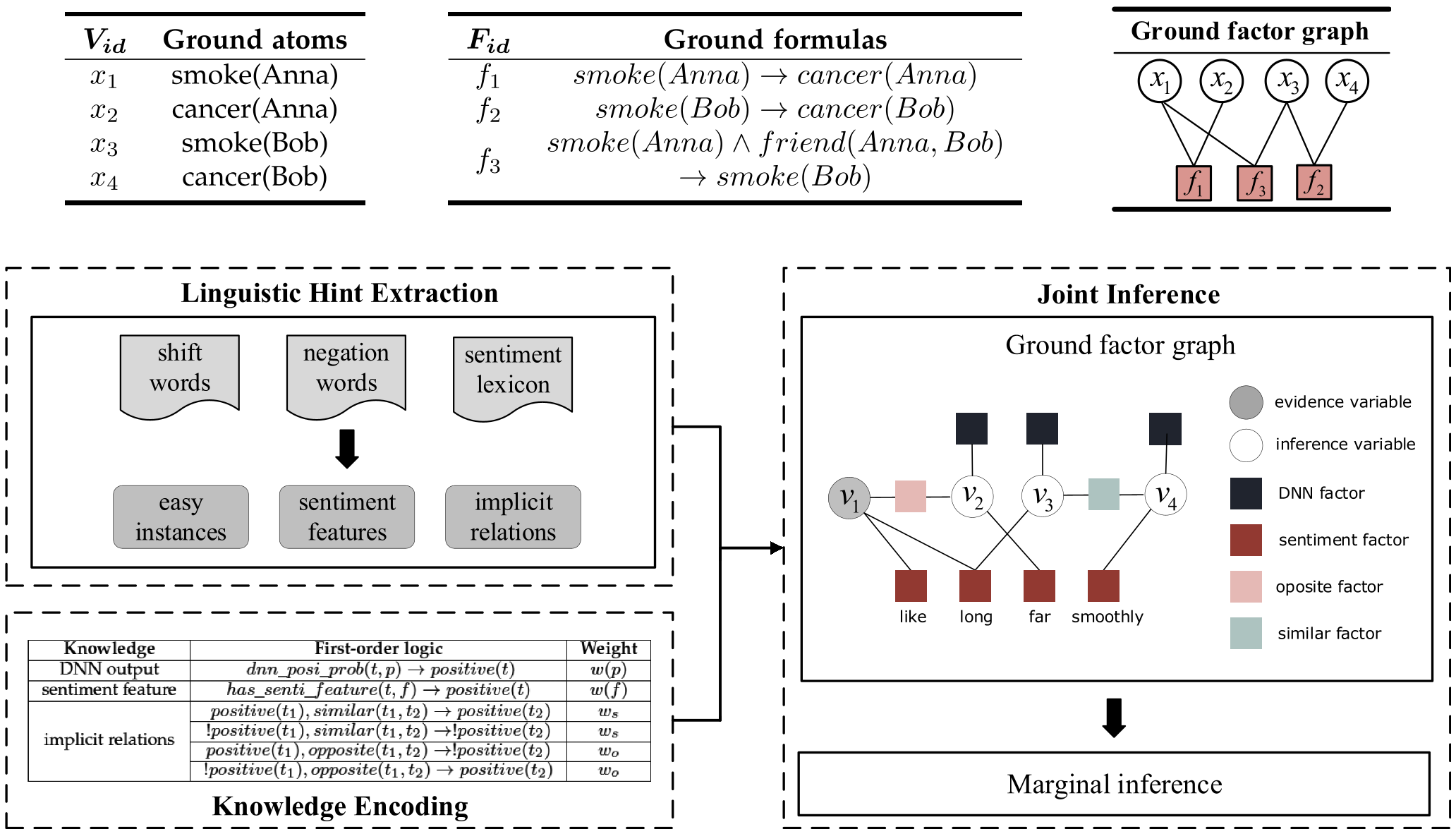
1. Linguistic Hint Extraction
The system identifies "Easy Instances"—sentences with strong, unambiguous sentiment words and no complex negation. These act as the "anchor points" for the logic model. It also extracts sentiment features and mines relations (Similar/Opposite) between different aspect units based on shift words like "but" or "although."
2. Knowledge Encoding via MLN
The core innovation is using Markov Logic Networks. The framework converts DNN outputs into probabilistic "soft" rules. For example:
- Neural Hint: If the DNN says it's 80% positive, the MLN assigns a corresponding weight to the "Positive" label.
- Relational Hint: If two aspects are in the same sentence without a shift word, they are likely to have the same polarity.
3. Joint Inference
By building a factor graph, SenHint performs "Joint Inference." If the DNN is unsure about a sentiment, but the linguistic rules show it is "Similar" to an easy instance that is definitely "Positive," the model will shift the uncertain instance to "Positive."
Experimental Performance
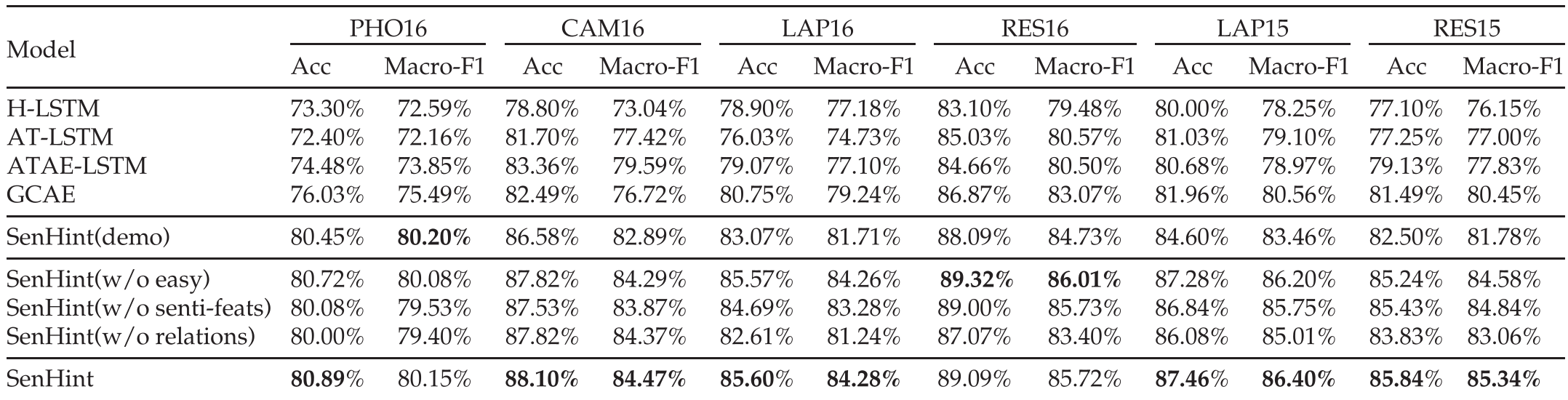
The researchers tested SenHint against a battery of SOTA models (H-LSTM, RAM, TNet, GCAE).
- ACSA Success: On the SemEval 2016 Phone dataset, SenHint reached 80.89% accuracy compared to GCAE's 76.03%.
- ATSA Success: In aspect-term tasks, the improvement was even more pronounced, with a 7% gain on Laptop datasets.
Ablation Insight: Why does it work?
Which hint matters most? The authors found that Polarity Relations (modeling how sentences relate to each other) provided the biggest boost. This proves that sentiment isn't just about word choice—it's about the flow of the argument.
Critical Analysis & Future Outlook
Strengths:
- Interpretability: Unlike pure DNNs, when SenHint makes a correction, we can point to the specific rule (e.g., the "Opposite" factor) that caused the change.
- Robustness: It uses "Easy Instances" to provide a ground truth that prevents the model from drifting.
Limitations:
- Rule Dependency: If no linguistic hints are present (e.g., very short or slang-heavy text), SenHint reverts to a standard DNN, losing its advantage.
- Extraction Errors: If the parser misidentifies a discourse relation, the MLN might "enforce" an incorrect label.
The Future: The authors suggest that by refining easy instance detection, we might eventually reach a point where DNNs require significantly less labeled training data, relying instead on the inherent logical structure of language.