
SourceCR: Bridging the Gap Between Rumor Verification and Source Identification
Joint Inference on Truth/Rumor and Their Sources in Social Networks
The paper introduces SourceCR, a joint inference framework that simultaneously identifies the veracity of claims (truth vs. rumor) and detects their geographical/logical sources in social networks. By coupling these two traditionally separate tasks, the method achieves State-of-the-Art performance, specifically an up to 35% gain in credibility accuracy and a 29% improvement in source detection rate.
Executive Summary
TL;DR: SourceCR is a novel framework that breaks the silos between truth inference and source detection in social networks. By treating user reliability as a shared bridge, it uses an iterative EM-based approach to simultaneously figure out if a claim is fake and who started the fire, outperforming independent models by up to 35% in accuracy.
Background: Within the academic landscape of social computing, identifying "fake news" and "patient zero" (source) are typically treated as two distinct pipelines. This paper identifies a "Mutual Reinforcement" opportunity: knowing the source's reliability helps verify the news, and knowing the news's truth helps weigh a user's reliability.
Problem & Motivation: The Disconnect in Current Research
Prior works often fail because:
- Source Detection assumes a level playing field: Most models assume all users are equally honest or reliable, which is rarely true during a crisis or political event.
- Truth Discovery ignores the 'Origin': Fact-checking algorithms look at content or network structure but often ignore the specific reliability of the source node.
The authors' core insight is that User Reliability is the hidden variable connecting both tasks. A reliable user is more likely to spread the truth and provide accurate answers when queried during a source investigation.
Methodology: The Iterative Synergy of SourceCR
The framework consists of two modules that feed into each other in a loop:
1. Credibility-Reliability Training (The "What")
Utilizing an Expectation-Maximization (EM) algorithm, this module calculates:
- Claim Credibility: The probability that a message is true given all observed user opinions.
- User Reliability: A score reflecting how often a user aligns with the truth.
2. Division-Querying (The "Who")
Once we have a sense of who is reliable and what is likely true, this module:
- Partitions the Network: Splits the graph into "pros" and "cons" subnetworks based on claim credibility.
- Strategic Querying: Within these subnetworks, it queries users to find the source. Crucially, it prioritizes answers from users the EM module identified as highly reliable.
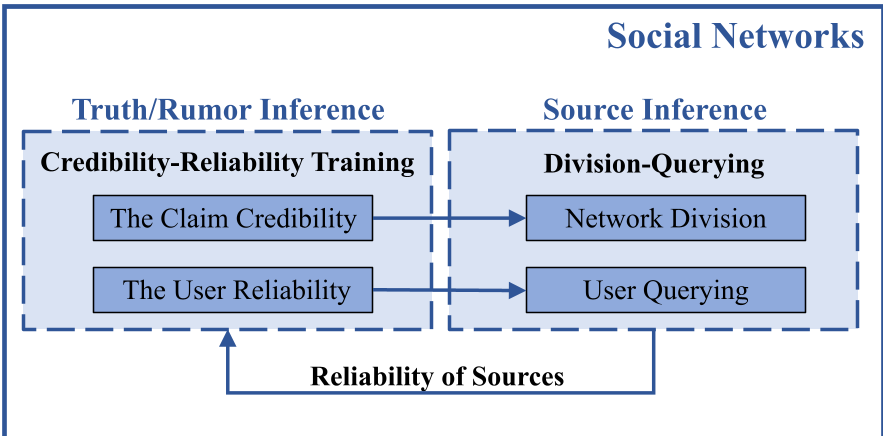
The beauty of this design is that the output of the source detection module (source reliability) becomes the prior for the next round of truth inference, refining the results until convergence.
Experiments & Results: Proving the Synergy
The authors tested SourceCR against baselines like TruthFinder and MVNA-SI on real-world datasets (gemsec-Deezer and Emergent).
Key Breakthroughs:
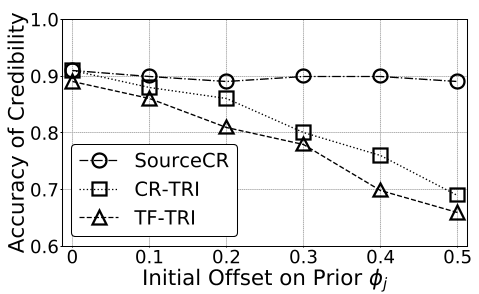
- Robustness to Priors: Even when the initial guess about a claim's truth was completely wrong (offset of 0.5), SourceCR recovered to nearly perfect accuracy, whereas standalone models collapsed.
- Efficiency: SourceCR reaches stable detection rates with a much lower "querying budget" (K) than its competitors.
- Performance Gain: On the Deezer dataset, the joint inference led to a 35% increase in credibility accuracy and a 29% gain in source detection.
Critical Analysis & Conclusion
Takeaway: The "Joint Inference" paradigm is highly effective for noisy social network data. By linking content veracity with user behavior reliability, SourceCR effectively filters out the cognitive noise created by bots or misinformed users.
Limitations:
- The theoretical budget guarantee is derived on a d-regular tree, which is a simplification of real-world scale-free networks.
- The "Querying" mechanism assumes we can interact with users (or their digital footprints) directly, which may have privacy or API limitations in practice.
Future Outlook: This framework sets a foundation for more "Active Learning" in social network moderation, where systems can strategically decide which users to "query" or verify to maximize the truth-to-rumor ratio of the entire platform.