
SAN: Bridging the Gap Between Who You Know and Who You Are
Joint Link Prediction and Aribute Inference Using a Social-Aribute Network
The paper introduces a unified framework leveraging a Social-Attribute Network (SAN) to simultaneously address link prediction and attribute inference. By representing users and categorical attributes as nodes in an augmented graph, the authors adapt representative unsupervised (CN, AA, RWwR) and supervised algorithms to outperform models that treat these tasks in isolation.
TL;DR
Social networks aren't just about connections; they are about the people (attributes) those connections represent. This paper proposes the Social-Attribute Network (SAN) framework, which bridges Link Prediction and Attribute Inference. By treating attributes as nodes in a graph, the authors show that knowing your friends helps guess your profile, and guessing your profile helps predict your future friends.
Problem & Motivation: The Silo Effect
In the world of social data mining, researchers often lived in two silos:
- Link Prediction: "User A and B share many friends, so they might know each other."
- Attribute Inference: "User A lives in San Francisco and works at Google, so they probably went to a top-tier school."
The authors argue these tasks are two sides of the same coin, driven by homophily (birds of a feather flock together) and social influence. Existing methods like Supervised Random Walks (SRW) were too "edge-centric," failing to capture the relationship between two users who share an attribute but aren't yet connected.
Methodology: The Unified SAN Framework
The core innovation is the Social-Attribute Network. Instead of just having user nodes, the graph is augmented with Attribute Nodes (e.g., "University of California, Berkeley", "Google").
The SAN Anatomy:
- Social Links: User-to-User connections.
- Attribute Links: User-to-Attribute connections (can be positive or negative).
- Mutex Links: Attribute-to-Attribute links representing mutually exclusive traits (e.g., you can't be both "Male" and "Female" in a binary setup).
 Note: The SAN explicitly links users to their traits, transforming attribute inference into a simple link-prediction task between a user node and an attribute node.
The Iterative Insight
A key find in this paper is the Iterative Link and Attribute Inference. Since many users have private profiles (missing attributes), the authors first use the network to infer those missing attributes. Then, they use these "hallucinated" attributes to build a richer SAN, which in turn makes social link prediction significantly more accurate.
Experiments & Results: Winning on Google+
The authors released and tested on a massive Google+ dataset. Their findings were definitive:
- Attribute Power: Adding attributes to unsupervised algorithms (like Adamic-Adar) boosted AUC across the board.
- Supervised Superiority: The SLP-SAN-VI model, which combines traditional topological features with SAN-based features, outperformed the previous state-of-the-art (SRW).
- Missing Link Recovery: The model proved remarkably robust at predicting "missing links"—connections that existed but were hidden due to privacy settings.
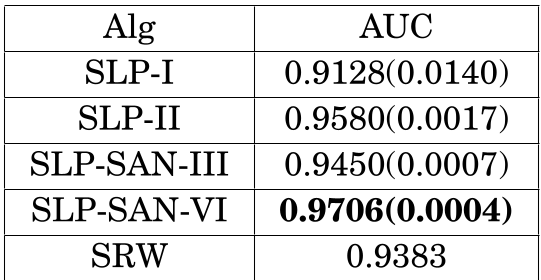 The table highlights that SLP-SAN-VI (0.9706 AUC) dominates models that ignore the Social-Attribute graph structure.
Critical Analysis & Conclusion
Takeaway
The SAN model is a masterclass in heterogeneous graph representation. It proves that attributes shouldn't just be "features" appended to a node; they should be first-class citizens (nodes) in the network architecture.
Limitations
- Scalability: While the authors mention SVD and local hops, global random walks on extremely dense graphs with millions of attribute nodes could still hit computational bottlenecks.
- Weighting: The current study treats all links as equal (weight = 1). In reality, a "Family" circle link is much stronger for attribute inference than a "Following" link.
Future Outlook
This work sets the stage for modern Graph Neural Networks (GNNs). The idea of "iterative inference" is a precursor to message-passing layers where node features and adjacency matrices are updated simultaneously. It remains a foundational read for anyone interested in the intersection of privacy, social graph evolution, and recommendation systems.