
PIERT: Decoding the "Who" and "What" of Social Event Participation
Joint Modeling of Participant Influence and Latent Topics for Recommendation in Event-based Social Networks
The paper introduces PIERT (Participant Influence and Event Recommendation with Topics), a joint generative framework for event recommendation in Event-Based Social Networks (EBSNs). It utilizes Poisson Factorization to model the implicit "participant influence" of existing attendees on new users while simultaneously extracting latent event topics from text descriptions to address cold-start challenges and improve accuracy.
Executive Summary
Why do we go to certain parties or professional meetups? Is it just the topic, or is it because a specific friend or influencer already RSVP'd "Yes"? This paper addresses Event-Based Social Networks (EBSNs)—platforms like Meetup or Facebook Events—where the social context is dynamic.
The authors propose PIERT, a sophisticated recommendation framework that shifts the paradigm from "suggesting events based on interest" to "suggesting events based on Participant Influence and Latent Topics." By using Poisson Factorization (PF), they handle the massive sparsity of event data while capturing the nuance of how one user's presence attracts another.
Problem: The Missing Link in Event Recommendation
Most existing models (like BPR or Collaborative Filtering) suffer from two major flaws in the context of events:
- The Passive Social Bias: They assume if you and I are friends, we like similar things. They don't model the fact that I might join a "Bicycle Repair" workshop purely because you are going, even if I have no prior interest in it.
- The Zero-Observation Trap: Standard Gaussian factorization treats "no RSVP" as a sign of dislike. In reality, a user might simply be too busy.
Methodology: The PIERT Framework
The core innovation is modeling a participant influence instance as a tuple: (User influences User for Event ).
1. Active vs. Passive Influence
PIERT assigns two distinct roles to every user:
- Active Influence (): How much does this user attract others?
- Passive Influence (): How susceptible is this user to being attracted by others?
2. Topic-Aware Influence
The model doesn't just look at user IDs. It extracts Latent Topics from event descriptions. A "Soccer Expert" might be highly influential for a "Tournament" event (Topic A), but have zero influence for a "Cooking Class" (Topic B).
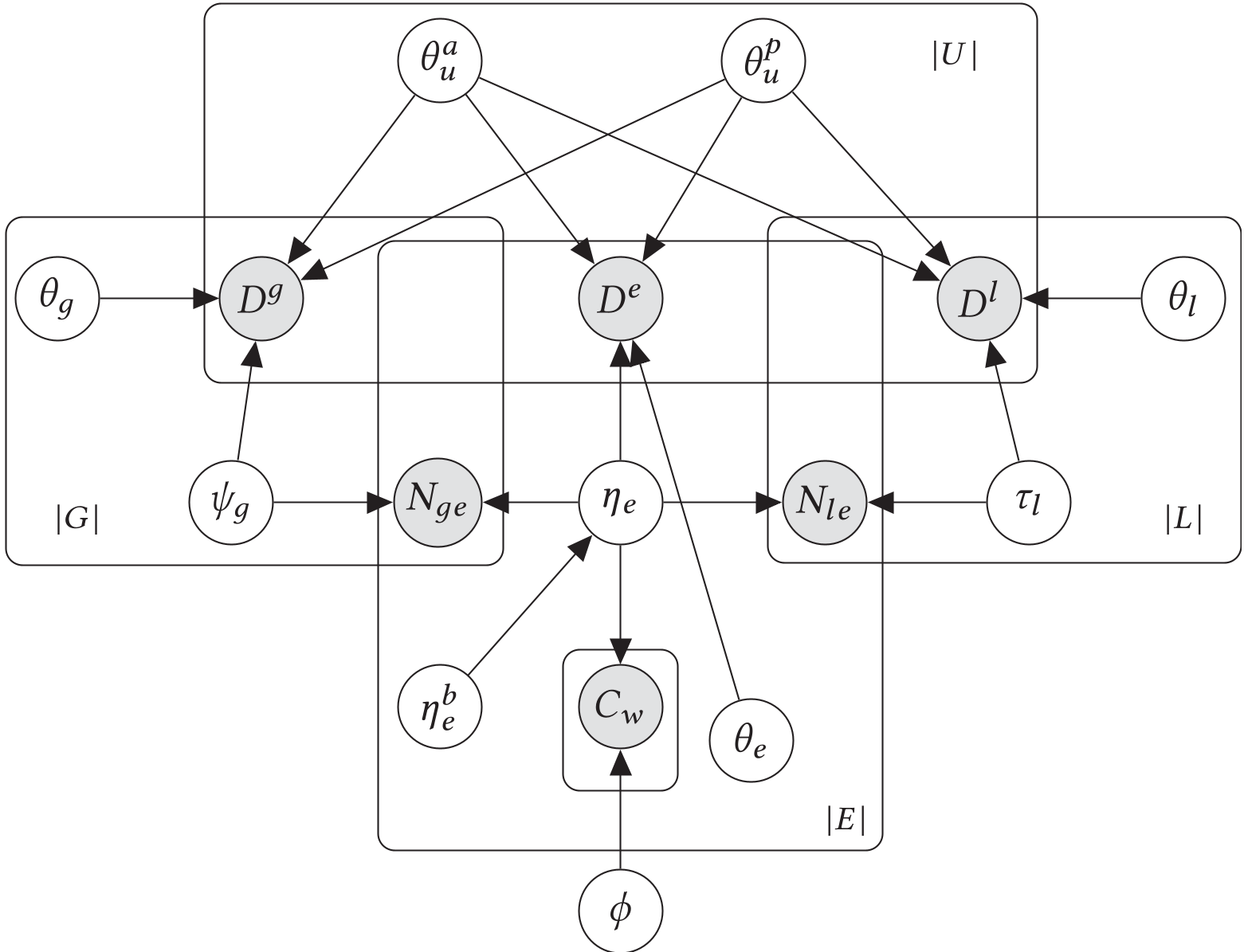 Figure: The Graphical Model showing the interplay between topics (η, φ), groups, locations, and user influence factors.
3. Why Poisson Factorization?
The authors favor Poisson over Gaussian distributions because:
- Budget Constraint: It accurately models that users have limited "spare time" (a Poisson rate).
- Sparsity: It handles the over-abundance of zero-interaction records more gracefully than traditional matrix factorization.
Experiments: Real-World Impact
The authors curated massive datasets from Meetup.com across four global cities.
SOTA Comparison
PIERT was compared against several heavyweights, including MCLRE (Multi-Contextual Learning to Rank) and CBPF (Collective Bayesian Poisson Factorization).
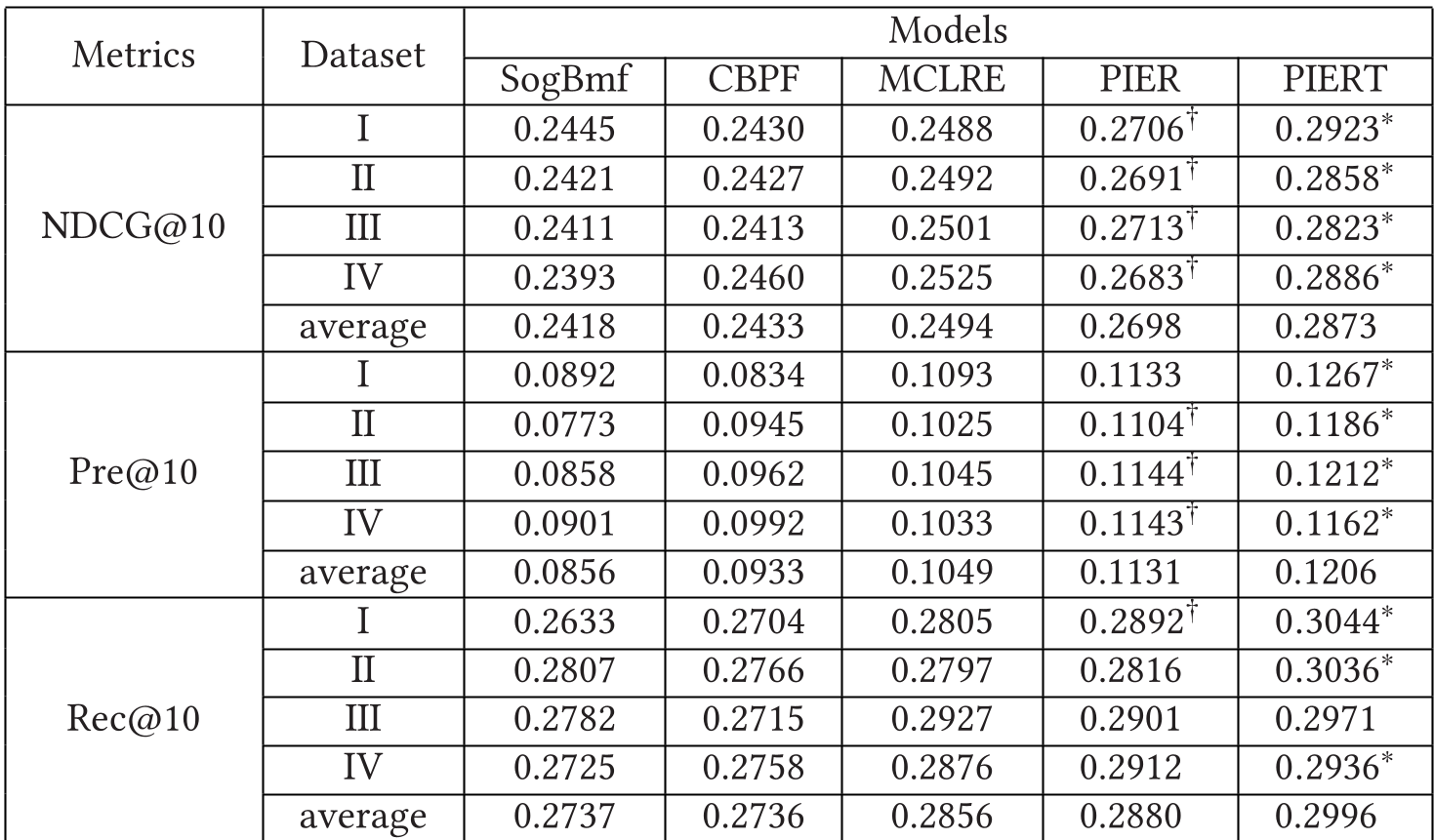 Table: Performance comparison in Los Angeles. PIERT shows a significant lead in NDCG@10 (0.2873 vs 0.2433 for CBPF).
Key Findings
- Topic Explainability: The model can actually explain why it recommended an event. For example, it might identify that a specific user pair is highly influenced by "Sports/Ride" topics (Topic 8) or "Food/Wine" topics (Topic 7).
- Cold-Start Prowess: Because PIERT learns the relationship between topics and host groups/locations, it can recommend brand-new events that have zero participants yet, simply by analyzing the "attraction power" of the host group's typical topics.
Critical Analysis & Takeaways
The most impressive aspect of this work is the semantic modeling of influence. By breaking down influence into active/passive components across different latent topics, the authors have created a tool that understands the social texture of a community.
Limitations:
- The model assumes the timestamp is the only indicator of influence (whoever RSVP'd first is the influencer). In reality, influence can be reciprocal or happen offline.
- Computational complexity: While efficient, the three-way tensor-like interaction still requires significant resources as the number of users and events scales.
Future Outlook: This research paves the way for "Companion-based Recommendations." Imagine an app not suggesting a restaurant because the food is good, but because the specific social mix of people there tonight is most likely to attract you.