
Beyond Independent Blurring: Strengthening LBSN Privacy through Joint Obfuscation
Joint Obfuscation for Privacy Protection in Location-Based Social Networks
This paper introduces a Joint Obfuscation approach for Location-Based Social Networks (LBSNs) that simultaneously generalizes geographical coordinates and semantic tags. By coupling these two dimensions, the method prevents adversaries from exploiting semantic-spatial inconsistencies to de-anonymize users.
TL;DR
Sharing your "Restaurant" visit on social media while blurring your location seems safe, but if the blurred area only contains one restaurant, you've just told an attacker exactly where you are. This paper introduces Joint Obfuscation, a method that aligns the blurring of your location with the blurring of your activities, making it mathematically harder for attackers to "filter out" the noise.
The "Semantic Matching" Trap
In modern LBSNs like Foursquare or Facebook, we don't just share where we are; we share what we are doing. The current industry standard for privacy is to generalize:
- Semantic Blur: "Burger Joint" becomes "Food & Drink."
- Spatial Blur: Your specific shop is replaced by a 1km square "Cloaking Area."
The fatal flaw identified here is Semantic Incompatibility. If a user reports being at a "Food & Drink" venue within a cloaking area, but 75% of that area consists of a lake and a residential zone with no restaurants, the adversary instantly ignores those regions. The "independent" protection fails because the two data types are physically correlated.
Methodology: The Power of Joint Intelligence
The authors propose a logic shift: Location obfuscation must be performed based on the result of the semantic tag obfuscation.
The Architecture of Joint Obfuscation
Instead of picking a random nearby grid to hide in, the algorithm evaluates potential cloaking areas based on their "Semantic Density."
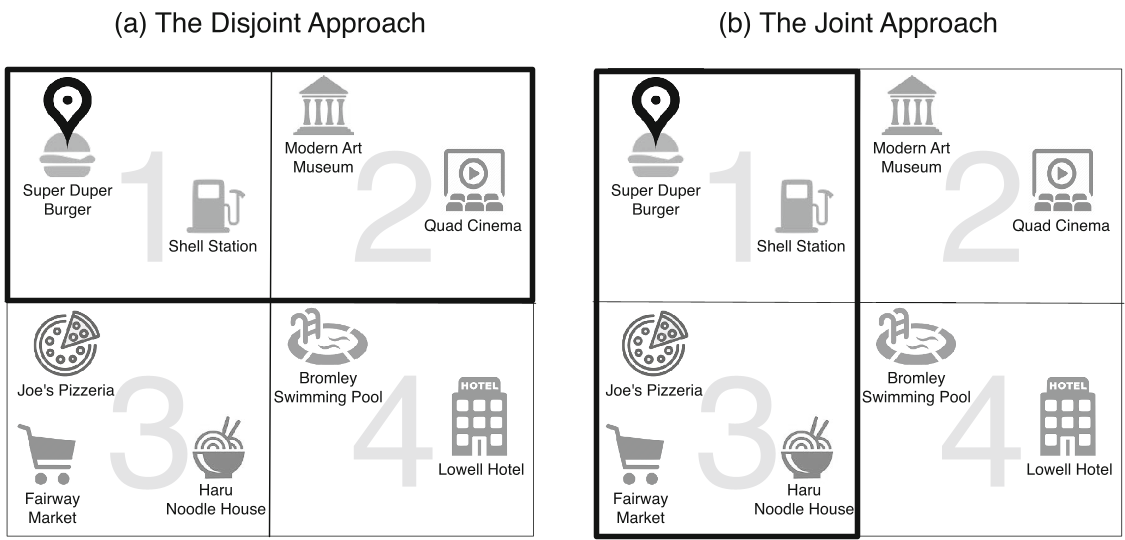 In the figure above, the joint approach (b) chooses Region 3 because it contains other restaurants, providing "safety in numbers," whereas the disjoint approach (a) chooses Region 2, which has no restaurants and can be easily ignored by an attacker.
The Adversary Model
The paper uses a Dynamic Bayesian Network (DBN) to model a sophisticated attacker. This attacker knows:
- The map and all venue categories.
- The mobility patterns of the user (e.g., people often go to a movie after dinner).
- The exact obfuscation algorithm being used.
The DBN allows the attacker to calculate the posterior probability of a user's true location by observing the entire history of obfuscated traces.
Experimental Battleground
Using real-world Foursquare check-in data from 1,065 users across six North American and European cities, the authors tested the joint vs. disjoint approaches.
Key Findings
- The Scaling Effect: As the location obfuscation level () increases, the Joint approach gains privacy much faster than the Disjoint approach.
- The Hiding Paradox: While simply hiding a check-in () increases privacy, it actually reduces the relative advantage of the joint approach, as there is less data for either approach to work with.
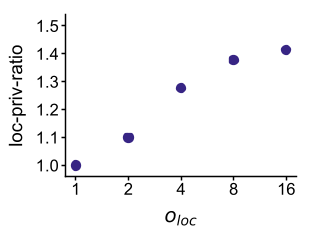 The ratio of location-privacy (loc-priv-ratio) consistently stays above 1.0, proving the Joint approach is superior across almost all parameter settings.
Critical Insight: The Future of Attributes
This paper serves as a vital proof of concept for Interdependent Privacy. As we move toward more complex digital shadows (combining heart rate data, shopping habits, and locations), we cannot afford to protect each attribute in a vacuum.
Limitations
- Computational Cost: Finding the "optimal" cloaking area among all potential grids is more expensive than random selection.
- Utility Trade-off: By forcing the cloaking area to include semantically similar venues, the service provider might receive a slightly less "representative" spatial area, though the paper argues the impact is minimal.
Conclusion
The transition from disjoint to joint obfuscation is a leap from Information Hiding to Information Alignment. By ensuring that our "lies" (obfuscated data) are internally consistent, we build a much more robust shield against the powerful inference capabilities of modern AI.