
ODOA: Maximizing Data Delivery through Joint Throwbox Optimization in MSNs
Joint optimization of throwbox deployment and storage allocation in Mobile Social Networks
This paper introduces ODOA, a joint optimization scheme for throwbox deployment and storage allocation in Mobile Social Networks (MSNs). By characterizing contact strength through historical user-location interactions, the authors maximize data delivery efficiency using a two-step greedy algorithm.
TL;DR
In the volatile landscape of Mobile Social Networks (MSNs), stationary relays known as throwboxes are essential for bridging intermittent connections. This paper argues that simply placing these boxes isn't enough; we must jointly optimize where they go and how much storage they carry. By introducing a "virtual visit" metric and a joint optimization model (ODOA), the researchers reduced data loss and significantly boosted delivery ratios compared to traditional uniform allocation methods.
The Bottleneck: Storage Saturation vs. Unused Capacity
Modern MSNs (a subset of Disruption Tolerant Networks) suffer from unstable topologies. While throwboxes help, existing research often assumes storage is infinite or handles deployment as a separate task from hardware sizing.
The "Storage Paradox" in MSNs:
- Under-allocation: Popular Gathering Points (GPs) experience storage saturation, where new data overwrites old data before it can be delivered (Data Loss).
- Over-allocation: Unpopular locations waste limited resources on idle storage.
- The Core Insight: Storage demand is a function of both the frequency of visits and the duration of those visits.
Methodology: The "Virtual Visit" and Joint Optimization
1. Evaluating Contact Strength
The authors move beyond simple frequency. They transform real-world visits into "independent virtual visits" using a normalization principle:
- Duration Factor: Long visits provide more chances for data exchange, effectively acting like multiple instantaneous contacts.
- Interval Factor: If the gap between visits is shorter than the data's lifecycle (), the visits are combined, treating the user as effectively "resident."
2. The Demand Analysis (HRoS vs. SRoS)
The paper defines two bounds for storage demand:
- Hard Requirement (HRoS): The worst-case scenario where all visits overlap.
- Soft Requirement (SRoS): The ideal scenario where visits are perfectly distributed.
- Optimal RoS: Calculated as a weighted balance .
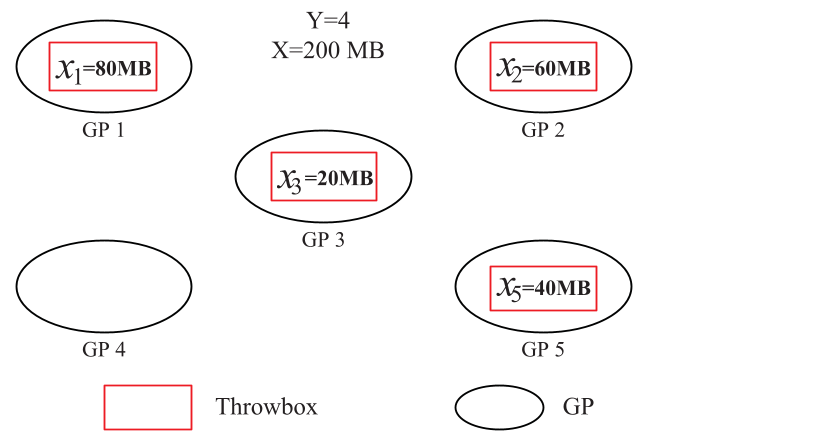
3. Joint Optimization Model
The objective function maximizes data delivery across all GPs: Subject to constraints on total storage () and total throwboxes (). Since this is NP-hard, a two-step greedy algorithm is employed to find a suboptimal yet highly efficient solution.
Experimental Results: Proving the Efficiency
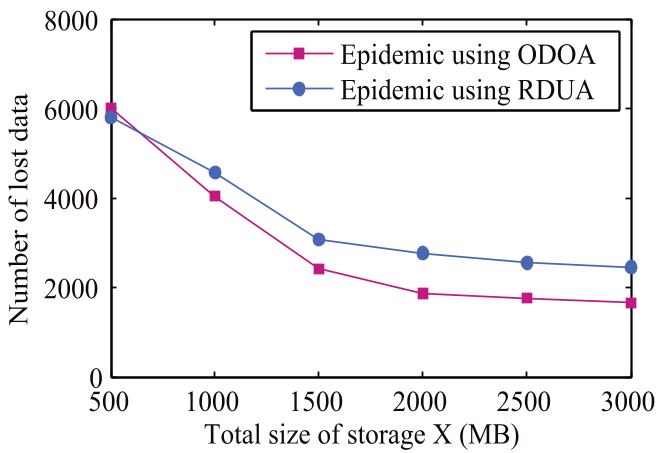
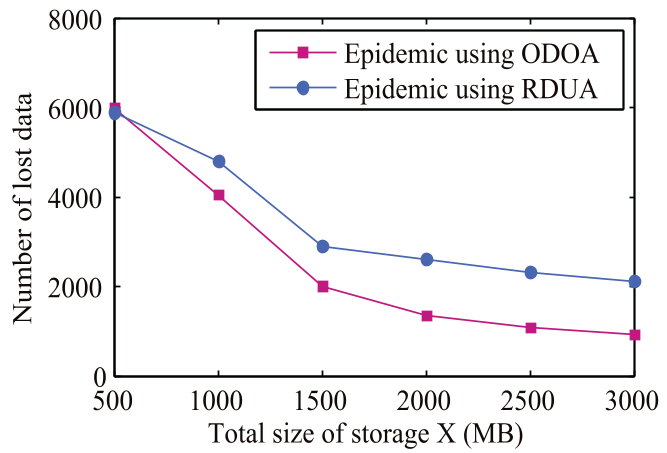
The ODOA (Optimal Deployment and Optimal Allocation) scheme was tested against RDUA (Random Deployment and Uniform Allocation) using the OMNeT++ simulator.
Key Finding 1: Minimizing Data Loss
By setting the storage factor (balancing the SRoS and HRoS), the system achieved a "sweet spot" where data loss due to buffer overflow was minimized.
Key Finding 2: Superior Delivery Ratios
Whether using Epidemic Routing (flooding) or Homing Spread (multi-copy), the ODOA scheme consistently outperformed the baseline. It ensures that the most "active" GPs (highest contact strength ) receive priority storage, which directly translates to more successful handshakes between nodes and the infrastructure.
Critical Analysis & Takeaways
This work bridges a critical gap in MSN architecture. By treating hardware deployment and resource allocation as a unified problem, it provides a mathematical framework for city-scale data relay networks.
Takeaway for Future Research: The efficiency of a relay node is not just about its location, but its capacity relative to the social "heat" of that location. Future extensions could incorporate energy harvesting constraints, where a throwbox must balance its storage operations with its available battery levels, adding a third dimension to this joint optimization.
Limitations: The model assumes a "computation period" based on history, which might not adapt well to sudden, large-scale social events (e.g., a flash mob or emergency evacuation) where contact history is no longer a reliable predictor.