
C2P: Bridging the Gap in Multilayer Social Networks with Joint Recommendations
Joint Recommendations in Multilayer Mobile Social Networks
This paper introduces the Cross-layer 2-hop Path (C2P) algorithm for joint friend recommendations in Multilayer Mobile Social Networks (MSNs). By leveraging "hybrid" paths that span different network layers, C2P achieves superior accuracy and diversity, significantly outperforming single-layer baselines.
TL;DR
Modern mobile social networks are rarely flat; they consist of multiple layers of interaction (e.g., replying vs. mentioning on Twitter). This paper presents C2P (Cross-layer 2-hop Path), a novel algorithm that identifies potential friends by traversing "hybrid" paths across these layers. The result is a recommendation engine that is up to 32% more accurate than single-layer methods while maintaining high diversity and low computational overhead.
Problem & Motivation: The Silo Effect in Social Discovery
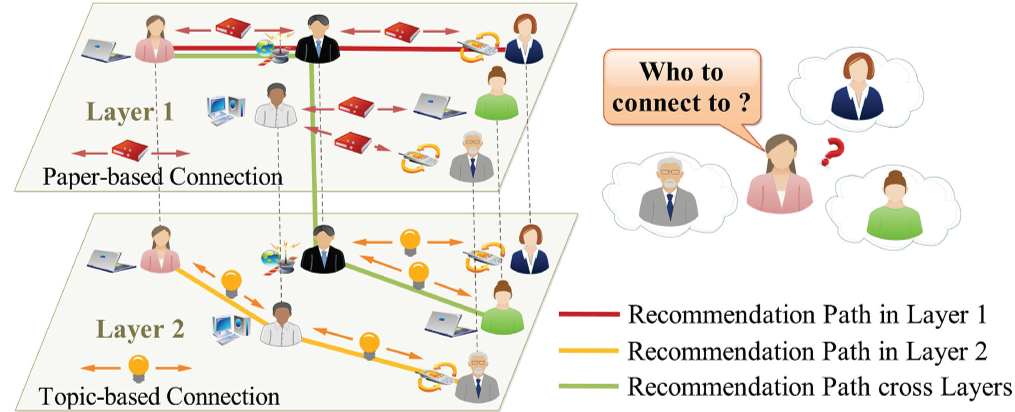
In an academic network, are you more likely to connect with someone because you co-authored a paper, or because you share a niche research interest? The answer is often both. However, most recommendation algorithms suffer from a "silo effect," analyzing only one type of connection at a time. This results in:
- Information Loss: Ignoring potential connections visible only in secondary layers.
- Poor Accuracy: Failing to capture the multifaceted nature of human friend-seeking behavior.
- Algorithmic Bias: Over-recommending popular "celebrity" nodes while ignoring relevant niche peers.
The authors argue that a user's demand is a product of their presence across all layers. For instance, a user active in "Layer A" might actually be looking for experts in "Layer B" to complement their profile.
Methodology: The Power of the "Hybrid" Hop
The core innovation of this paper is the Cross-layer 2-hop path. Instead of looking for a "friend of a friend" in the same layer (e.g., Author-Paper-Author), C2P looks for neighbors reachable through different layers (e.g., Author-Paper-Relay-Topic-Author).
Mathematical Intuition
The algorithm assigns weights to nodes based on the product of edge weights along these cross-layer paths. A key breakthrough is the User Demand Model, which balances a node's popularity (weighted degree) against the source user's specific activity levels.
The probability of recommending node to user is modeled as: This formula ensures that the recommendation is sensitive to the relative importance of each layer for that specific user.
Experiments & Results: SOTA Performance
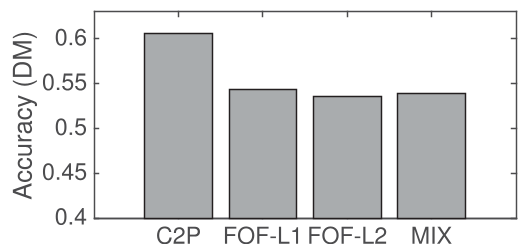
The researchers tested C2P against several baselines (FOF-L1, FOF-L2, and a simple Mixture model) using synthetic data and massive real-world datasets, including a Twitter dataset and the Microsoft Academic Graph (millions of nodes).
1. Accuracy Gain
C2P consistently outperformed baselines. In the Computer Vision (CV) dataset, the accuracy gain reached a staggering 32%.
2. Diversity & Scalability
Unlike many high-accuracy algorithms that fall into the "popularity trap," C2P maintains high Diversity. By utilizing cross-layer randomness, it avoids recommending the same few "super-nodes" to everyone. Furthermore, the algorithm is highly efficient—the complexity per recommendation stays at (where is the number of local neighbors), making it viable for platforms with millions of users.
Critical Analysis & Conclusion
Takeaway
The C2P algorithm serves as a bridge for MSNs that are naturally multilayered. It proves that joint information is not just "more data," but a qualitatively different way to understand social proximity.
Limitations & Future Work
- Layer Scalability: The current proof focuses largely on 2-layer systems. Extending this to -layers without exponentially increasing the path length (which would dilute recommendation quality) remains a challenge.
- Interdependent Networks: The paper assumes nodes are shared across layers, but edges are independent. Investigating interdependent layers (where an edge in one layer forces an edge in another) is a promising next step.
In conclusion, C2P offers a mathematically rigorous yet practically efficient solution for the next generation of social recommendation engines, turning the complexity of multilayer networks into a distinct advantage for user discovery.