
Joint User-Entity Representation: Solving the Transiency Trap in Event Recommendations
Joint User-Entity Representation Learning for Event Recommendation in Social Network
The paper proposes a joint user-entity representation learning model for large-scale event recommendation on social networks (specifically Facebook). It utilizes parallel Convolutional Neural Networks (CNNs) to project heterogeneous user attributes and event semantic text into a shared latent space, achieving a +6% AUC lift and significant precision improvements (+29% PR80) over a strong production baseline.
TL;DR
Recommending social events is notoriously difficult because events are transient—they expire quickly, leaving behind sparse interaction data. This paper from Facebook Engineering introduces a joint representation learning framework using parallel Convolutional Neural Networks (CNNs). By mapping heterogeneous user data and event semantics into the same latent space and feeding them into a GBDT combiner, they achieved a 6% AUC lift and a massive 29% boost in precision at high recall levels.
The Problem: The "Transiency Trap"
Standard recommendation algorithms (like Matrix Factorization) thrive on stable item sets. However, social events are different:
- Short Lifespan: An event is only relevant until it happens. By the time enough users have interacted with it to train a Collaborative Filtering (CF) model, the event has often already passed.
- Extreme Sparsity: Users attend events much less frequently than they "like" posts or watch videos, creating a "cold-start" nightmare.
- The Information Bottleneck: Traditional models (LDA/PLSA) often require users and items to be in the same feature space. This prevents models from using a user's rich profile (demographics, group memberships) to match against an event's text description.
Methodology: Bridging Heterogeneous Domains
The authors propose a two-stage system that moves beyond simple keyword matching to deep semantic understanding.
1. The Dual-Column CNN Architecture
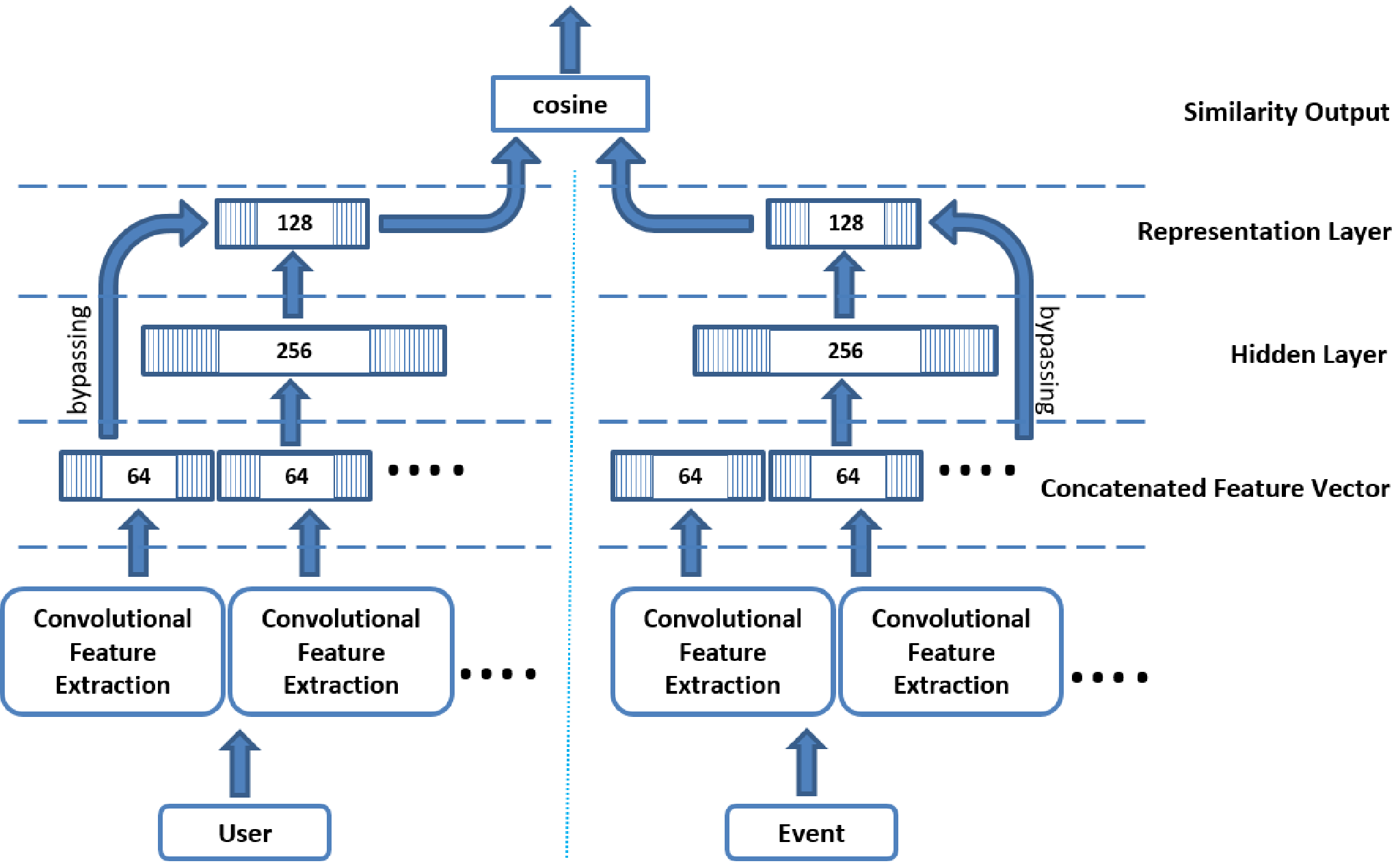
The core innovation is a parallel neural network that processes users and events separately before projecting them into a shared latent space.
- Event Side: Uses CNNs with letter trigram tokenization to capture the semantics of titles and descriptions, effectively handling typos and rare words.
- User Side: A highly flexible head that processes categorical IDs (like location or interests) and text (subscribed page titles).
- Joint Space: Both sides are optimized such that the cosine similarity between a user vector and an event vector is maximized for successful participations.
2. The GBDT Combiner
Rather than using the raw cosine similarity for the final recommendation, the authors extract the latent vectors and feed them into a Gradient Boosting Decision Tree (GBDT). This allows the system to learn high-order interactions between the deep-learned "latent topics" and traditional features like "number of friends attending."
Experiments: More Than Just "Keyword Match"
The model was tested against a high-bar production baseline at Facebook.
| Integration Setting | Precision @ Recall 80 (PR80) | AUC |
|---|---|---|
| Baseline | 0.262 | 0.810 |
| Add Rep. Vectors (Ours) | 0.339 | 0.861 |
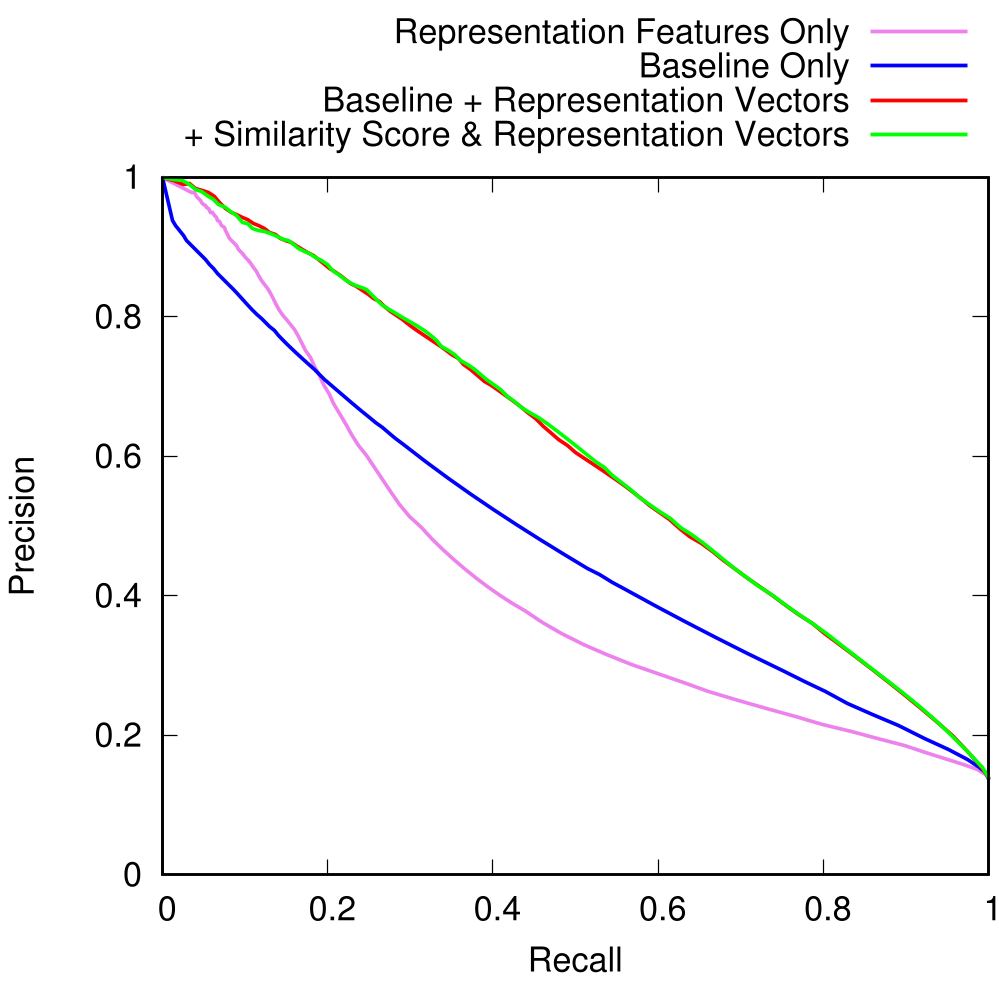
The results show that Representation Learning provides a much larger boost than traditional Collaborative Filtering in this domain. This confirms that when history is sparse, semantic understanding of the entity is the primary driver of relevance.
Deep Insight: Why CNNs?
Unlike Bag-of-Words models, the CNN approach with log-sum-exp pooling identifies "trigger phrases" regardless of where they appear in the text. As shown in the paper's visualization, the model successfully attends to informative nouns and verbs like "Ice Cream," "Festival," and "Baptism," even in long, noisy descriptions.
Critical Analysis & Conclusion
Takeaway
This work demonstrates that "Semantic Matching" is not just for search engines; it is a critical component for recommender systems dealing with short-cycled content. By decoupling representation learning from ranking, Facebook built a system that scales to hundreds of millions of users.
Limitations
- Real-time Computation: Deep CNNs are expensive. The authors mitigate this by caching vectors, but this might not work for hyper-dynamic updates where event descriptions change frequently.
- Negative Sampling: The paper uses random negative sampling; further gains might be found using "hard negative mining" (sampling events that are popular but not relevant to that specific user).
Future Outlook
The move toward "Joint Representations" paves the way for cross-domain recommendations—where your activity in "Groups" or "Marketplace" can directly inform your "Events" feed, breaking down the silos of isolated recommendation engines.