
JMBS-Net: Decoding the Digital Footprints of Student Success
Jointly Modeling Individual Student Behaviors and Social Influence for Prediction Tasks
The paper introduces JMBS-Net, a general deep neural network designed to predict student outcomes (GPA, library usage, financial hardship) using campus digital footprints. It uniquely combines an individual's heterogeneous behavior sequences with a sub-graph representing social influence, achieving SOTA results across multiple university-level prediction tasks.
TL;DR
Researchers from Shanghai Jiao Tong University have developed JMBS-Net, a deep learning framework that predicts a student's academic future and financial needs by looking at their "digital footprints." By analyzing patterns like library entrance times, meal habits, and social circles—factoring in even the weather—the model provides a highly accurate tool for university administrators to provide timely interventions.
Context: Beyond the Gradebook
Traditionally, if a university wanted to predict which students might struggle, they looked at last semester's grades. But grades are lagging indicators. The leading indicators are the daily habits: Is the student going to the library? Are they eating at regular times? Do their friends have similar study habits?
The challenge lies in the complexity of this data. Behavior is context-dependent (you don't go to the library in a storm) and socially influenced (you study more if your friends study more). JMBS-Net addresses these nuances directly.
Methodology: The Three Pillars of JMBS-Net
The architecture is elegantly divided into three functional parts:
1. Context-Aware Behavior Modeling
Standard LSTMs treat every input equally. JMBS-Net uses a Context-Aware LSTM variant. It treats weather and "Day of Week" as control signals within the input, forget, and output gates. This reflects physical reality: we process our environment differently depending on the context.
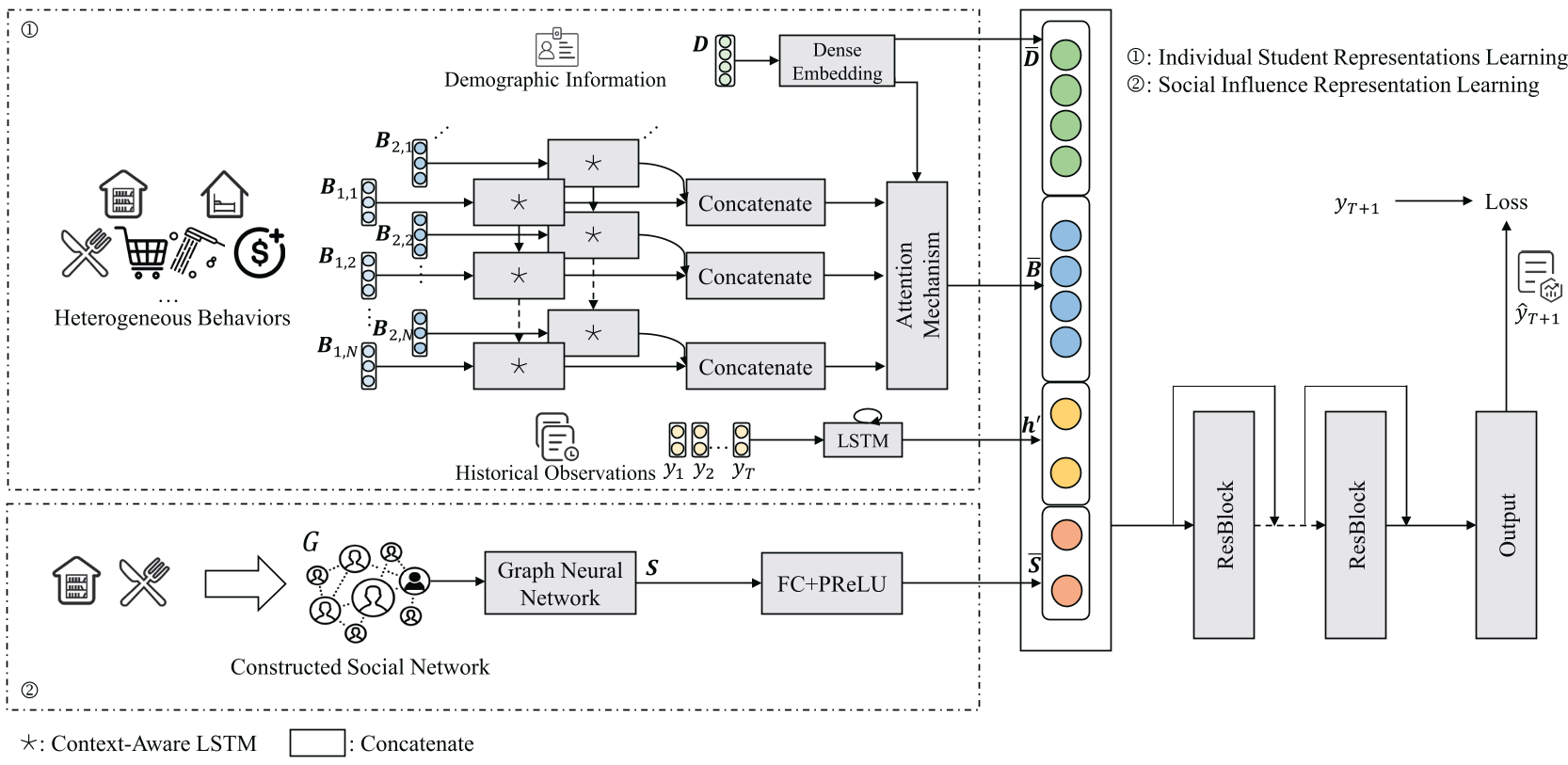
Furthermore, not every day is equally representative of a student’s "Unique Habit." The model uses an Attention Mechanism to dynamically assign weights to specific days, learning, for instance, that a student’s weekend library habits might be a stronger predictor of success than their weekday attendance.
2. The "Ghost" Social Network
Universities rarely have an explicit list of who is friends with whom. The authors solved this by inferring friendship via spatiotemporal co-occurrence.
- The Intuition: If two students enter the library or pay at the same canteen POS within a 10-minute window repeatedly (e.g., >30 times/semester), they are likely friends.
- The Math: These relationships are mapped into a social graph and converted into feature vectors using Structural Deep Network Embedding (SDNE), which preserves the "local" and "global" clusters of the campus social fabric.
3. Residual Interaction Decoder
Finally, the "Individual Habits" and "Social Influence" vectors are fused. To handle the high-dimensional nonlinearities, the authors used a Residual Network (ResNet) based decoder. This prevents the "vanishing gradient" problem and allows the model to find deep, subtle correlations between social circles and academic outcomes.
Experimental Results & Insights
The model was tested against several baselines, including Gradient Boosting (GBDT) and standard MLPs.
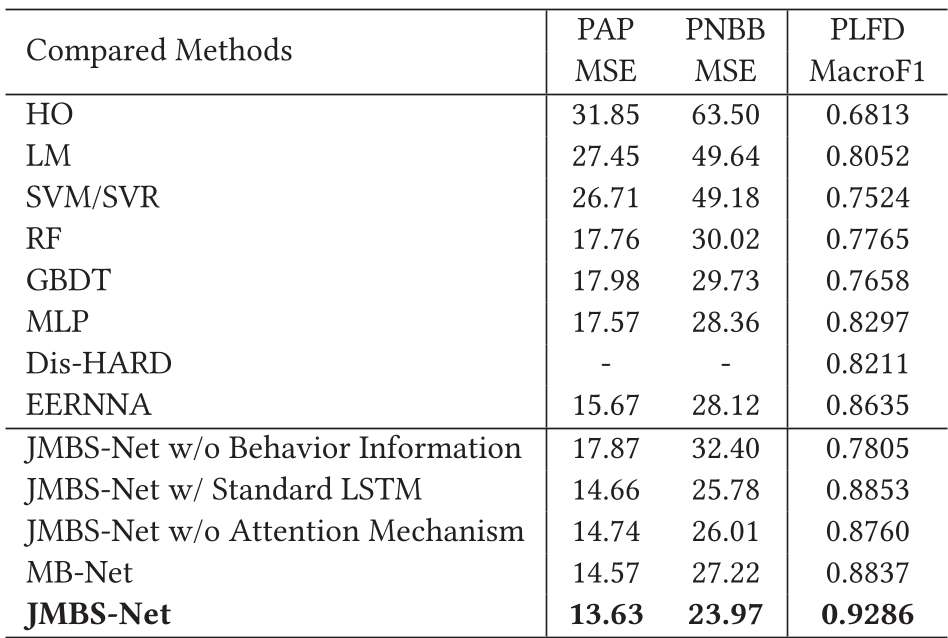
- SOTA Achievement: JMBS-Net achieved a 13.63 MSE in grade prediction, significantly lower (better) than its closest competitor EERNNA (15.67).
- The Power of Social: The Ablation study showed that removing the Social Influence module led to a performance drop of up to 13.6%. Who you hang out with truly matters.
- Timing: The study found that predictions made after 9 weeks of a semester (the half-way point) are optimal, providing a balance between data sufficiency and the need for early intervention.
Critical Insight & Future Outlook
The beauty of JMBS-Net is its extensibility. While the authors used smart card swipes, they explicitly noted that this can be swapped for WiFi log data, which is even more ubiquitous.
However, the "Black Box" nature of Deep Learning remains a hurdle for educational ethics. While the model knows who is at risk, it doesn't always explain why in a way a counselor can easily relay. The next frontier for this research will likely be Explainable AI (XAI)—turning these digital footprints into actionable, transparent advice for students.
Conclusion
JMBS-Net proves that students are not just a collection of grades, but individuals embedded in a complex physical and social environment. By "listening" to the digital echoes of campus life, institutions can move from reactive grading to proactive support.