
JoinUs: Orchestrating the City as a Living Lab through Mobile Social Networks
JoinUs: Management of Mobile Social Networks for Pervasive Collaboration
This paper introduces "JoinUs," a pervasive collaboration system that integrates mobile social networks with urban sensing. It utilizes a "mini-campaign" framework to organize spontaneous "flash mobs" for localized tasks using built-in smartphone sensors like GPS and cameras.
TL;DR
JoinUs is a pioneering framework designed for the mobile era that transforms casual social networking into a tool for pervasive collaboration. By leveraging spatial locality, temporal synchronization, and a unique social credit system (SoDits), it enables the creation of "mini-campaigns"—spontaneous flash mobs that use smartphones to collect data or perform urban tasks.
Context: Beyond the Desktop Social Network
Back when mobile social networking was a nascent field, the primary challenge was moving beyond simple "status updates." The authors of JoinUs recognized that smartphones were more than communication devices; they were mobile sensor hubs. However, the missing link was a mechanism to coordinate strangers or communities based on their physical location and immediate interests.
The Problem: The Coordination Gap in Urban Sensing
Prior work in urban sensing often relied on passive data collection without user engagement, or social networks that had no concept of "geofenced tasks." This led to two main issues:
- Inertia: Users had no incentive to participate in "useful work" for society.
- Noise: Sending invitations to every user nearby would lead to notification fatigue and network flooding.
Methodology: The Three Pillars of JoinUs
The authors address these gaps through a structured conceptual model that integrates social physics with economic theory.
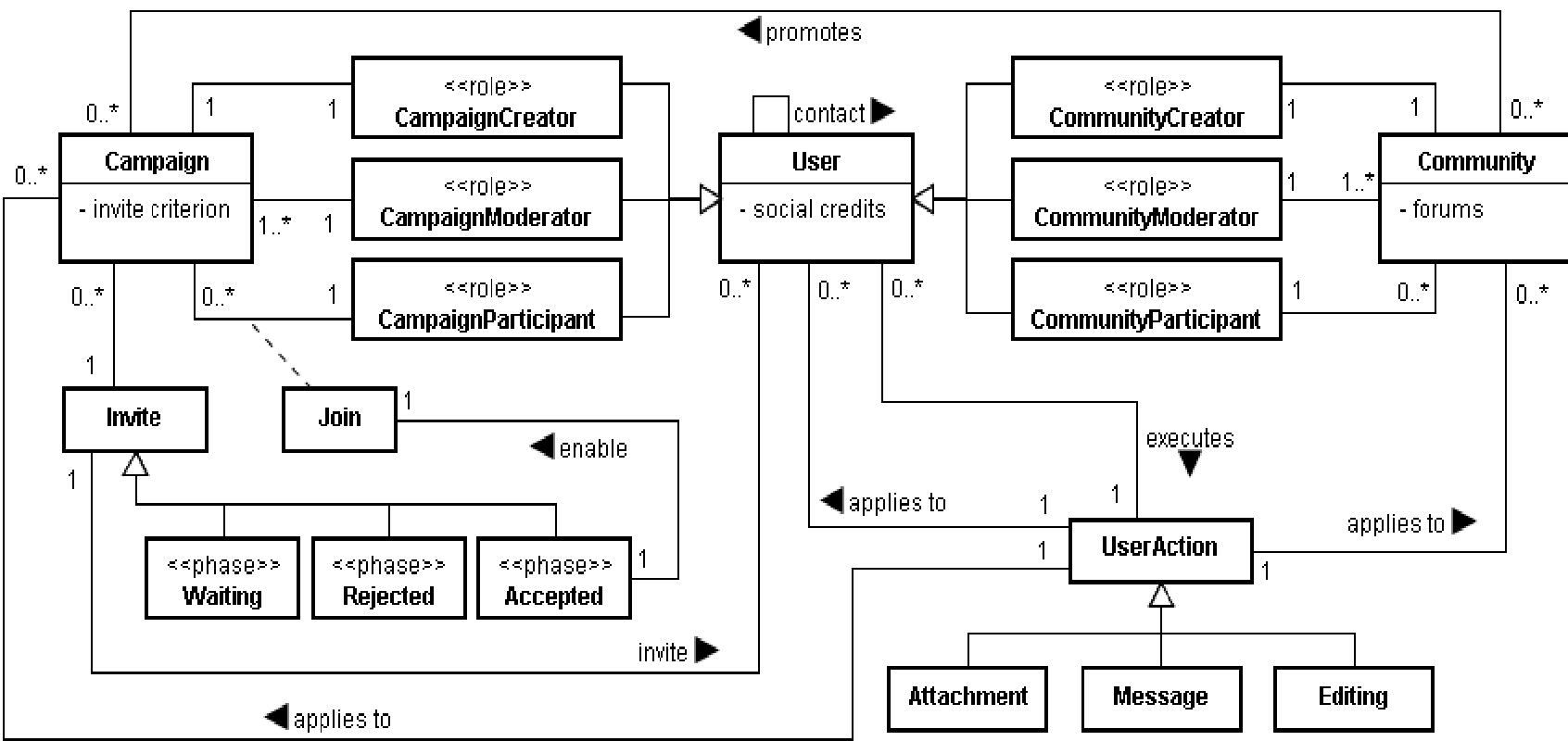
1. The Conceptual Model (Campaigns & Communities)
JoinUs structures interactions around Campaigns. A campaign is a time-bound, location-specific task. The system uses a role-based hierarchy (Creator, Moderator, Participant) to maintain order within these spontaneous groups.
2. SoDits: The Virtual Economy of Collaboration
To solve the "free-rider" problem and prevent system abuse, the authors introduced SoDits (Social Credits).
- As a Regulator: Creating a global-scale campaign costs more SoDits than a local one, preventing spam.
- As an Incentive: Users earn SoDits by contributing to campaigns (e.g., taking photos for a search-and-rescue mission). This "Tit-for-tat" logic, inspired by P2P protocols like BitTorrent, ensures the system remains sustainable.
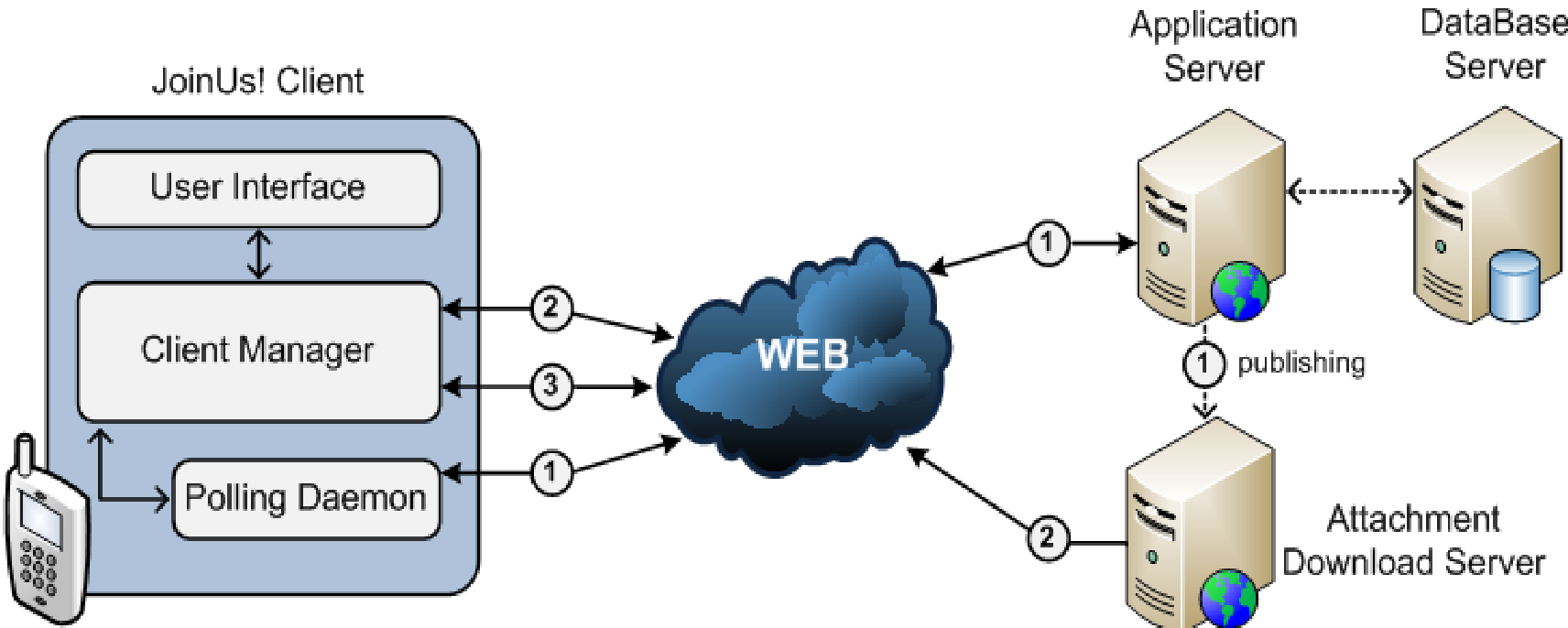
3. Client-Server Distribution Architecture
The architecture relies on a polling mechanism where the mobile client periodically updates the server with GPS coordinates and battery status. The server then matches the user against active campaign criteria (Spatial and Temporal locality) and pushes relevant invitations.
Experiments: Prototyping on Android
The researchers implemented JoinUs using the early Google Android SDK. They demonstrated a scenario called "Ecological Hunting," where a user could trigger a mission for a specific bird sighting within a 3-mile radius of a park.
Key Results:
- Feasibility: The system effectively managed invitations based on geographical polygons.
- Monitoring Capabilities: The developed Location Manager allowed for real-time tracking of movement and campaign density, providing a high-level view of collective urban activity.
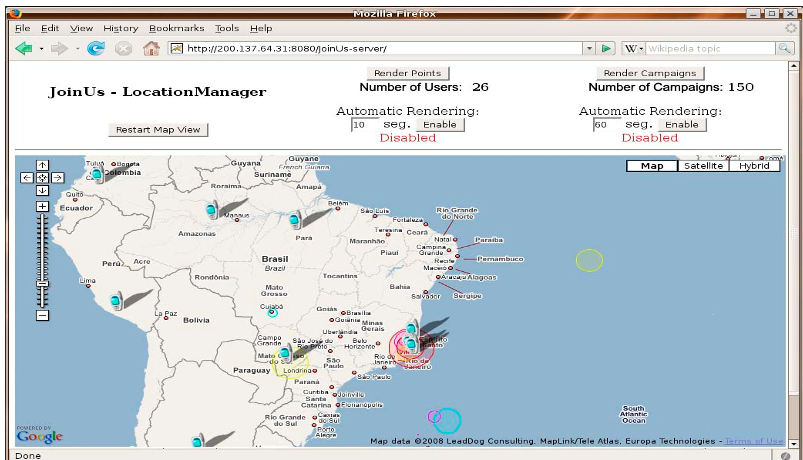 Figure: Zooming and Moving map tools used to monitor local campaign density.
Critical Analysis & Conclusion
JoinUs is a visionary piece of work that anticipated the "Gig Economy" and modern "Participatory Sensing" applications.
Strengths:
- The use of SoDits is a brilliant early application of gamification and tokenomics in social computing long before the blockchain era.
- The focus on spatial-temporal locality ensures that digital interactions are rooted in physical reality.
Limitations:
- Privacy: The prototype requires frequent GPS updates to a central server, raising significant privacy concerns that would require sophisticated encryption or federated approaches today.
- Scalability: The polling-based sync process might struggle with millions of concurrent users without the "user clusters" mentioned in the future work section.
The Takeaway: JoinUs proves that for mobile collaboration to work, the system must bridge the gap between digital social ties and physical location, using economic incentives as the glue. It sets the stage for everything from Waze-like traffic reporting to modern disaster management apps.