
HMPGA: Solving the Curse of Dimensionality in Credit Scoring via Hybrid Evolutionary Search
Journal of Computational and Applied Mathematics
The paper introduces HMPGA, a two-phase hybrid feature selection system for credit scoring that combines filter approaches (F-score, Information Gain Ratio, Pearson Correlation) with a Multiple Population Genetic Algorithm (MPGA). Using SVM as the base classifier, the method achieves state-of-the-art accuracy on UCI German and Australia datasets by optimizing feature subsets through co-evolution.
TL;DR
Credit scoring models are the backbone of modern banking risk management, yet they are often bogged down by high-dimensional, noisy data. This paper presents HMPGA, a hybrid system that leverages Multiple Population Genetic Algorithms and Filter methods to extract the most predictive features. By allowing multiple "tribes" of solutions to evolve and exchange information, HMPGA achieves higher accuracy and faster convergence than standard genetic algorithms.
Background: The High Stakes of Feature Selection
In the wake of the 2007 financial crisis, the importance of accurate credit risk assessment skyrocketed. While banks possess massive amounts of customer data, much of it is "noise"—features that don't actually help predict default. Standard feature selection methods like Filters (fast but ignore classifier interaction) or Wrappers (accurate but computationally expensive) have distinct trade-offs. The authors seek a middle ground: a Hybrid approach that is both intelligent and efficient.
The Problem: Why Standard GA Fails
Standard Genetic Algorithms (GA) often suffer from Premature Convergence. In the evolutionary process, a dominant (but sub-optimal) individual can quickly take over the population, leading to a lack of genetic diversity. The algorithm "stalls," failing to find the global optimum. Furthermore, starting a GA with a purely random population is like searching for a needle in a haystack without a map.
Methodology: The HMPGA Architecture
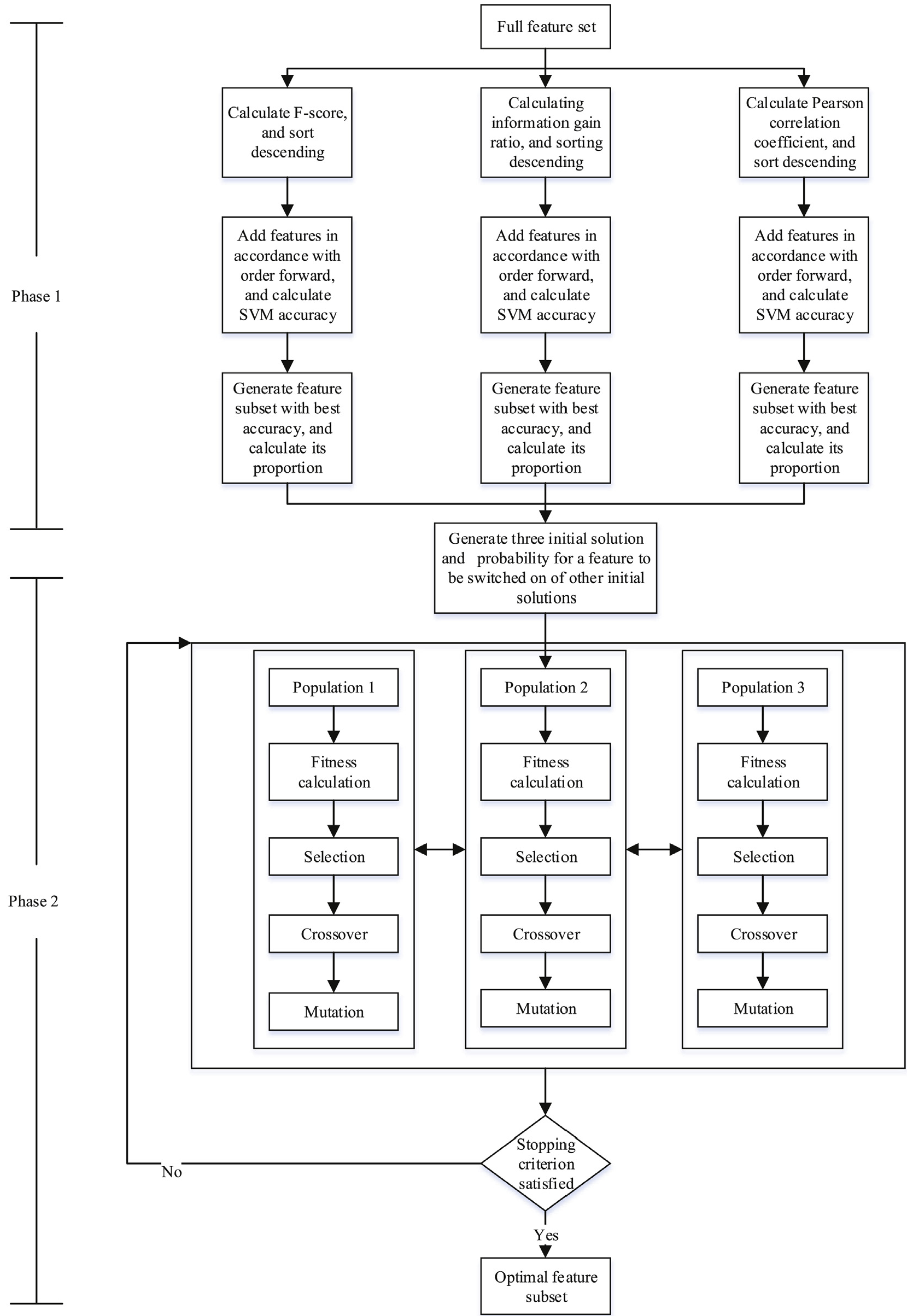
The proposed HMPGA framework operates in two distinct phases to solve these challenges.
Phase 1: Prior Information Mining
Instead of starting from zero, the authors use three filter methods (F-score, Information Gain Ratio, and Pearson Correlation) to rank features. They then use a "Forward Selection" wrapper to find the optimal number of features for each filter type.
- Insight: These results serve as "expert seeds" for the genetic population.
- Switch-on Probability: The average optimal feature proportion from these filters is used to set the initial bit-string density for the rest of the population.
Phase 2: Multiple Population Evolution
This is where the "Multiple" in MPGA comes in. Instead of one population, HMPGA maintains several, each with different Crossover () and Mutation () probabilities.
- Population 1: High , High (Global exploration).
- Population 2: High , Low (Local refinement).
- Immigration Operator: Every few generations, the best individuals migrate between populations, ensuring that if one group finds a "gold mine" of features, the information is shared without losing the diversity of other groups.
Experimental Results: SOTA Performance
The authors tested HMPGA on two classic benchmarks: the German and Australia credit datasets from the UCI repository.
1. German Dataset Analysis
The German dataset is complex, with 24 features and a 7:3 split of good/bad customers. Using a standard SVM with all features yielded 75.5% accuracy. HMPGA improved this to 78.53% while reducing the feature count to approximately 15.
2. Australia Dataset Analysis
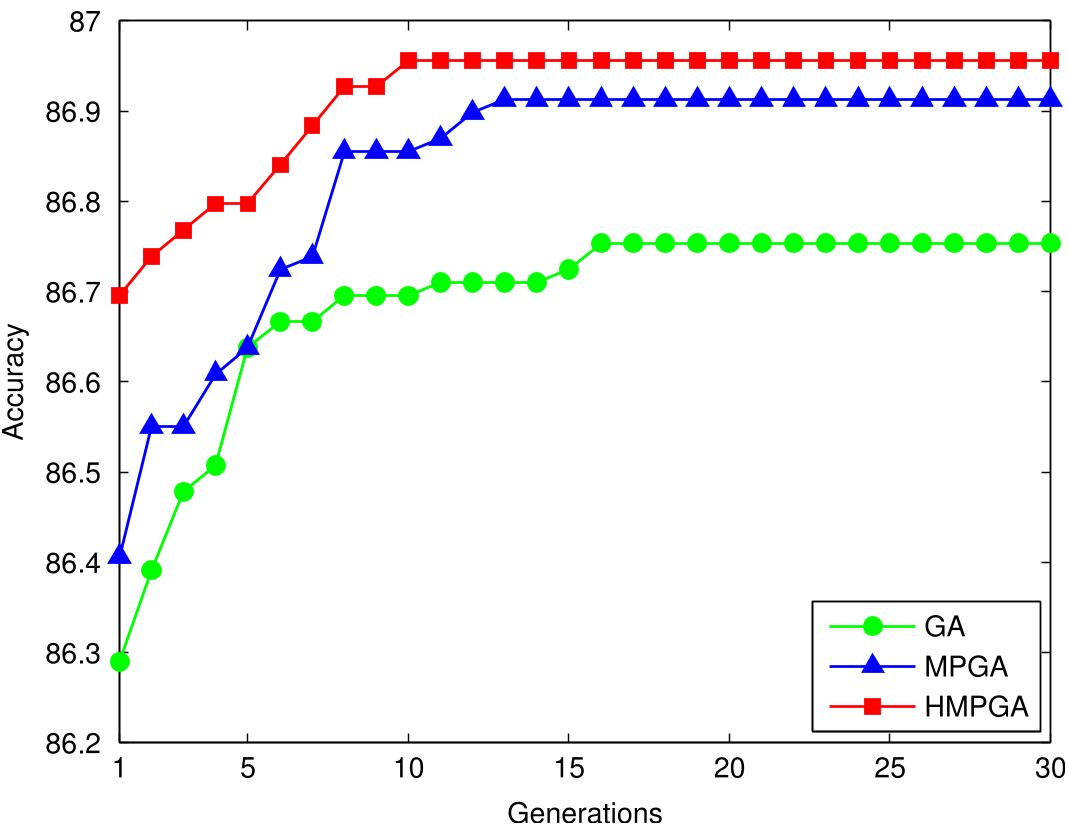
In the Australia dataset, HMPGA reached a mean accuracy of 86.96%. More importantly, the standard deviation of its results was nearly zero (), indicating extreme stability and convergence reliability compared to standard GA (0.24%).
3. Convergence Speed
As seen in the evolutionary plots, HMPGA starts at a much higher baseline accuracy thanks to the Phase 1 prior information and maintains a steeper improvement curve compared to its predecessors.
Implementation Insight: Parameter Optimization
The study doesn't just optimize features; it also optimizes the classifier. They used a Grid Search for the SVM RBF kernel parameters ( and ), utilizing 10-fold cross-validation to ensure the results wasn't just "overfitting" to the training set—a critical step in financial modeling where generalization is everything.
Critical Analysis & Conclusion
Takeaways
- Hybridization is Key: Combining the speed of filters with the precision of wrappers provides a robust solution for NP-hard feature selection problems.
- Diversity Matters: The Multi-Population approach effectively "cracked" the premature convergence bottleneck that has plagued simple GAs for decades.
Limitations & Future Work
While HMPGA is powerful, the authors note that results can still be sensitive to the initial control parameters of the multiple populations. Future research could focus on Adaptive Genetic Algorithms (AGA), where mutation and crossover rates change dynamically based on the fitness variance of the population, potentially removing the need for manual parameter tuning altogether.
Beyond credit scoring, the HMPGA framework is a versatile tool for any high-dimensional data mining task, from medical diagnosis to fraud detection.