
The Finance-Growth Nexus in Asia: Beyond Traditional Econometrics
Journal of Computational and Applied Mathematics
This study investigates the nexus between financial development (proxied by private credit) and economic growth in China, Japan, and India using a novel Bootstrap ARDL testing framework and machine learning classifiers. The research demonstrates that while long-run cointegration is statistically elusive, significant short-term causal relationships exist, and ML models like the Iterative Classifier Optimizer can effectively predict economic status.
TL;DR
Is financial depth a prerequisite for economic wealth, or does wealth create the demand for complex financial systems? This study re-examines the relationship between private credit and GDP in China, Japan, and India (1960–2016). By applying a more rigorous Bootstrap ARDL framework and Machine Learning, the authors find that while a permanent "lock-step" long-term bond (cointegration) is hard to prove, the short-term causal feedback loops are powerful and distinct across these three economic giants.
Problem & Motivation: The "Chicken or Egg" Dilemma
The academic debate on financial development has long been split into three camps:
- Supply-Leading: Finance is a precondition for growth (Schumpeterian view).
- Demand-Following: Growth creates a need for financial services (Robinsonian view).
- Bidirectional: They feed into each other.
The motivation for this study stems from the fact that previous research using the standard ARDL (Autoregressive Distributed Lag) approach often ignored "degenerate cases"—statistical traps where variables seem related but lack a true long-term equilibrium. By focusing on China, Japan, and India, the study targets the three most influential growth engines in Asia.
Methodology: High-Precision Econometrics meets AI
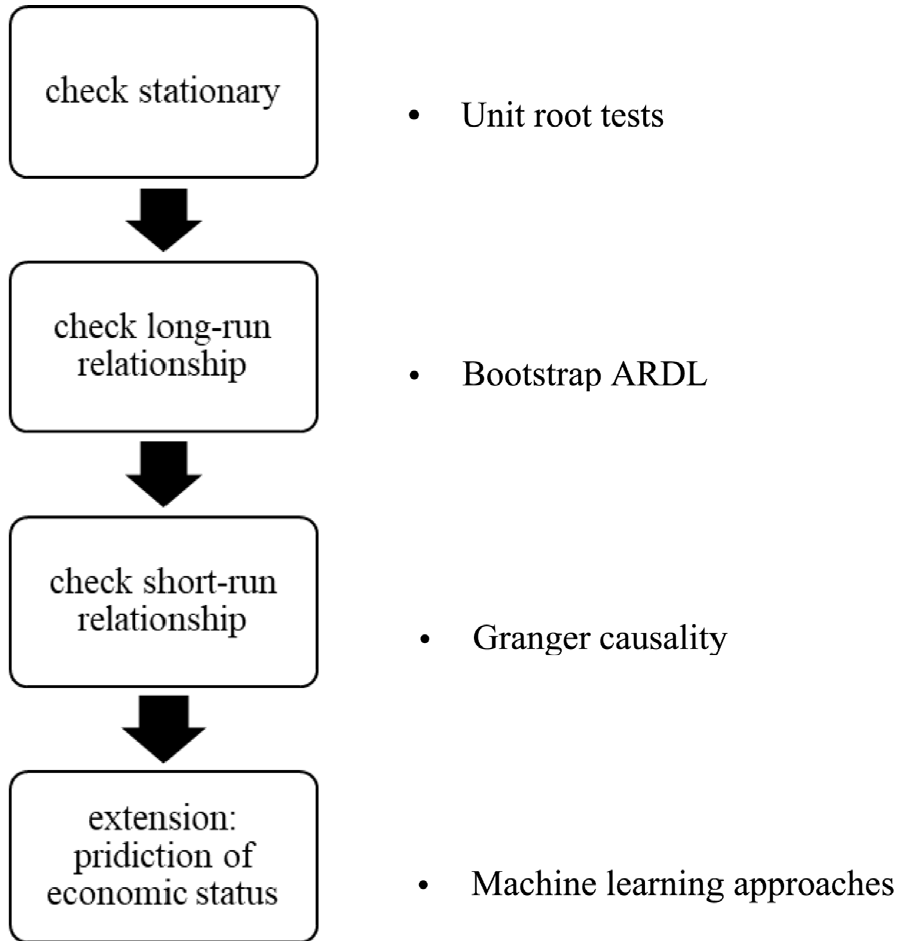
The authors move beyond the "Bounds Test" by adopting the Bootstrap ARDL method.
1. The Bootstrap Advantage
Unlike traditional tests that assume the exogeneity of independent variables, the bootstrap variant:
- Allows for endogeneity (feedback loops).
- Uses three criteria (F-test, , and ) to rule out false-positive cointegration.
- Addresses structural breaks in the timeline (like the 1990s Asian Financial Crisis or China's 1978 reforms).
2. Machine Learning as a Complement
The study doesn't stop at causality; it uses classification algorithms to predict economic phases.
Core Findings: A Tale of Three Giants
Despite the rigorous testing, the study found no definitive long-run cointegration. This suggests that while finance and growth are linked, they aren't permanently tethered by a single equilibrium in these specific countries. However, the Short-Run Granger Causality revealed fascinating nuances:
- Japan & India: Showed positive bidirectional feedback. Finance drives growth, and growth incentivizes further financial depth.
- China: Exhibited a unique pattern—Positive Supply-Lead (credit helps growth) but Negative Demand-Following. This implies that while credit expands the economy, rapid growth might actually lead to a decline in the efficiency of private credit allocation, possibly due to state-dominated banking sectors.
Performance of ML Classifiers
The study compared SVM, Bayesian Networks, Random Forests, and AdaBoost. The Iterative Classifier Optimizer emerged as the SOTA (State-of-the-art) for this dataset.

Critical Analysis & Policy Insights
The study’s lack of long-run cointegration is a "negative result" that carries significant weight—it warns researchers that the finance-growth link is more fragile and context-dependent than previously thought.
Managerial Takeaways:
- For China: The focus should shift from "credit volume" to "financial efficiency." Monitoring non-performing loans in state-owned enterprises (SOEs) is vital to ensure that credit actually transforms into productive output.
- For Japan & India: The "virtuous cycle" is intact. Policymakers should continue facilitating financial integration and market-oriented reforms to sustain the engine of growth.
Limitations
The study uses "Private Credit" as the sole proxy for financial development. Future research might benefit from including Stock Market Capitalization or FinTech adoption rates, as traditional banking credit is only one slice of a modern financial system.
Conclusion
By blending the statistical rigor of the Bootstrap ARDL with the predictive power of AdaBoost, this paper provides a robust blueprint for macroeconomic analysis. It proves that in the complex Asian landscape, finance is not just a passive passenger of growth, but a dynamic (though sometimes inefficient) driver that requires constant regulatory fine-tuning.