
Beyond Ambient Awareness: How ESNs Transform Managers into Information Hubs
Journal of Strategic Information Systems
This study validates and extends Communication Visibility Theory (CVT) through a quantitative analysis of 206 employees. It examines how Enterprise Social Networks (ESNs) foster "meta-knowledge"—knowing who knows what and who knows whom—across various organizational contexts.
TL;DR
Is scrolling through your company's internal social network a waste of time? New research validates Communication Visibility Theory (CVT) across diverse industries, proving that Enterprise Social Networks (ESNs) are critical for developing "meta-knowledge." The study reveals that ESNs don't just work through passive "osmosis"—they provide immediate benefits through active searching, and managers actually gain more value from them than regular employees.
The Problem: The "Leaky Knowledge" Dilemma
In a world of distributed teams, the biggest hurdle isn't just what we know, but knowing who knows what. This is called meta-knowledge. Without it, employees waste hours reinventing the wheel.
Earlier theories suggested that ESNs help by making private conversations public, allowing others to "overhear" expertise. However, this process was thought to be slow and passive. Furthermore, critics wondered: Does this actually work outside of tech-savvy financial firms? And do managers—who are often the most skeptical of social tools—actually benefit?
Methodology: Testing the Multi-Context Bridge
The researchers surveyed 206 employees across various sectors (Automotive, Banking, IT, etc.) in Germany and Switzerland. They moved beyond simple observations to a complex Moderated Mediation Model.
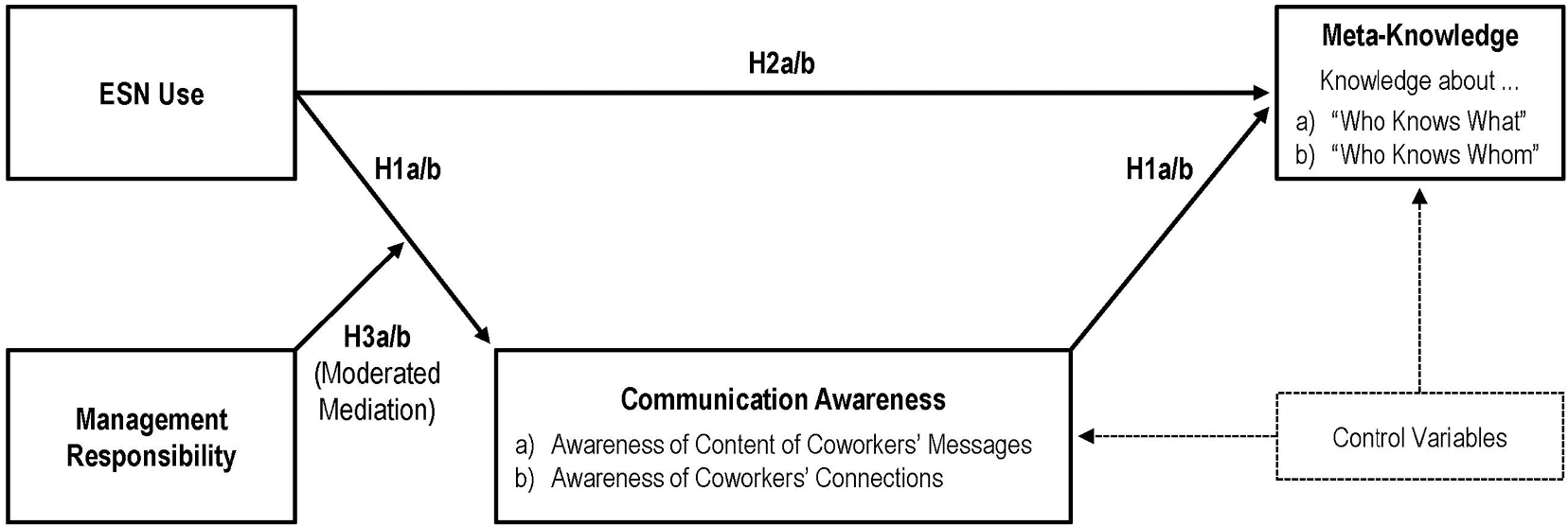
The Research Model
The study looked at two pathways:
- The Indirect Path: ESN Use Communication Awareness Meta-knowledge.
- The Direct Path: ESN Use Meta-knowledge (via active searching/posting).
Core Insight: The "Managerial Edge"
The most striking finding is the role of Management Responsibility. Managers have an inherent "information hunger" due to their need to coordinate resources and span boundaries.
The data showed that when a manager uses an ESN, their Communication Awareness increases significantly more than a non-manager's does for the same level of usage.
- Why? Managers actively look for "who is doing what" to fill gaps in their strategic oversight. They treat the ESN as a live dashboard of organizational capability rather than just a social feed.
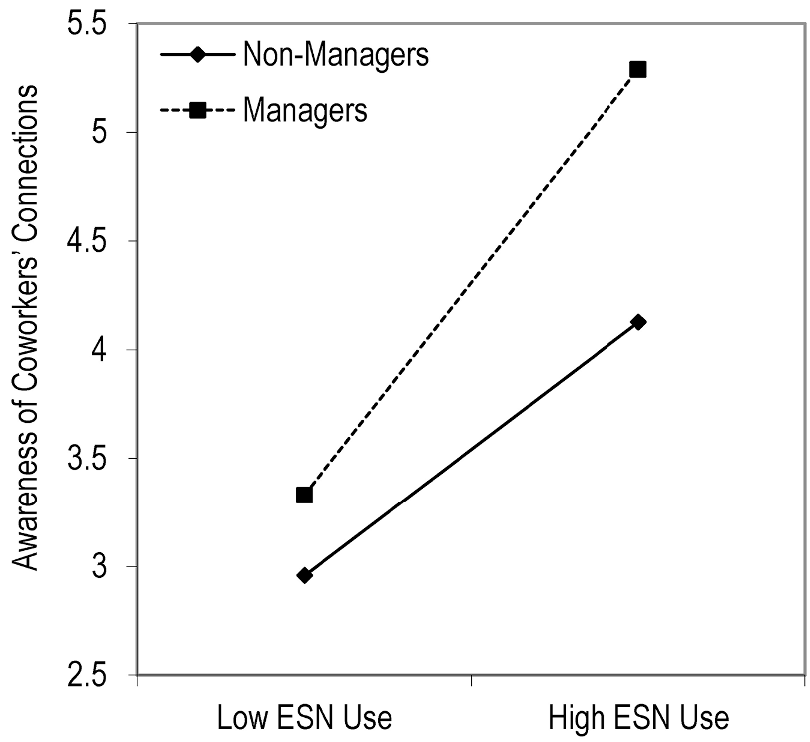 The interaction plots clearly show that for "High ESN Use," managers (solid line) achieve significantly higher awareness of coworkers' connections compared to non-managers (dashed line).
Key Competitive Results
- Cross-Context Validation: The theory held up across different company sizes and industries, proving ESNs are a universal tool for Transactive Memory Systems (TMS).
- Direct Efficiency: ESNs offer a "fast track" to meta-knowledge. Users don't have to wait months to "absorb" the culture; they can use search functions and profiles to gain immediate insights ( for all direct paths).
- Statistical Power: The model explained roughly 50% of the variance in meta-knowledge (), a very high figure for social science research.
Critical Analysis & Conclusion
This paper serves as a vital "rebranding" of ESNs for the C-suite. For years, executives viewed ESNs as "Facebook for work"—a potential distraction.
The Takeaway: ESNs are actually high-fidelity sensors for organizational expertise.
Limitations
- Cultural Specificity: The study was limited to German-speaking countries, where organizational hierarchies might influence communication differently than in Silicon Valley or Asia.
- Cross-Sectional: It captures a snapshot in time, not the long-term evolution of these digital networks.
Future Outlook
As we move into the era of AI-Integrated ESNs, the "visibility" of communication will only increase. Future systems might automatically "map" expertise for managers, reducing the cognitive load of staying aware. For now, the message is clear: if you are a manager and you're staying off the ESN, you're flying blind.