
JPR: Synchronizing Partitioning and Replication to Slash OSN Traffic
JPR: Exploring Joint Partitioning and Replication for Traffic Minimization in Online Social Networks
This paper introduces Joint Partitioning and Replication (JPR), a novel data placement scheme for Online Social Networks (OSNs). By formulating the task as a revised graph partitioning problem with overlaps, it simultaneously optimizes both inter-server read and write traffic, significantly outperforming traditional decoupled methods.
TL;DR
Managing petabytes of data for billions of users in Online Social Networks (OSNs) requires more than just random hashing. While we traditionally use Partitioning (to group friends together) and Replication (to make data available locally), doing them separately is inefficient. This paper introduces JPR (Joint Partitioning and Replication), which uses a clever mathematical trick—transforming social graphs into Line Graphs—to optimize both read and write traffic simultaneously. The result? Up to a 40% reduction in server-to-server communication.
The Bottleneck: The "Multi-get Hole"
In modern OSNs like Facebook, when you load your newsfeed, the system performs a "multi-get" to fetch data from dozens of friends. If these friends are scattered across different servers (the "Multi-get Hole"), inter-server traffic explodes.
Why Current Solutions Fail:
- Consistent Hashing: Great for load balancing, but ignores social relationships, leading to high read traffic.
- SPAR (Simple Replication): Puts all friends on one server. While read traffic hits zero, write traffic (syncing dozens of replicas) becomes a nightmare.
- Decoupled Heuristics: Methods that "partition first, then replicate" fail because the "optimal" partition changes once you start adding replicas. It’s a classic chicken-and-egg problem.
Methodology: The Line Graph Insight
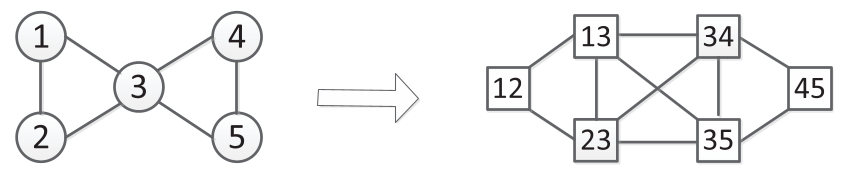
The authors' masterstroke is moving the problem from a standard Social Graph to a Line Graph.
How it works:
- In a standard graph, nodes are users and edges are interactions.
- In a Line Graph, the edges of the original graph become the nodes.
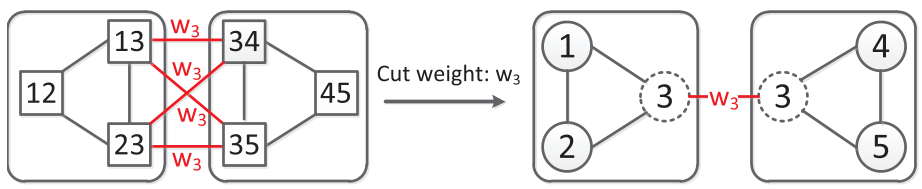
- Partitioning this Line Graph naturally creates overlaps in the original graph. These overlaps represent the replicas.
By partitioning the line graph, JPR optimizes for minimal cut weight, which translates directly to minimal inter-server write traffic. Once the replicas are placed, a secondary placeMaster() algorithm decides which server should hold the "Master" copy to minimize read traffic.
Performance: Quantitative Gains
JPR was tested against a Facebook dataset of ~25k users and ~626k interactions.
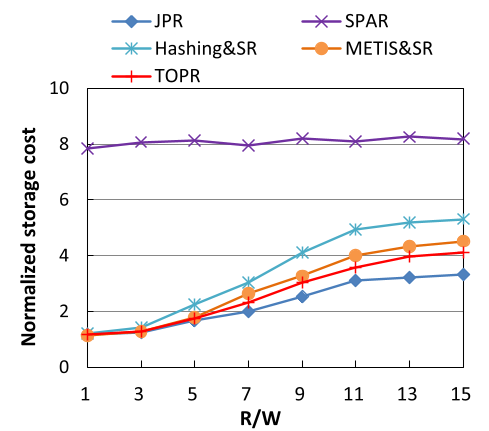
- Traffic Minimization: JPR consistently achieves the lowest total traffic across various Read/Write ratios. As OSNs are typically read-heavy, JPR’s ability to selectively replicate based on interaction frequency gives it a massive edge.
- Load Balancing: Using the Gini Coefficient, the authors proved that JPR maintains "fair" server loads, even when the constraints are tight.
- Storage Efficiency: Unlike SPAR, which replicates aggressively, JPR only creates a few replicas per user (usually < 4), significantly saving on hardware costs.
Critical Insights & Future Outlook
JPR proves that we cannot treat data placement as a black-box problem. The Interaction Graph (who actually talks to whom) is a much better signal than the Social Graph (who is "friends" with whom).
Limitations & Future Work:
- Computational Complexity: Transforming large-scale graphs (billions of edges) into line graphs significantly increases the vertex count for the partitioning algorithm. While the authors suggest parallelization (Label Propagation), real-time implementation on a global scale remains a challenge.
- Dynamic Adaptability: The paper proposes a hierarchical "Clustering Tree" to handle users joining/leaving, but the migration traffic during re-balancing is still a cost OSN providers must weigh carefully.
Summary: JPR is a mathematically elegant solution to a messy infrastructure problem, turning social locality from a burden into a performance advantage.