
The Just-in-Time Social Cloud: Engineering Social Influence for Better Decisions
Just-in-Time Social Cloud: Computational Social Platform to Guide People's Just-in-Time Decisions
This paper introduces the Just-in-Time Social Cloud, a computational framework designed to deliver real-time social influences via mobile devices at the exact moment of decision-making. By deploying two real-world applications, MealTime and SocialMenu, the study demonstrates that filtered social signals can mitigate behavioral biases and guide users toward long-term goals.
TL;DR
Humans are notoriously bad at making "virtuous" choices in the heat of the moment, often favoring immediate gratification (vices) over long-term goals. This paper presents a Just-in-Time Social Cloud—a mobile architecture that injects social signals (what your friends or the crowd are doing) at the exact second you make a choice. Through real-world experiments, the researchers prove that viral social influence can be "programmed" to help us save money, eat better, and resist impulsive biases.
Problem & Motivation: The Conflict of the "Present Self"
Why do we plan to eat a salad for lunch but end up ordering a burger when we look at the menu? The authors point to two cognitive "bugs" in human hardware:
- Hyperbolic Discounting: We undervalue future rewards compared to immediate ones.
- The Immediacy Effect: Vices become significantly more attractive at the moment of decision, even if we preferred virtues during the planning phase.
Existing social networks like Facebook focus on "engagement," but they don't help us solve these biases. The authors' insight is that mobile phones, which are always with us, can act as a "Persuasive Interface" to deliver a computational social cloud that redirects these impulsive forces.
Methodology: The Architecture of Influence
The authors break down the Just-in-Time Social Cloud into a sleek four-part engine:
- Goal: The user's long-term objective (e.g., "Eat Healthier").
- Selection: Computing which part of your social network is currently succeeding at that goal.
- Presentation: Deciding whether to show you a list of friends, a popularity "heat map," or group trends.
- Timing: Triggering the influence exactly at the "decision point."
Experimental Platforms: MealTime & SocialMenu
The team built two custom iPhone apps to test their theories in the wild:
- MealTime: Tracked campus dining transactions and showed users what their friends were buying via "digital receipts."
- SocialMenu: A digital restaurant menu that showed different social cues (e.g., "3 friends ordered this" or "Most popular item") while the user was seated and ready to order.
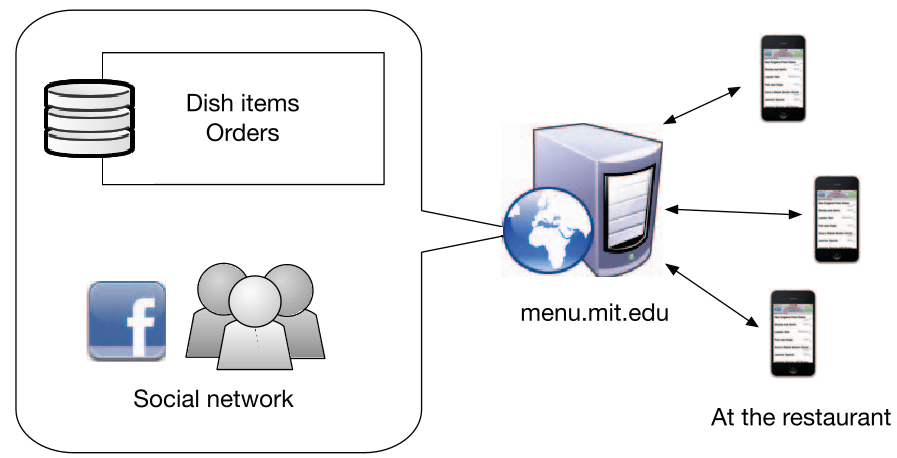 Figure 1: The SocialMenu architecture, mapping menu items to real-time social repositories.
Key Findings: Shortcuts vs. Engagement
The results reveal a fascinating "tuning" effect of social data:
- The Decoupling of Preference: 56% of participants chose dishes that were NOT on their pre-stated list of favorites once they saw the social cloud. This proves our "preferences" are highly volatile and context-dependent.
- Popularity is a Shortcut: When users saw "Aggregated Popularity," their time-to-decision decreased. It acts as a heuristic to reduce cognitive load—we just follow the herd to save brainpower.
- Friends Increase Engagement: When individual friend names were shown, users spent more time browsing. Seeing a specific peer's choice triggers social comparison and deeper deliberation.
- Group Pressure Saves Money: Seeing what a "group of friends" chose had the strongest effect on pulling users toward lower-priced items, suggesting a "normative" influence on spending.
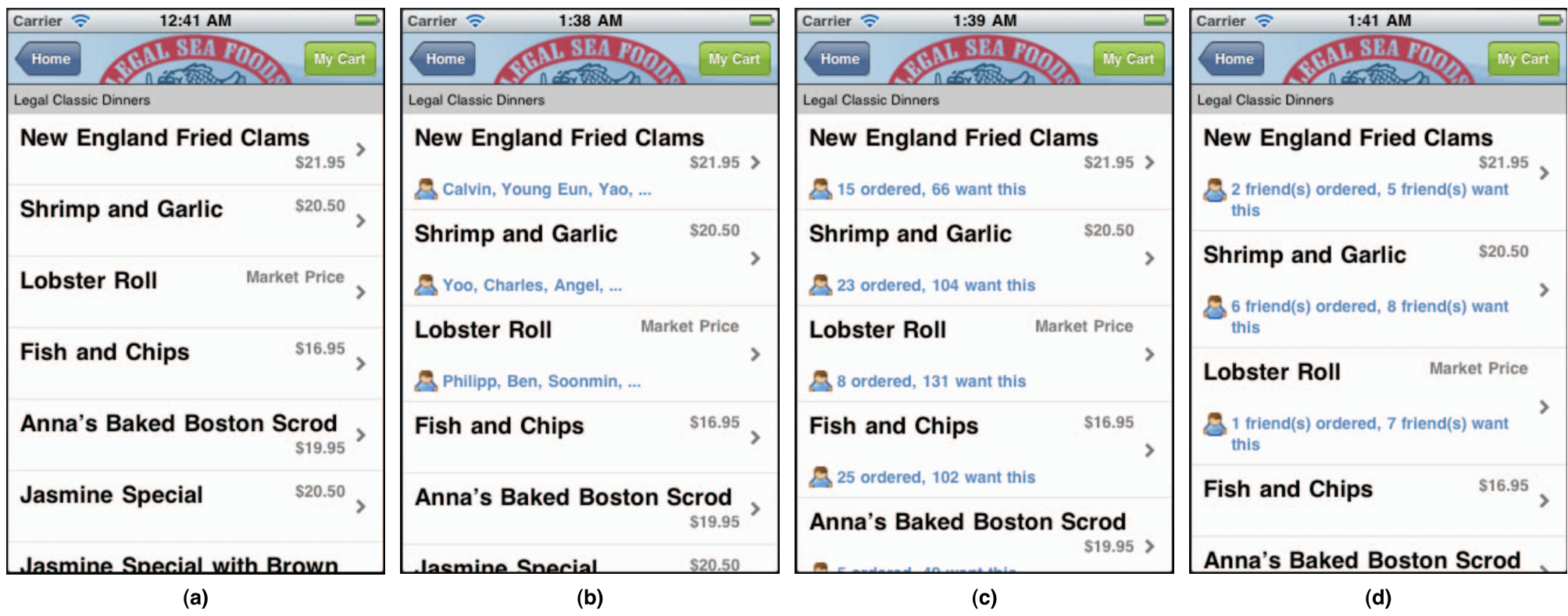 Figure 2: Different UI manifestations: (a) Control, (b) Friends, (c) Popularity, (d) Group influence.
Deep Insight: The Diversity Index
One of the paper's most potent contributions is the Diversity Index (). This metric measures how varied a person's choices are.
- High Diversity: You are an explorer, open to new options, and theoretically more susceptible to social influence.
- Low Diversity: You are a creature of habit. For these users, the social cloud acts as a reinforcement rather than a change agent.
Critical Analysis & Conclusion
Takeaway: Our mobile phones are no longer just windows into information; they are steering wheels for our behavior. By carefully choosing how we show social data—whether as a "popularity shortcut" or "peer engagement"—designers can nudge users toward better health and financial outcomes.
Limitations: The study notes that digital menus can sometimes decrease direct social interaction between diners. There is also a risk that the same technology could be weaponized by marketers to push "vices" (unhealthy, expensive items) rather than the "virtues" the authors intended.
Future Outlook: The next generation of AI assistants won't just tell you the weather; they will use your "Diversity Index" and your social graph to actively talk you out of that 11 PM impulse purchase.