
Preserving Global Structure: Distance-Aware Anonymization in Social Networks
A k-Anonymization Algorithm on Social Network Data that Reduces Distances between Nodes
The paper introduces a distance-aware k-anonymization algorithm for social network data based on the k-neighbor metric. It aims to satisfy privacy requirements by modifying graph structures while minimizing the distortion of node-to-node distances, ensuring the structural integrity of the anonymized graph remains suitable for analysis.
TL;DR
Anonymizing social network data often involves adding "noise edges" to make nodes indistinguishable to attackers. However, blindly adding edges can destroy the graph's structural essence. This paper proposes a Distance-Aware k-neighbor algorithm that uses Dijkstra-based selection to ensure noise edges only connect nodes that are already close to each other, thereby preserving the graph's utility for data analysis.
Background: The Cost of Privacy
In the era of social media, publishing user relationship data is vital for research but poses a massive privacy risk. Even if names are removed, an attacker with "neighborhood knowledge" (knowing who a target's friends are and how those friends relate) can identify individuals.
The k-neighbor metric ensures that every node's neighborhood subgraph is isomorphic to at least other nodes. While effective for privacy, existing greedy algorithms often connect nodes from opposite sides of the network to achieve this isomorphism. This "long-distance" edge addition shrinks accurately measured distances and merges distinct social communities, making the data "worthless" for structural analysis.
The Core Motivation: Why Location Matters
The authors identify a critical flaw in prior work: the utility gap. Prior algorithms (like Bin and Pei's) prioritize the number of edges but not their length.
- Prior Intuition: Just find any node with a low degree to complete the subgraph.
- Proposed Intuition: Find the nearest node with a low degree. By keeping changes local, we preserve the "Global Small-World" characteristics and the community boundaries of the original network.
Methodology: Smart Node Selection
The proposed solution modifies the node selection process during the isomorphism phase. Instead of a global search for low-degree nodes, the algorithm performs a local expansion.
The Distance-Controlled Greedy Search
The algorithm employs a modified Dijkstra approach to find a candidate node to connect to node :
- Proximity First: Start a BFS/Dijkstra search from the target node .
- Multisector Filtering: Among nodes within a distance threshold , select the one that has the lowest degree and the most similar label (attribute).
- Noise Node Fallback: If no suitable existing node is found within distance , only then create a completely new "noise node" to avoid long-distance bridges.
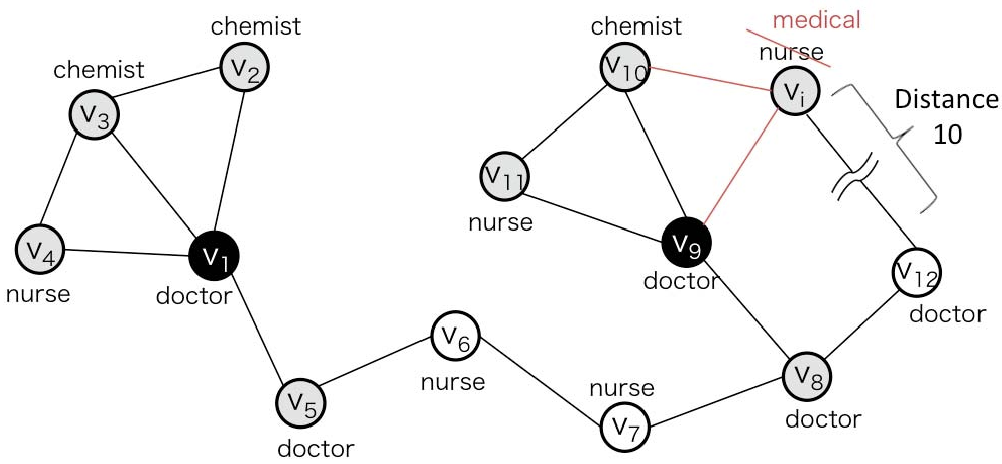 Fig 1: Example of how traditional algorithms create "long-distance" bridges (e.g., connecting v9 to v12), destroying the structure.
Experimental Validation
The authors tested their approach using synthetic small-world graphs (300 nodes, 600 edges).
Key Metrics:
- Average Connection Distance: How far apart are the nodes we just connected?
- Average Path Length (APL): How much did the total graph "shrink" after anonymization?
Results Analysis:
The results confirm that the proposed algorithm significantly reduces the average distance of added edges across all values of .
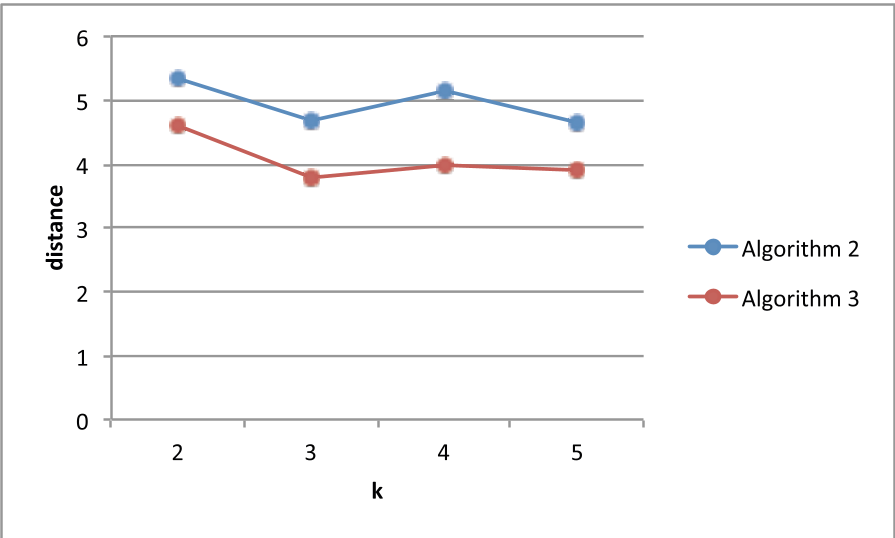 Fig 2: Comparison of average distance between connected nodes. The proposed method (Algorithm 3) consistently selects closer candidates.
While the APL (Average Path Length) showed improvement at , the authors noted that as increases, the sheer volume of noise edges required tends to saturate the graph, highlighting a fundamental trade-off between high levels of privacy () and the maintenance of specific graph properties like APL in dense clusters.
Critical Insight & Conclusion
This paper highlights a nuance often missed in privacy research: Structural Anonymity is not enough if it destroys Structural Utility.
Takeaways:
- Localism is Key: In graph data, the "cost" of an edge should be proportional to its topological length.
- Limitations: The algorithm's effectiveness depends on the original graph's density. In very sparse graphs, finding "close" candidates is harder, leads to more noise nodes, and potentially more information loss.
- Future Path: Integrating this distance-aware approach with l-diversity (protecting sensitive labels) and refining the distance threshold dynamically based on local edge density.
By shifting the focus from "how many edges" to "where are the edges," this work provides a more surgical approach to data privacy in complex social networks.