
k-hop Centrality: Scaling Influence Identification in Dynamic Large-Scale Networks
K-hop centrality metric for identifying influential spreaders in dynamic large-scale social networks
This paper introduces k-hop centrality, a novel localized metric designed to identify influential spreaders in dynamic large-scale social networks. By generalizing degree centrality to include nodes within k-hops with an attenuation factor, the method achieves state-of-the-art accuracy in predicting spreading influence as measured by the SIR model.
TL;DR
Identifying "super-spreaders" in social networks is critical for viral marketing and disease control, but we face a trade-off: Degree Centrality is fast but "blind" to topology, while Betweenness Centrality is "smart" but computationally crippled by large graphs. This paper introduces k-hop centrality, a tunable metric that uses localized k-step neighborhood information to provide high-accuracy influence prediction with a fraction of the computational cost ( vs ).
Problem & Motivation: The Global vs. Local Dilemma
In the context of the Influence Maximization problem, the goal is to select a set of nodes that triggers the largest cascade. Current academic benchmarks face two major hurdles:
- Computational Deadlock: Global metrics like Betweenness and Closeness require shortest-path calculations across the entire graph. In a dynamic network where nodes are added or removed every second, recalculating these is mathematically prohibitive.
- Topological Blindness: Degree Centrality simply counts direct neighbors. However, a node with 100 neighbors tucked away in a remote cluster is far less influential than a node with 50 neighbors situated at the heart of a "bridge" between communities.
The authors' insight is grounded in the physical intuition of attenuated reach: an influential spreader's value is determined by how many people they can reach quickly, but their influence decays as the "hops" increase.
Methodology: The k-hop Metric
The k-hop centrality is defined as a weighted sum of the number of nodes reachable within hops, where distant nodes contribute less to the total score:
- : Number of nodes within hops.
- : The average degree of the network (used as a penalty factor).
- : A tunable parameter (typically offers the best accuracy/speed balance).
Architecture and Scalability
Unlike global metrics, k-hop only requires knowledge of the local neighborhood. If an edge changes, you only need to update the values for nodes within its -hop radius, not the entire graph.
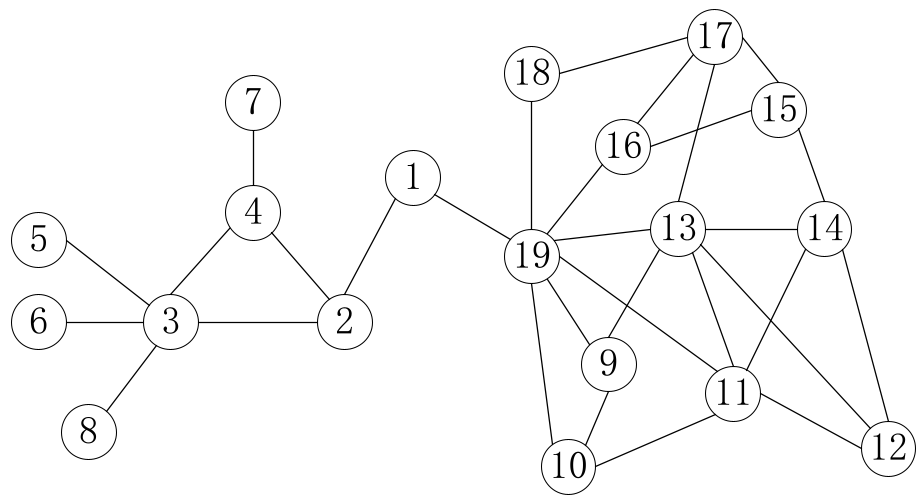 Figure 1: Comparison of nodes. Nodes with the same degree (like 3 and 11) have different spreading capabilities based on their multi-hop connectivity.
Experiments & Results
The authors validated the metric using the SIR (Susceptible-Infected-Recovered) model on four distinct datasets, including US flights and university email networks.
1. Spreading Accuracy
The study compared the "Ground Truth" (actual infection ratio in simulation) against various indices. While k-shell and betweenness showed a chaotic spread (meaning the index couldn't reliably predict the result), k-hop showed a tight, linear correlation with the infection ratio.
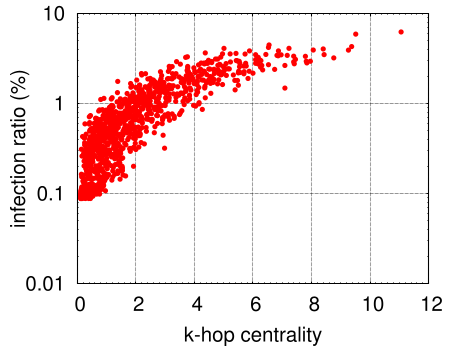 Figure 2: Performance of k-hop vs others. Note how k-hop (h) provides a clearer, more predictable correlation with spreading influence than Betweenness (a).
2. Multi-Spreader Efficiency
In real-world marketing, you don't pick one seed; you pick many. k-hop outperformed all baselines in the multiple-origin scenario. It successfully avoids "overlapping coverage"—a common failure in k-shell where several identified top nodes are too close to each other, wasting their spreading potential.
Critical Analysis & Conclusion
Takeaway
The k-hop metric effectively provides a "slider" between the speed of Degree Centrality and the depth of Katz Centrality. By setting , researchers can achieve high-fidelity influence mapping that evolves alongside the network in real-time.
Limitations
While the paper proves efficiency, the choice of the attenuation factor as the "average degree" is a heuristic. In highly heterogeneous networks (Power-Law distributions), a static might over- or under-estimate influence in dense cores versus sparse peripheries.
Future Work
The next logical step is applying k-hop centrality to multi-layer networks (e.g., how an influencer on Twitter impacts a trend on Instagram) and optimizing the value dynamically based on the local clustering coefficient.