
Mining k-Median Chromosome Association Graphs: A New Lens on Cellular Heterogeneity
8692_Mining k-median chromosome association graphs from a population of heterogeneous cells.
The paper introduces a novel optimization framework for mining k-median chromosome association graphs to identify structural patterns in heterogeneous cell populations. By representing chromosome territories (CTs) as weighted directed graphs and utilizing semi-definite programming (SDP) and local search, the method successfully differentiates between normal (MCF10A) and metastatic (MCF10CA1a) breast cancer cells based on interchromosomal arrangements.
TL;DR
Determining how chromosomes are organized in a nucleus has long been a "black box" hampered by manual observation and indistinguishable chromosome pairs. This paper presents a sophisticated computational framework to mine k-median association graphs from heterogeneous cell populations. By combining Semi-Definite Programming (SDP) and high-dimensional embeddings, the researchers can now automatically cluster cells and identify distinct chromosomal "architectures" that differentiate healthy tissue from metastatic cancer.
Background: The Structural Logic of Life
In the interphase nucleus, chromosomes are not a tangled mess of spaghetti; they occupy discrete regions known as Chromosome Territories (CTs). The spatial arrangement of these territories is non-random and crucial for gene regulation. However, studying these patterns is difficult because:
- Heterogeneity: A sample might contain cells at different cycle stages or cancer progressions.
- Homologue Uncertainty: Humans have two copies (homologues) of each chromosome that look identical under a microscope, making labeling a combinatorial nightmare.
- Irregular Geometry: Distance isn't enough; we need to measure the "association degree" at the chaotic 3D boundaries of CTs.
Methodology: From Biological Uncertainty to Mathematical Precision
1. Defining Association Degree
Instead of simple Euclidean distance between centers of mass, the authors define a directed Association Degree. This captures the percentage of a chromosome's boundary that lies within a threshold distance of another, reflecting the "intermingling" vital for translocations.
2. The k-Median Architecture
The core of the paper is solving the k-median problem on graphs where the labels are uncertain.
- Initial Seeding (SDP): Since the problem is NP-hard, the authors use adaptive sampling and relax a cubic programming model into a Semi-Definite Programming (SDP) problem to find a "good enough" starting point.
- High-Dimensional Embedding: Every possible labeling of a cell (up to combinations) is mapped to a point in a -dimensional Euclidean space.
- Complexity Reduction: Using the Johnson-Lindenstrauss (J-L) Lemma, they project these points into a lower-dimensional space while preserving the structural distances between the graphs.
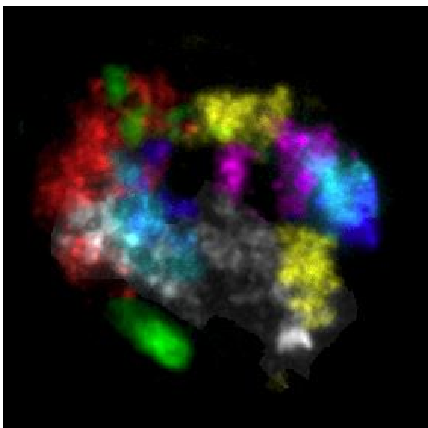 Figure 1: Segmentation of nucleus images and the resulting 3D chromosome territory representations.
3. Local Search on Uncertain Data
Standard clustering (like k-means) fails here because each "data point" (a cell) is actually a set of possible points (each representing a different homologue labeling). The authors developed a specialized local search that selects the "most likely" representative for each cell in every iteration, ensuring the global objective function is minimized.
Experiments and Biological Insights
The method was tested on a dataset of MCF10A (Healthy) and MCF10CA1a (Cancer) breast cells.
Key Findings:
- Pattern Coherence: Both normal and cancer populations showed one "dominant" cluster, proving that specific chromosomal architectures exist and are maintained within cell types.
- Cancer Markers: The associations between Chromosome 1 and X were significantly different in cancer cells compared to healthy ones. Specifically, the "degree" of their interaction changed, which often correlates with a higher frequency of cancer-driving translocations.
- Scalability: The use of the J-L Lemma drastically reduced computation time (up to 50% faster) without sacrificing clustering accuracy.
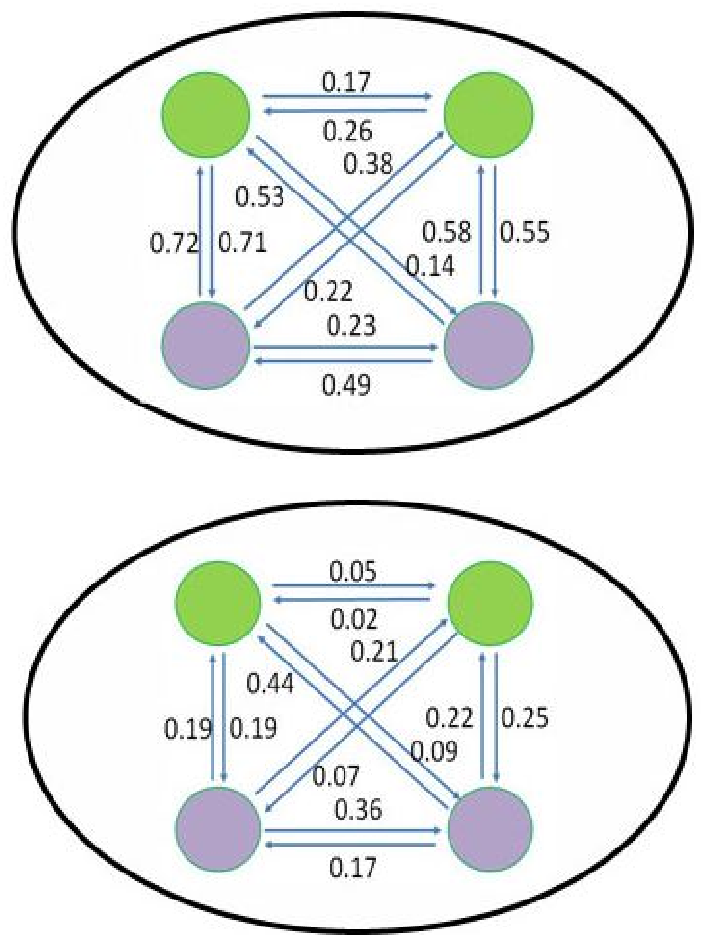 Figure 2: Computed medians showing the spatial relationship between Chromosome pair 1 and X in different clusters.
Critical Insight: Why This Matters
The brilliance of this work lies in its handling of Semantic Interpretation. Unlike general graph matching algorithms that might match "Node A" to "Node B" just to minimize distance, this framework respects the biological identity of chromosomes. By treating homologue ambiguity as a problem of uncertain data clustering, the authors have bridged the gap between pure machine learning and hard-core genomics.
Future Outlook
While the current model handles up to 10 chromosome pairs (a physical limitation of current imaging), the mathematical framework is ready for whole-genome analysis. As "Multi-color FISH" and 3D imaging technology improve, these k-median algorithms will become essential for defining the "architectural fingerprints" of various diseases, potentially leading to earlier cancer detection based purely on nuclear structure.
Summary
- Task: Mining structural patterns (median graphs) from populations.
- Innovation: SDP relaxation for graph initialization and local search for uncertain homologue labels.
- Impact: Near-optimal recovery of biological patterns that distinguish healthy cells from metastatic cancer cells.