
k-Metric Antidimension: Strengthening Social Graphs Against Active Adversaries
k -Metric antidimension: A privacy measure for social graphs
The paper introduces (k, Δ)-anonymity, a novel privacy measure for social graphs designed to resist active attacks by modeling adversary background knowledge as the metric representation of nodes. It defines the k-metric antidimension problem in graph theory and proposes a true-biased algorithm to compute it, achieving over 80% success in identifying privacy levels for graphs up to 100 nodes.
TL;DR
As social network data is increasingly shared for research, the risk of "active attacks"—where an attacker inserts fake accounts to "fingerprint" the network—grows. This paper introduces (k, Δ)-anonymity, a privacy metric based on a new graph-theoretic concept called k-metric antidimension. It measures how many attacker nodes are needed to ensure no user can be uniquely identified by their distances to those attackers.
Background: The Limits of Passive Anonymity
Most social graph anonymization techniques focus on passive attacks. If an adversary knows you have 5 friends (degree) or a specific cluster of connections (neighborhood), they can find you in a "de-identified" graph. However, active attacks are more insidious. By creating a few "Sybil" nodes and linking them to a target, the adversary creates a unique "distance profile" for that target.
The authors argue that the adversary's strongest tool is the Metric Representation: a vector of shortest-path distances from a victim to a set of attacker nodes .
Methodology: The k-Metric Antidimension
To counter this, the authors propose the k-antiresolving set.
- The Intuition: For a set of attacker nodes , the graph is "safe" if every node (not in ) looks exactly like at least other nodes in terms of its distance to the nodes in .
- The Goal: The k-metric antidimension () is the minimum size of such a set .
- (k, Δ)-anonymity: A graph is protected if the number of nodes an attacker can realistically control () is less than the -metric antidimension.
The Algorithm
Because finding this value is computationally heavy (NP-hard flavor), the authors developed a true-biased algorithm. It uses a recursive function to expand a candidate set of vertices until it either proves a k-antiresolving set exists or shows it's impossible.
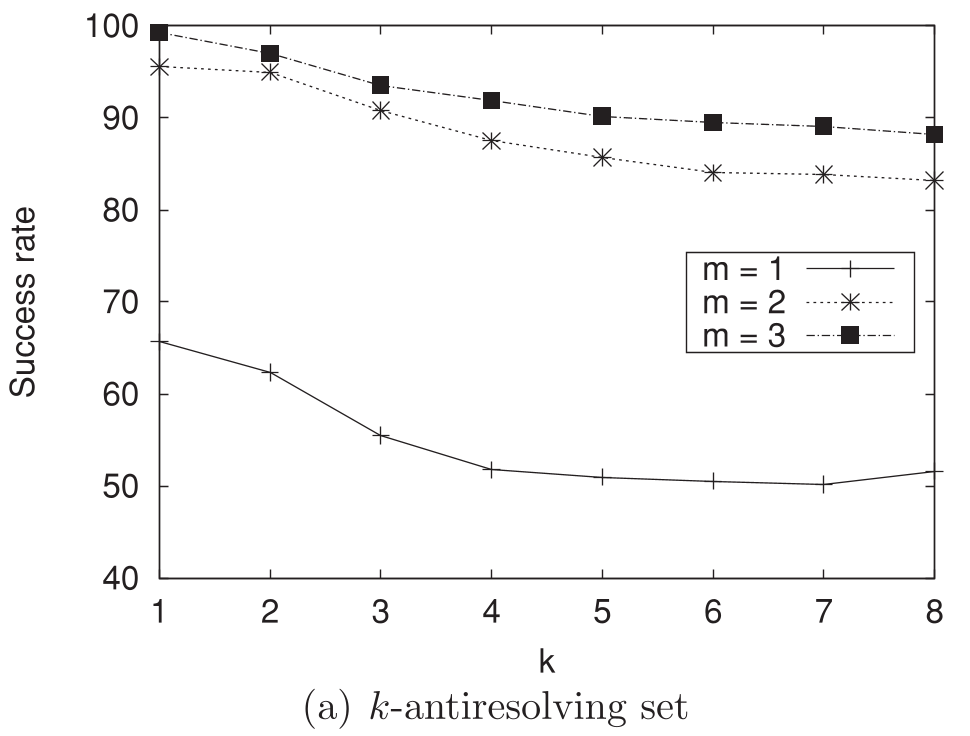 Figure: The success rate of the proposed algorithm significantly improves as the parameter 'm' increases, showing a clear trade-off between computational cost and accuracy.
Key Results & Theoretical Insights
The paper doesn't just provide an algorithm; it deep-dives into the "physics" of different graph structures:
- Paths & Cycles: Odd paths and cycles are surprisingly resilient, often having a 2-metric antidimension of 1.
- Trees: The authors provide a tight lower bound for trees based on "-equivalent branches"—subtrees that look the same relative to a central node.
- Real World Data: When tested on Facebook and Panzarasa datasets, the results were sobering. Both networks failed to provide privacy beyond , meaning a single well-placed attacker node could potentially identify targets.
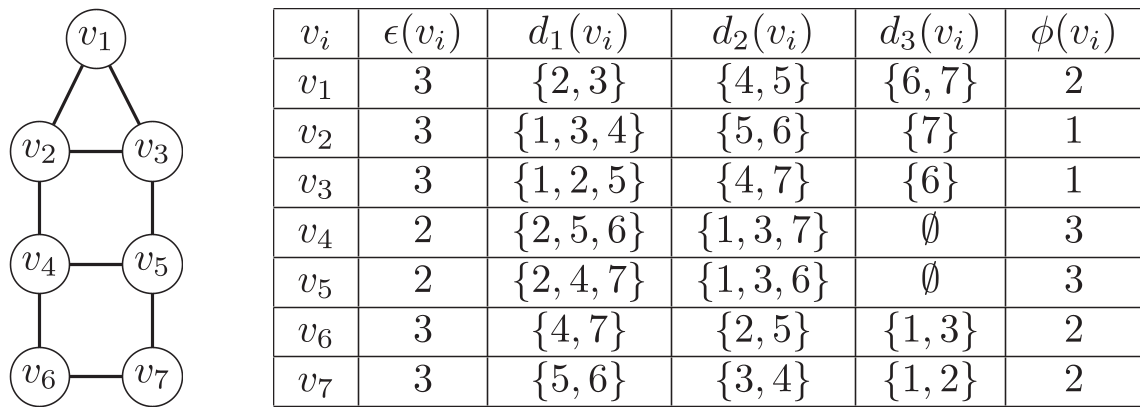 Table: Calculation of eccentricities and values used to determine the k-metric antidimensionality of a graph.
Critical Analysis
This work is a significant bridge between Discrete Mathematics and Data Privacy. By formalizing -metric antidimension, it gives developers a target: if we want to publish a graph, we must modify it (by adding/removing edges) until its -metric antidimension is higher than the expected number of Sybil nodes.
Limitations: The algorithm, while effective for , faces a "double exponential" scaling challenge for massive graphs. Future work needs to focus on approximate heuristics or local graph partitioning to scale this to Facebook-sized networks.
Summary
The k-metric antidimension is a powerful new lens for looking at social network security. It reminds us that in a connected world, distance is a quasi-identifier. To protect users, we must ensure that no one is "uniquely far" or "uniquely close" to a potential attacker.