
H-OSTP-K: Navigating Complex Trust Networks to Find the K-Best Service Providers
Finding K Optimal Social Trust Paths for the Selection of Trustworthy Service Providers in Complex Social Networks
This paper introduces H-OSTP-K, a heuristic algorithm designed to identify K optimal social trust paths in complex social networks. It models trust evaluation as a Multiple Constrained K Optimal Paths (MCOP-K) problem, incorporating Trust, Social Intimacy, and Role Impact factors to achieve SOTA performance in trustworthy service provider selection.
TL;DR
Trust is the currency of social networks, but finding the most "trustworthy" path between a consumer and a provider is computationally expensive. This paper treats trust as a multi-dimensional "Quality of Trust" (QoT) problem and introduces H-OSTP-K, a heuristic algorithm that solves the NP-Complete task of finding the best social trust paths. It outperforms prior baselines by over 20% in path quality while maintaining high efficiency through specialized backward-forward search strategies.
Background: Why One Path is Not Enough
When you look for a recommendation on LinkedIn or a provider on an e-commerce platform, you don't just rely on one friend's opinion. Cognitive science suggests that humans are more likely to trust information confirmed by multiple independent sources.
While previous research focused on finding the single shortest or most trustworthy path, this work argues that we need K optimal paths to provide a comprehensive trust evaluation. However, adding constraints (like minimum intimacy or expert intervention) turns a simple search into a Multi-Constrained K Optimal Path (MCOP-K) problem, which is mathematically NP-Complete.
Problem & Motivation: The Limitations of Simplicity
Existing models suffer from three main flaws:
- Ignoring Context: They overlook "Recommendation Roles" (e.g., a professor's referral carries more weight in academia than a peer's).
- Linear Assumptions: Social intimacy decays non-linearly, a factor rarely modeled in trust propagation.
- Deterministic Constraints: Standard algorithms like Dijkstra or Yen’s cannot handle multiple end-to-end constraints (e.g., "Total Trust > 0.8 AND Average Intimacy > 0.5").
Methodology: The H-OSTP-K Framework
1. The Quality of Trust (QoT) Model
The authors define QoT through three aggregated attributes:
- Trust (): Multiplicative aggregation across the path.
- Social Intimacy Degree (): Modeled using a hyperbolic curve to reflect non-linear decay.
- Role Impact Factor (): An average of the intermediate participants' expertise levels.
2. The Dual-Search Strategy
H-OSTP-K breaks the problem into two distinct phases to manage complexity:
- Backward K-Search: Searching from the target back to the source. This phase identifies if any feasible solutions exist and records "foreseen" QoT values at each node.
- Forward K-Search: Using a priority queue, it traverses from the source to the target. It uses a Utility Function () to rank paths.
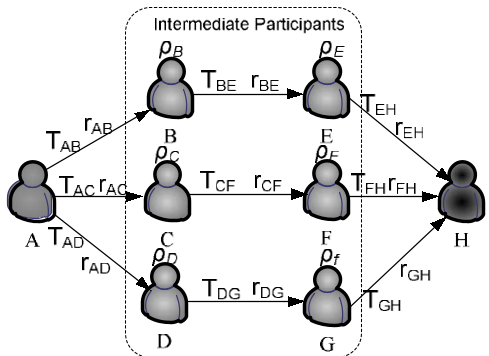 Figure 1: Complex Social Network structure incorporating Trust, SID, and RIF.
3. Optimization Strategies
To beat the NP-Complete complexity, the authors use two key insights:
- Feasibility Pruning: If the backward search finds only feasible paths (where ), the forward search stops at , saving significant time.
- Dijkstra-based Expansion: It only expands nodes that can potentially form a feasible path based on the "foreseen" data from the backward pass.
Experiments & Results
The researchers tested H-OSTP-K on the Enron Email Dataset, a standard for real-world social interaction mining.
Performance Gains
In terms of "Path Utility" (the overall trust score), H-OSTP-K achieved a 20.29% average improvement over the previous H-OSTP state-of-the-art. This is because by searching for paths, the algorithm explores a wider variety of "foreseen" routes, often finding superior paths that a single-path optimizer would miss.
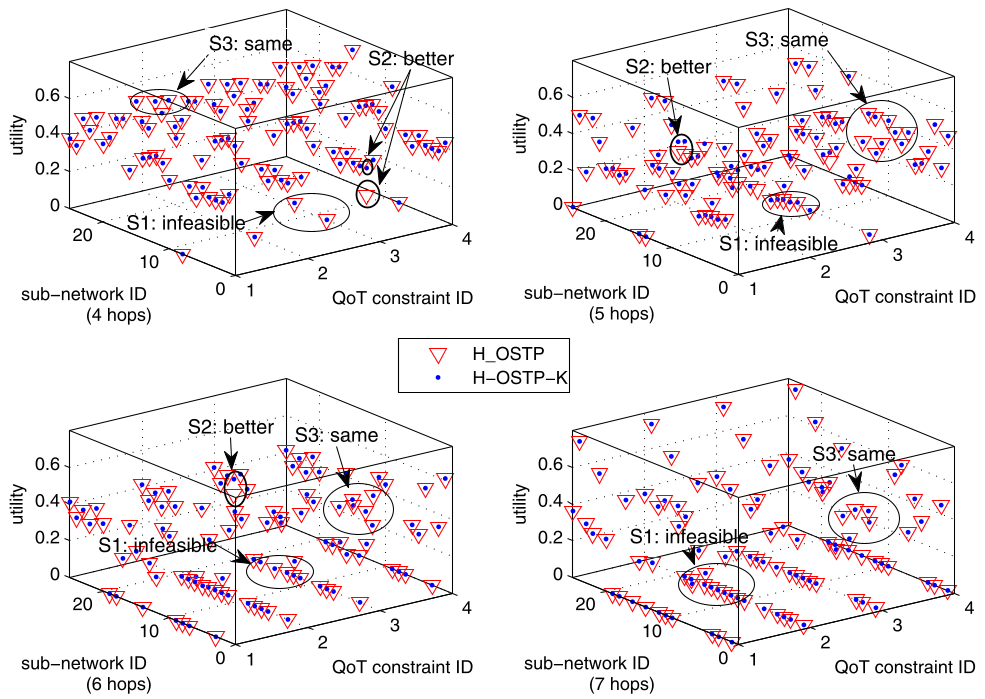 Figure 2: Utility comparison across various sub-network scales (hops 4 to 7).
Computational Efficiency
By implementing the optimization strategies, the algorithm was 37.22% faster than a standard multi-constrained search (H-WOP-K). The time complexity is kept at , making it practical for large networks with tens of thousands of nodes.
Critical Analysis & Conclusion
Takeaway
H-OSTP-K successfully bridges the gap between complex social psychology (roles and intimacy) and hard-core graph theory. It proves that multi-constrained search in social networks doesn't have to be slow if heuristic "foreseen" information is used correctly.
Limitations
- Attribute Mining: The paper assumes SID and RIF are already calculated. In real-time systems, recalculating these as the network evolves could become a bottleneck.
- Constraint Setting: The model relies on the user (consumer) to set the QoT constraints, which might be difficult for non-technical users to calibrate accurately.
Future Outlook
The authors suggest this could become the backbone of a Trust-Oriented Search Engine. Imagine a version of LinkedIn that doesn't just show you "Who" knows someone, but precisely the "K" most reliable referral chains to reach them based on your specific requirements.